
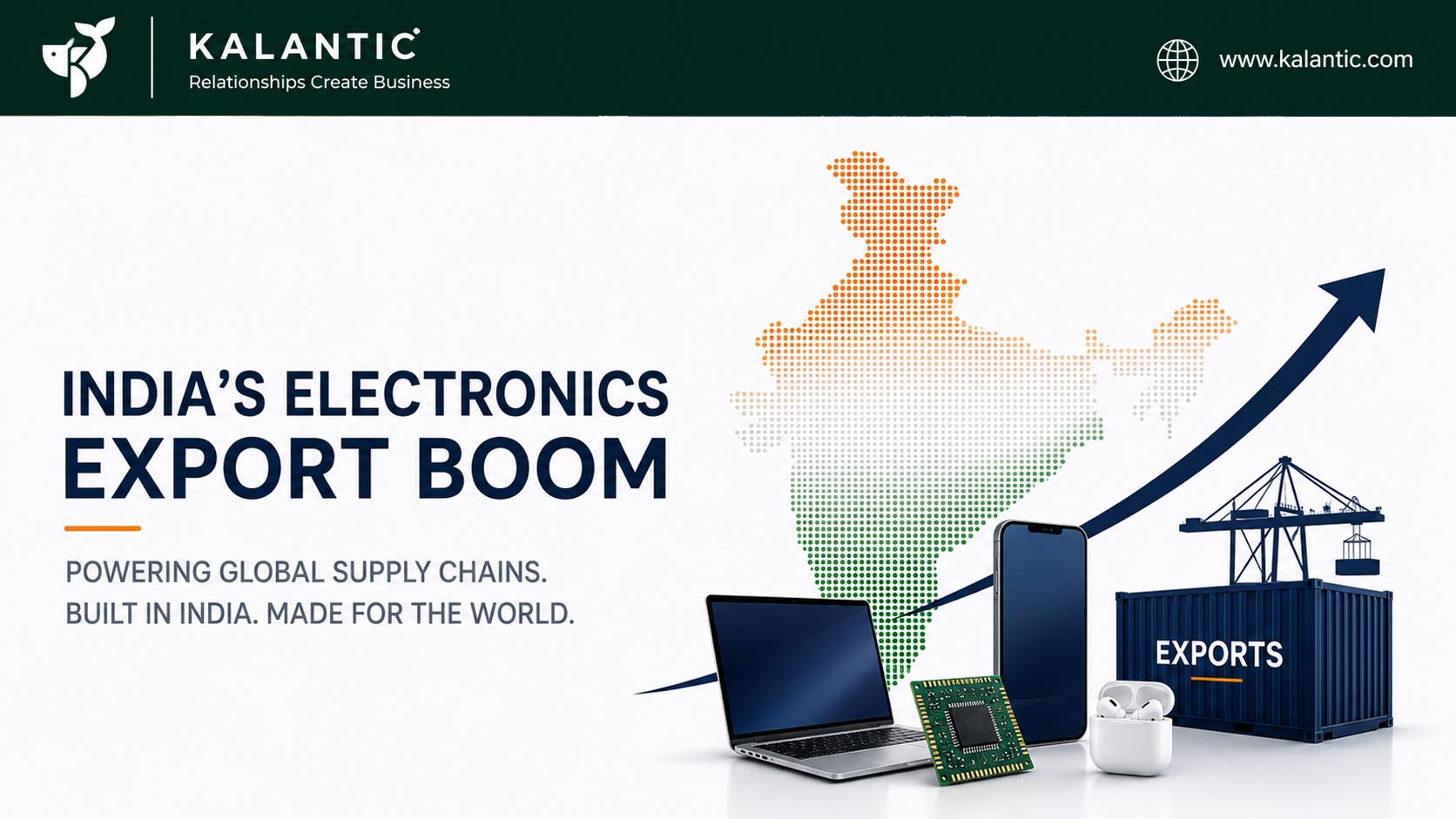
India’s Electronics Industry Is Entering a New Phase
India's electronics story is changing rapidly.
New government data reported this week shows that India's electronics exports have surged to around $44.5 billion in FY2025–26, representing more than an eleven-fold increase over the period highlighted by the government.
The headline number is significant.
But for international businesses, the more important question is what sits behind it.
India is moving beyond being simply a large consumer market for electronics.
It is increasingly becoming part of the global production and export network.
From Importer to Exporter
Not long ago, India's electronics market was primarily driven by imports.
Domestic demand was growing rapidly, but much of the value chain — from components to finished products — remained dependent on overseas manufacturing.
That picture has changed.
Mobile phones have become one of India's largest export products, while domestic electronics production has expanded substantially.
Government data indicates that mobile-phone production rose to approximately $65.7 billion in FY2025–26, while mobile-phone exports reached around $27.1 billion.
India is now the world's second-largest mobile-phone manufacturer by volume.
That is no longer simply a domestic manufacturing story.
It is an export story.
The Bigger Shift Is Happening Further Up the Value Chain
The most interesting development is that India is beginning to build a broader electronics ecosystem.
Finished-device manufacturing is only one part of the equation.
A competitive electronics ecosystem requires:
- Components
- Printed circuit boards
- Displays
- Camera modules
- Batteries
- Semiconductors
- Testing and certification
- Precision engineering
- Industrial automation
- Logistics
- Design and engineering services
This is where India's next opportunity lies.
The country does not simply need more factories assembling finished products.
It needs the suppliers, technology companies and specialised manufacturers that make those factories competitive.
That creates opportunities for international businesses.
Why Global Companies Should Pay Attention
For an international electronics company, India's attraction is becoming more multidimensional.
There is the domestic market, with more than a billion consumers and rapidly increasing digital adoption.
There is the manufacturing base.
There is an expanding supplier ecosystem.
There is a large engineering and technology talent pool.
And increasingly, there is the possibility of using India as an export base.
That combination changes the market-entry calculation.
A company entering India does not necessarily have to choose between serving the Indian market and building an export operation.
It may be able to do both.
The China+1 Conversation Is Evolving
For several years, India was frequently discussed as a potential "China+1" destination.
That description made sense.
Companies wanted to reduce concentration risk and diversify their manufacturing footprints.
But the electronics story suggests that the opportunity may be broader than simple diversification.
India can potentially become one node in a much larger global manufacturing network.
A multinational may manufacture components in one country, assemble products in another, conduct engineering in India and serve customers across multiple markets.
The question is therefore no longer:
Can India replace another manufacturing location?
It is:
What role can India play within our global manufacturing network?
That is a much more strategic question.
The Supplier Ecosystem Will Matter
For electronics companies, manufacturing scale alone is not enough.
The competitiveness of an operation depends heavily on the network surrounding it.
Who supplies the components?
Who provides tooling?
Who handles testing?
Who can maintain specialised equipment?
Who provides logistics?
Who can meet international quality standards?
Who can scale alongside the manufacturer?
These relationships are critical.
And building them takes time.
A company can announce a manufacturing investment relatively quickly.
Building a reliable supplier network is a much longer process.
Government Policy Is Helping Build the Ecosystem
Several policy initiatives are aimed at strengthening India's electronics manufacturing capabilities.
The Production Linked Incentive schemes have encouraged investment in electronics manufacturing.
The Electronics Component Manufacturing Scheme is designed to attract investment into critical components.
The India Semiconductor Mission is supporting the development of semiconductor manufacturing and related capabilities.
Modified Electronics Manufacturing Clusters are intended to provide infrastructure for companies operating within the ecosystem.
The objective is increasingly clear:
Build more of the value chain in India.
That is important because a manufacturing ecosystem becomes significantly more competitive when companies can source a larger proportion of their requirements locally.
What This Means for International Companies
The opportunity is not limited to large electronics manufacturers.
The growth of the ecosystem can create opportunities for companies involved in:
- Electronic components
- Industrial automation
- Semiconductor equipment
- Testing and measurement
- Manufacturing technology
- Engineering services
- Supply-chain management
- Industrial software
- Logistics
- Quality and compliance
- After-sales services
For many of these businesses, India may represent both a customer market and a potential manufacturing or partnership base.
Entering India Requires More Than Capital
This is where international companies need to think beyond the investment announcement.
Entering India is not simply about establishing a legal entity or selecting an industrial location.
The real work often begins with questions such as:
Who should we sell to?
Which suppliers should we work with?
Which local companies could become strategic partners?
Which industrial cluster is right for us?
Who understands the regulatory environment?
How do we build relationships before committing significant capital?
These questions can determine whether an expansion becomes a sustainable business or simply an expensive market experiment.
India Is Becoming Part of the Global Electronics Network
The most important takeaway from India's latest electronics export numbers is not the 11-fold increase itself.
It is the direction of travel.
India is building manufacturing capacity.
It is developing component ecosystems.
It is attracting global companies.
It is expanding exports.
And it is gradually becoming more integrated into international supply chains.
For global electronics companies, that creates a strategic opportunity.
India may no longer be simply a market to sell into.
It can increasingly become a market to build in, source from and export from.
The companies that recognise this early may have an advantage.
But successful entry will depend on more than identifying the opportunity.
It will depend on understanding the ecosystem and building the right relationships within it.
Because factories can be built.
Supply chains can be designed.
But business relationships have to be developed.
Sources
- Government of India data reported on August 13, 2026, on India's electronics manufacturing and exports.
- Electronics and IT sector data reported by IANS/ETHRWorld, July 29, 2026.
- Press Information Bureau, Government of India — electronics manufacturing and semiconductor ecosystem updates.
Ready to Explore India?
Expanding into India requires more than market research—it requires the right customers, partners, and commercial strategy. Kalantic helps international companies validate opportunities, identify customers and channel partners, and build a sustainable business presence in India. Whether you’re evaluating India for the first time or accelerating your expansion, our team can help you make informed decisions with confidence.
Book an India Market Entry Discussion
Or email us at: info@kalantic.com