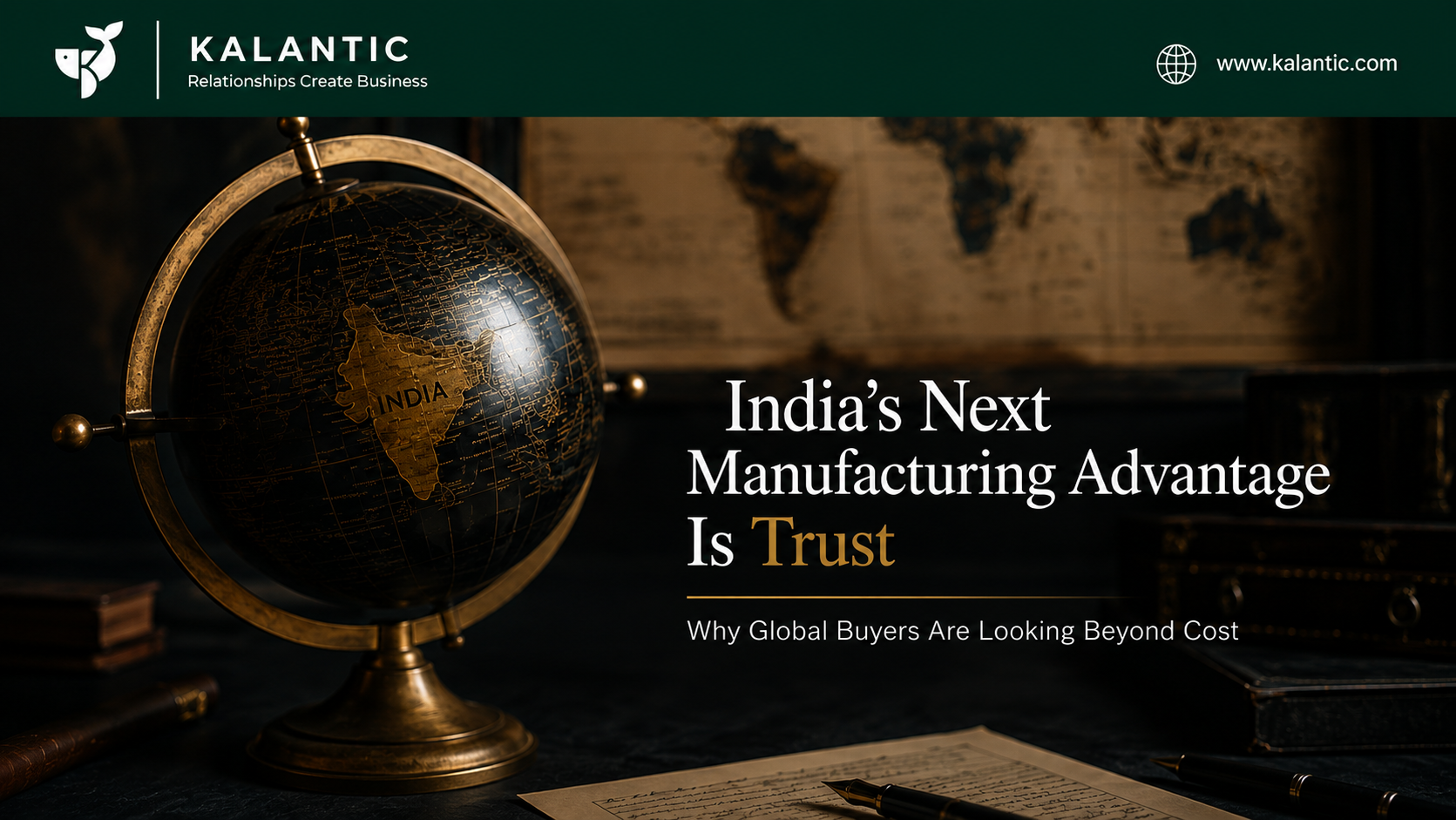
India's next competitive advantage is no longer lower manufacturing costs alone. As new trade agreements, global supply chain diversification, and evolving buyer expectations reshape international commerce, global companies are increasingly choosing suppliers they can trust. For India, this means the future of manufacturing will be defined by quality, consistency, reliability, compliance, and long-term partnerships rather than price alone.
Key Takeaways
- India is transitioning from a manufacturing alternative to a strategic sourcing partner.
- Global buyers increasingly prioritize reliability over the lowest possible cost.
- Trade agreements like the India-UK FTA are creating fresh opportunities for Indian exporters and international businesses.
- Companies entering India must invest in supplier quality, governance, and long-term relationships.
- Trust is becoming one of India's strongest competitive advantages.
Today's global supply chains look very different from those of five years ago.
The pandemic exposed vulnerabilities. Geopolitical tensions accelerated diversification. Rising costs in traditional manufacturing hubs pushed companies to rethink sourcing strategies.
As a result, international businesses are asking a different question.
Instead of asking:
"Where can we manufacture most cheaply?"
They are asking:
"Who can we depend on for the next decade?"
That subtle shift may become India's biggest opportunity.
The News Behind the Trend
Industry leaders speaking at Messe Frankfurt highlighted that India's textile sector is entering a new growth phase supported by the recently implemented India–UK Free Trade Agreement and several upcoming trade agreements. More importantly, they emphasized that India's future success depends on winning the confidence of global buyers—not merely competing on manufacturing costs.
Although these comments were made in the context of textiles, the message applies across industries.
Whether electronics, automotive components, engineering products, pharmaceuticals, chemicals, or industrial equipment, buyer expectations are changing.
Why Trust Has Become a Competitive Advantage
Cost remains important.
But for multinational companies, supplier failure is often far more expensive than paying a slightly higher manufacturing price.
International buyers increasingly evaluate suppliers based on:
- Consistent product quality
- Delivery reliability
- Regulatory compliance
- ESG performance
- Communication
- Financial stability
- Scalability
- Innovation capability
A supplier that consistently delivers on these parameters becomes far more valuable than one offering only lower prices.
India's Position Is Strengthening
Several structural trends are working in India's favor.
1. Supply Chain Diversification
Many global companies continue implementing China+1 strategies to reduce concentration risk.
India has emerged as one of the largest beneficiaries of this diversification across multiple manufacturing sectors.
2. Trade Agreements
Recent and upcoming FTAs improve market access for Indian exporters while making cross-border trade more attractive for international buyers.
3. Manufacturing Ecosystem Maturity
India is no longer viewed only as a source of low-cost labor.
Across many industries, suppliers are investing in automation, quality systems, product development, and international certifications.
This evolution enables buyers to source more sophisticated products while reducing operational risk.
What International Companies Should Consider
Companies evaluating India should avoid selecting suppliers solely on quotations.
Instead, they should assess:
- Manufacturing capability
- Capacity scalability
- Quality management systems
- Export experience
- Supply chain resilience
- Financial health
- Communication processes
- Technology adoption
- Long-term partnership potential
The strongest supplier relationship is usually built long before the first purchase order.
Building Business in India Requires More Than Finding Suppliers
Many international companies assume that entering India simply means identifying manufacturers.
In reality, successful market entry often requires:
- Market research
- Supplier identification
- Partner qualification
- Customer development
- Business development
- Relationship management
- Commercial negotiations
- Ongoing partner engagement
Finding a capable supplier is only the beginning.
Building a reliable business ecosystem is what creates long-term success.
Frequently Asked Questions
Why is buyer trust becoming more important than manufacturing cost?
Global companies face higher risks from supply chain disruptions than from marginal differences in manufacturing costs. Reliability, quality, and consistency reduce business risk.
Does this trend affect only the textile industry?
No.
The same shift is occurring across electronics, engineering, automotive, pharmaceuticals, chemicals, industrial manufacturing, and consumer products.
How does the India–UK FTA help businesses?
Trade agreements improve market access, reduce trade barriers in many cases, and create stronger commercial relationships between participating countries, making India more attractive as a sourcing destination.
What should international companies prioritize when sourcing from India?
Beyond price, companies should evaluate supplier capabilities, governance, compliance, communication, scalability, and long-term partnership potential.
Final Thoughts
India's manufacturing story is entering a new chapter.
Competitive pricing may open doors, but trust keeps them open.
As global buyers become more selective about where they source products, India's greatest opportunity lies in proving that it is not simply an economical manufacturing destination—but a dependable long-term business partner.
Companies that recognize this shift early will be better positioned to build resilient supply chains and lasting commercial relationships in one of the world's fastest-growing manufacturing economies.
About Kalantic
Kalantic helps international companies build customers, partners, and business in India. From market research and partner identification to business development and customer acquisition, we help businesses navigate India's complex commercial landscape with confidence.
Sources
- Economic Times – India's next phase of textile growth hinges on winning global buyers' confidence
- Moneycontrol – India's textile sector enters a new growth cycle on China+1 and trade pact tailwinds
Ready to Explore India?
Expanding into India requires more than market research—it requires the right customers, partners, and commercial strategy. Kalantic helps international companies validate opportunities, identify customers and channel partners, and build a sustainable business presence in India. Whether you’re evaluating India for the first time or accelerating your expansion, our team can help you make informed decisions with confidence.
Book an India Market Entry Discussion
Or email us at: info@kalantic.com