
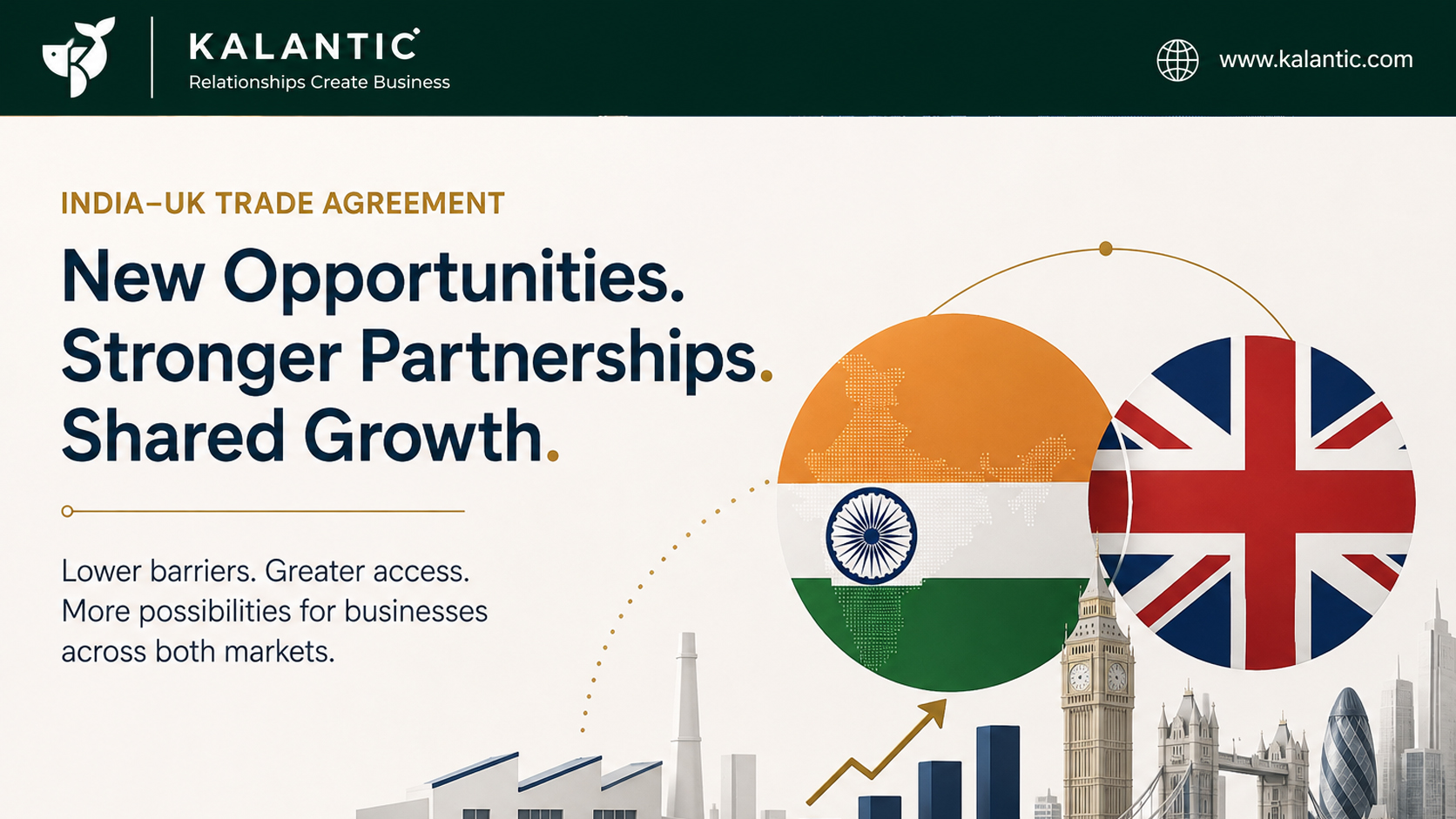
The India–UK Comprehensive Economic and Trade Agreement (CETA) represents one of India's most significant trade partnerships in recent years. By reducing tariffs, improving market access and encouraging greater commercial collaboration, the agreement creates new opportunities for manufacturers, exporters and investors in both countries. More importantly, it reinforces India's growing role as a strategic destination for global business expansion.
Key Takeaways
- The India–UK trade agreement lowers barriers for bilateral trade.
- Manufacturers gain improved access to one of the world's largest consumer markets.
- India becomes an even stronger export base for international companies.
- UK businesses receive greater opportunities to invest and expand in India.
- Success still depends on choosing the right market-entry strategy and local partners.
The India–UK Trade Deal Is More Than a Trade Agreement
Trade agreements rarely make headlines outside government circles.
Yet for businesses, they often reshape investment decisions for years to come.
The recently concluded India–UK Comprehensive Economic and Trade Agreement is one such example.
While much of the discussion has focused on tariff reductions, the broader significance lies elsewhere.
The agreement sends a strong signal that India continues to deepen its integration with global markets while strengthening its position as a manufacturing and export hub.
For international businesses, this creates opportunities that extend far beyond bilateral trade.
Why This Agreement Matters
Companies investing internationally seek more than favourable tax rates or lower production costs.
They look for access.
Access to customers.
Access to supply chains.
Access to export markets.
Trade agreements improve that access by reducing commercial friction.
Lower tariffs make products more competitive.
Simplified trade procedures reduce costs.
Greater regulatory cooperation improves business confidence.
For companies manufacturing in India, easier access to the UK market strengthens the commercial case for expanding operations.
India's Manufacturing Story Continues to Strengthen
India's manufacturing ambitions are no longer driven by cost alone.
The country is investing heavily in infrastructure, logistics, industrial corridors and digital governance.
Global manufacturers are increasingly viewing India as both a production base and a large domestic market.
Trade agreements such as the India–UK CETA further enhance this position.
They demonstrate that India's manufacturing strategy extends beyond domestic reforms to deeper global economic integration.
Opportunities Across Industries
Several industries are expected to benefit from the agreement.
These include:
- Automotive and auto components
- Engineering products
- Pharmaceuticals
- Textiles and apparel
- Food processing
- Consumer goods
- Advanced manufacturing
Companies supplying these industries may also experience increased demand as investment expands across the broader ecosystem.
Market Entry Still Requires Local Execution
A trade agreement creates opportunity.
It does not automatically create commercial success.
Businesses entering India still need to answer important strategic questions.
Which state offers the strongest opportunity?
Who are the right distributors?
Which partners can support long-term growth?
How should products be positioned for Indian customers?
The companies that succeed are those that combine favourable policy conditions with strong local execution.
India Is Becoming a Strategic Export Base
Global supply chains are increasingly diversified.
Companies are looking beyond traditional manufacturing centres and building regional production networks.
India's growing manufacturing ecosystem, combined with improving trade relationships, positions the country as an attractive base for serving multiple international markets.
This is particularly relevant for companies seeking resilience alongside growth.
Final Thoughts
The India–UK trade agreement represents much more than improved bilateral trade.
It reflects India's continued emergence as a globally connected manufacturing and business destination.
For international companies evaluating expansion, the opportunity is no longer limited to serving India's domestic market.
India is increasingly becoming a platform for global growth.
Businesses that prepare early, identify the right partners and execute with a long-term perspective will be best positioned to benefit from this changing landscape.
About Kalantic
Kalantic helps international companies build customers, partners and business in India through market research, partner identification, customer acquisition and on-ground commercial representation.
Whether you're exploring India for manufacturing, exports or commercial expansion, we help turn opportunities into sustainable business growth.
Sources
- Economic Times – India–UK trade agreement analysis.
- UK Department for Business and Trade.
- Ministry of Commerce & Industry, Government of India.
Ready to Explore India?
Expanding into India requires more than market research—it requires the right customers, partners, and commercial strategy. Kalantic helps international companies validate opportunities, identify customers and channel partners, and build a sustainable business presence in India. Whether you’re evaluating India for the first time or accelerating your expansion, our team can help you make informed decisions with confidence.
Book an India Market Entry Discussion
Or email us at: info@kalantic.com