
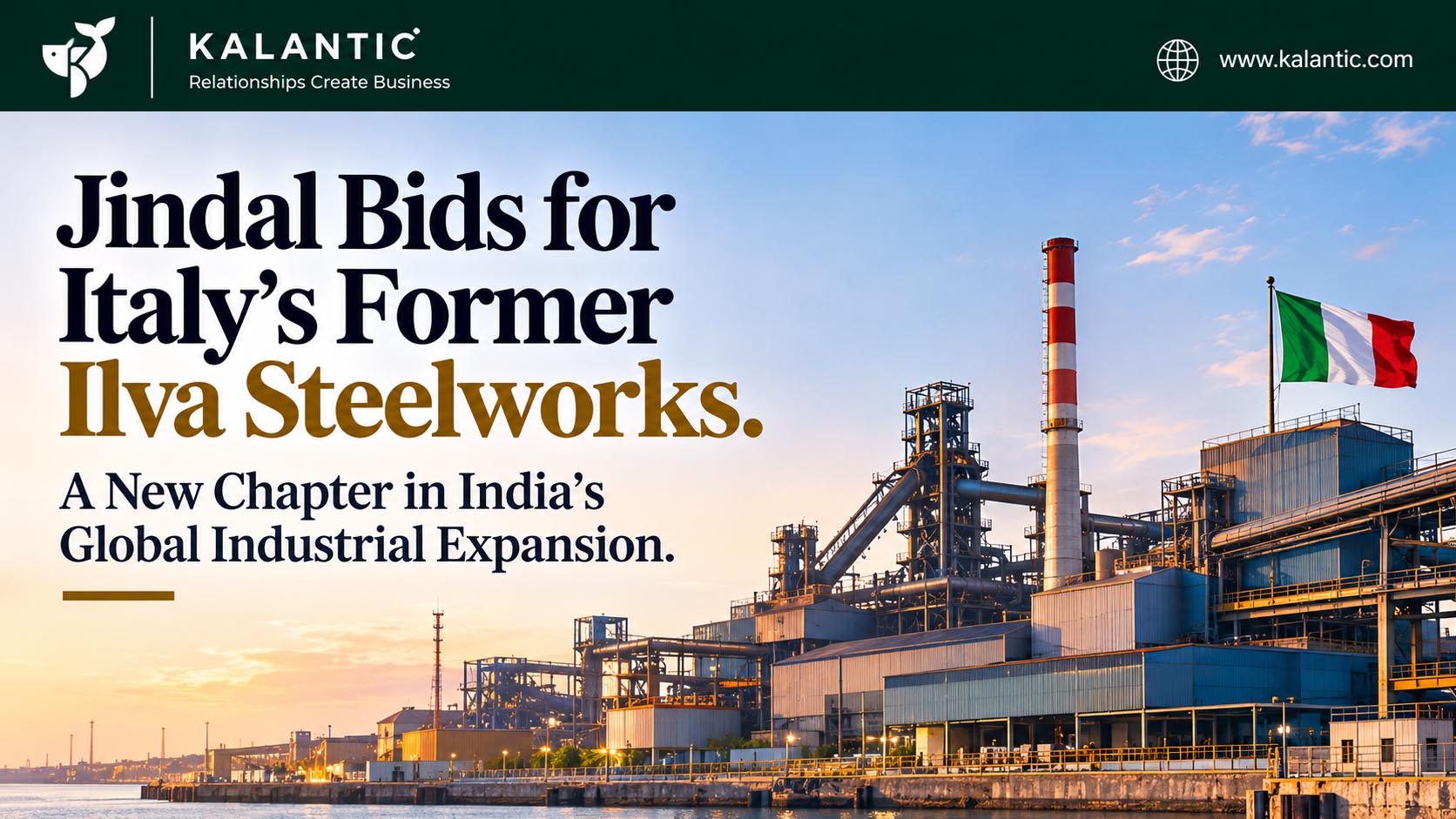
Direct Answer
India's Jindal Steel International has submitted a binding bid to acquire Italy's former Ilva steelworks, now operated as Acciaierie d'Italia (AdI). It is competing against Italian steelmaker Arvedi Group, with the Italian government's special commissioners now reviewing the two proposals.
The bid is significant because it places an Indian industrial group in contention for a major European steelmaking asset—not simply as an exporter or supplier, but as a potential owner and operator of an established industrial platform.
However, this is not a completed acquisition. The bids are still under evaluation, and the future of the steelworks remains complicated by financial, operational, environmental and employment challenges.
Key Takeaways
- An Indian bidder in a major European industrial transaction: Jindal Steel International has submitted a binding offer for the former Ilva business.
- A direct contest: Italy's Arvedi Group is the other bidder identified by the special commissioners.
- A substantial industrial footprint: The Taranto steelworks directly employs approximately 8,000 people, while other AdI facilities employ around 1,500.
- A complicated turnaround: The site faces operational difficulties and legal restrictions on blast furnace operations following environmental and health-related concerns.
- A broader strategic signal: Indian industrial groups are increasingly looking at opportunities to acquire capabilities, assets and market positions beyond India.
Main Article
1. What has happened?
On 9 November 2026, the special commissioners overseeing Acciaierie d'Italia announced that they had received two offers for the acquisition of the former Ilva industrial facilities.
The bidders are:
- Jindal Steel International, representing Indian industrial interest.
- Arvedi Group, an Italian steelmaker.
Both proposals cover the acquisition of all active business complexes associated with the former Ilva operations.
The commissioners will examine the submissions to determine whether they are complete and comply with the tender requirements.
The announcement marks an important stage in Italy's effort to find a long-term owner for the troubled steelmaking business.
2. Why is the former Ilva steelworks strategically important?
The former Ilva business is centred on the Taranto steelworks in southern Italy.
It is Italy's only integrated steelworks and has historically been an important part of the country's manufacturing infrastructure.
Its significance extends beyond the steel it produces.
The facility supports a wider industrial ecosystem involving:
- Steel-consuming manufacturers.
- Engineering and industrial services.
- Logistics and port operations.
- Equipment suppliers and maintenance contractors.
- Local employment and ancillary businesses.
The Taranto facility directly employs approximately 8,000 people. AdI also operates facilities in Liguria and Piedmont, employing another 1,500 people.
For Italy, finding a buyer is therefore not simply a question of transferring ownership. It is about preserving industrial capacity, employment and the future of an important manufacturing centre.
3. Why is this opportunity complicated?
The acquisition opportunity comes with substantial challenges.
The former Ilva business has experienced years of financial and operational difficulties. Its ownership and management history has also been complicated by disputes and restructuring.
More recently, an Italian Supreme Court ruling ordered the shutdown of blast furnaces at Taranto on health and environmental grounds.
This has complicated the sale because a prospective buyer must consider how the facilities can operate in compliance with environmental requirements while maintaining commercial viability.
The challenge is likely to involve several interconnected decisions:
- How to restore production capacity.
- Whether existing production processes can be modernised or replaced.
- How much fresh capital will be required.
- How to manage employment and relationships with labour unions.
- How to secure regulatory and local stakeholder acceptance.
- How to build a commercially sustainable operating model.
The winning bidder will need more than acquisition capital. It will need a credible industrial transformation plan.
4. The decarbonisation question
One of the most important dimensions of the transaction is the future technology pathway for steel production.
Arvedi's proposal reportedly envisages installing an electric arc furnace within two to three years, followed by a second furnace. It also includes a potential direct reduced iron facility, subject to local approvals.
These technologies could help reduce emissions compared with conventional blast furnace-based steelmaking.
The details of Jindal's submitted offer have not been publicly disclosed in the announcement. It would therefore be premature to assume that its proposal contains any particular production configuration or investment commitment.
Nevertheless, the broader issue is clear: the future owner will have to reconcile industrial output, environmental compliance, investment requirements and employment considerations.
The transition to lower-emission steel production is not merely a sustainability exercise. It is becoming a competitive requirement for industrial operators seeking to serve European markets.
5. What does this mean for India's global industrial ambitions?
For years, India's international industrial presence has been associated primarily with exports, project execution, engineering services and manufacturing supply.
The Jindal bid represents a different kind of ambition.
An Indian industrial group is seeking to participate in the ownership and potential transformation of an established European industrial asset.
This is strategically different from exporting finished steel.
An acquisition of this nature, if successful, could potentially provide access to:
- Established European industrial infrastructure.
- Proximity to European steel-consuming customers.
- Existing manufacturing and logistics networks.
- Local engineering and technical capabilities.
- A platform for deeper participation in European industrial markets.
These are potential strategic benefits, not guaranteed outcomes. Their realisation would depend on the acquisition terms, operating performance, regulatory conditions and the investment required to modernise the facilities.
6. The commercial lesson: International acquisitions are won beyond the negotiating table
A cross-border industrial acquisition is rarely determined by price alone.
The buyer must navigate an ecosystem of stakeholders whose interests may differ considerably.
In this case, those stakeholders include:
| Stakeholder | What matters to them |
|---|---|
| Italian government | Industrial continuity, employment and national manufacturing interests |
| Special commissioners | Compliance with tender requirements and transaction viability |
| Labour unions | Employment protection, investment and production commitments |
| Local authorities | Environmental compliance and regional economic impact |
| Regulators and courts | Legal and environmental obligations |
| Customers and suppliers | Production reliability and continuity of business |
For an international buyer, understanding this stakeholder landscape is essential.
A commercially attractive asset can become a difficult investment if the buyer underestimates local institutional relationships, political considerations, labour expectations or regulatory requirements.
This is particularly relevant for Indian businesses expanding into Europe, just as it is for European businesses entering India.
7. What international businesses can learn from the Jindal bid
The transaction offers three broader lessons.
First, international expansion is moving beyond exports.
Companies with strong domestic manufacturing capabilities are increasingly exploring overseas assets, acquisitions and operating platforms.
Second, local knowledge is a competitive advantage.
Understanding the regulatory environment, industrial ecosystem, workforce, local expectations and decision-making structures can be as important as financial resources.
Third, the acquisition is only the beginning.
The real test comes after ownership changes. Integrating operations, retaining talent, modernising facilities and building customer confidence determine whether a cross-border transaction creates lasting value.
For companies considering international expansion, the lesson is to build the right relationships and understand the local business environment before committing capital.
Frequently Asked Questions
What is the former Ilva steelworks?
The former Ilva steelworks is a major Italian steelmaking business now operating as Acciaierie d'Italia. Its principal facility is located in Taranto, southern Italy.
Which Indian company has bid for the Ilva steelworks?
Jindal Steel International has submitted a binding bid for the former Ilva industrial facilities. The special commissioners have also received an offer from Italy's Arvedi Group.
Has Jindal acquired the Italian steelworks?
No. The submission of a binding bid does not mean that the acquisition has been completed. The special commissioners are reviewing the proposals for completeness and compliance with tender requirements.
Why is the Taranto steelworks important to Italy?
It is Italy's only integrated steelworks and a significant part of the country's manufacturing infrastructure. The facility directly employs approximately 8,000 people.
What are the challenges facing the potential buyer?
The buyer will need to address operational and financial difficulties, environmental and legal requirements, production continuity, capital investment and employment considerations.
What does the bid indicate about Indian companies expanding internationally?
It highlights the growing willingness of Indian industrial groups to pursue overseas ownership, strategic assets and manufacturing capabilities rather than relying exclusively on exports.
Final Thoughts
The Jindal bid for Italy's former Ilva steelworks is an important development to watch—not because an acquisition has already been secured, but because of what the attempt represents.
Indian industrial companies are increasingly looking at international opportunities that involve ownership, technology, manufacturing infrastructure and access to established markets.
But global expansion requires more than capital and industrial capability. It requires an understanding of local institutions, business relationships, regulatory expectations and the stakeholders who influence commercial outcomes.
That is what makes cross-border business development a strategic discipline.
The opportunity may begin with an acquisition bid. Its success will ultimately depend on the relationships and execution that follow.
About Kalantic
Kalantic helps international businesses explore, enter and develop commercial opportunities in India.
From identifying potential partners and distributors to building business relationships and supporting market-level engagement, Kalantic works at the intersection of market access and commercial execution.
Because entering a new market is not just about identifying opportunities. It is about knowing whom to engage, how to build trust and how to turn relationships into business.
Whom should you know to build your business in India?
Explore more at Kalantic.
Sources
Reuters — India's Jindal, Italy's Arvedi bid for former Ilva steelworks, 9 November 2026. https://www.reuters.com/world/india/indias-jindal-italys-arvedi-bid-former-ilva-steelworks-2026-11-09/
Acciaierie d'Italia — Official announcement confirming receipt of two offers, 9 November 2026. https://www.acciaierieditalia.com/it/comunicati-stampa/ADI-due-offerte-per-acquisto/
ANSA — India's Jindal and Italy's Arvedi make bids for former ILVA steelworks, 9 November 2026. https://www.ansa.it/english/newswire/english_service/2026/11/09/indias-jindal-and-italys-arvedi-make-bids-for-former-ilva_02e5273a-8e9f-48cc-a086-1045204d27eb.html
Ready to Explore India?
Expanding into India requires more than market research—it requires the right customers, partners, and commercial strategy. Kalantic helps international companies validate opportunities, identify customers and channel partners, and build a sustainable business presence in India. Whether you’re evaluating India for the first time or accelerating your expansion, our team can help you make informed decisions with confidence.
Book an India Market Entry Discussion
Or email us at: info@kalantic.com