
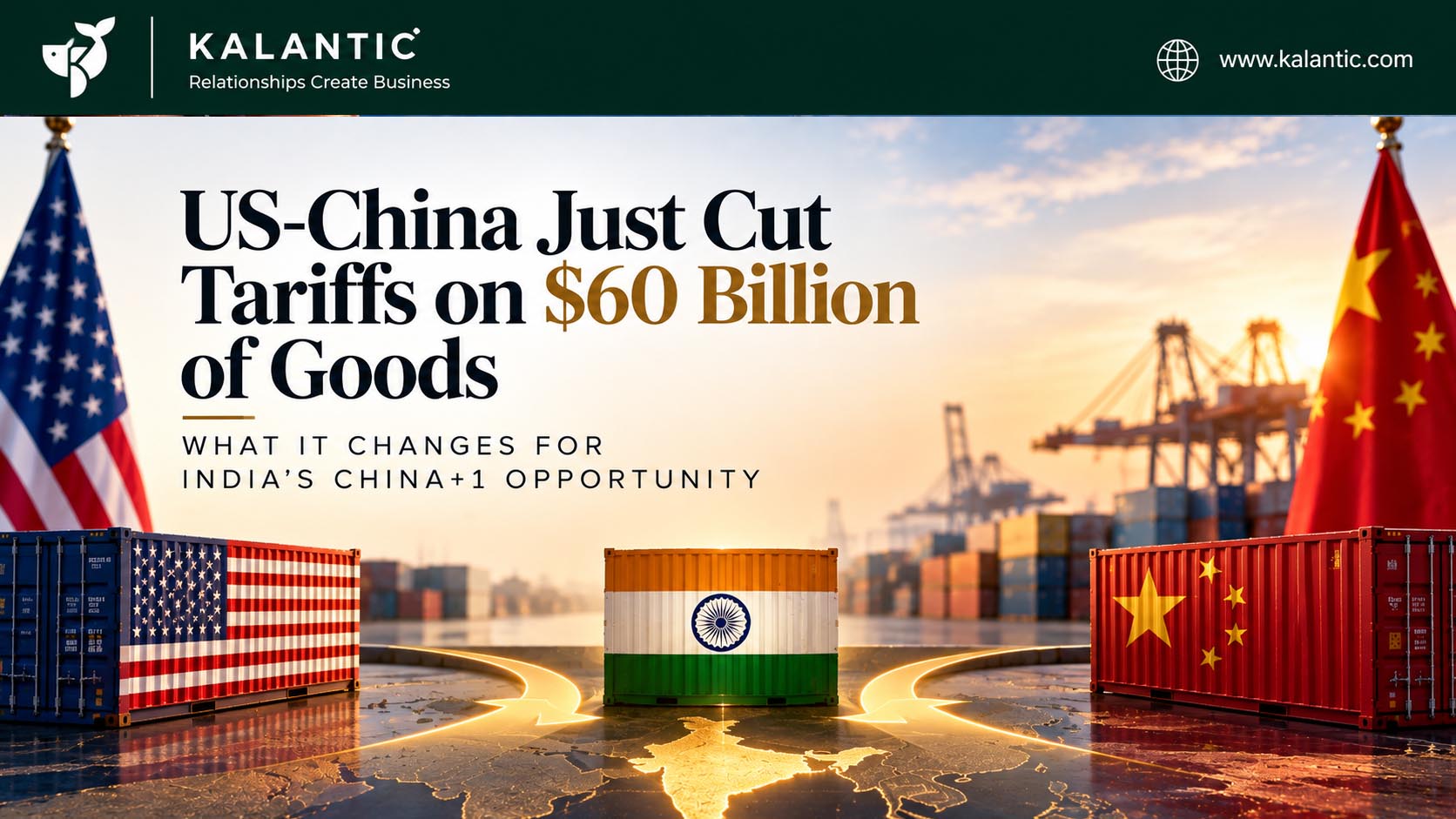
The United States and China have agreed to move toward lower tariffs on roughly $60 billion of goods—about $30 billion of products in each direction.
The immediate effect is concentrated in non-sensitive products. The US list includes Chinese toys, household appliances, decorations and other consumer goods, while China's list covers more than 1,600 US products, including agricultural goods, personal-care products, medical equipment and coal.
For global companies, however, the more important development is strategic.
The economic pressure that helped accelerate the "China+1" conversation may begin to change if US-China trade relations continue to stabilise.
That does not eliminate the case for India.
It changes the question companies need to ask.
Instead of:
"Should we move away from China?"
the more relevant question may become:
"Where should the next increment of our global capacity, sourcing and market access sit?"
And India will have to compete for that answer.
Key Takeaways
- The US and China have identified around $30 billion of goods on each side for more favourable tariff treatment.
- More than 90% of the products covered are expected to receive treatment at Most-Favoured-Nation tariff levels once the arrangement is implemented.
- The US list includes Chinese toys, home appliances, household products and other consumer goods.
- China's list includes US agricultural products, personal-care products, medical equipment and coal.
- The arrangement is not yet a permanent end to US-China trade tensions; implementation still requires domestic legal and procedural steps.
- For multinational companies, a reduction in tariff friction could make some China-based operations more commercially attractive again.
- For India, the development could make the China+1 proposition more competitive—but it does not remove India's broader advantages in manufacturing, services, talent and market access.
- Companies considering India may increasingly evaluate China and India as complementary parts of a global operating model rather than as simple substitutes.
$60 Billion Is the Number. The Bigger Story Is the Signal.
The United States and China have taken another step toward reducing trade friction.
Under the new "30-for-30" framework, each country has recommended approximately $30 billion of imports from the other for reduced tariff treatment.
China's list covers more than 1,600 US products.
The US list covers 77 categories of Chinese products.
According to China's Ministry of Commerce, more than 90% of the products covered on each side are expected to have the additional tariffs removed and return to Most-Favoured-Nation tariff treatment, subject to each country's domestic procedures.
The products are deliberately concentrated outside the most sensitive areas of the relationship.
That distinction matters.
This is not the disappearance of US-China strategic competition.
It is a reduction in tariff friction across a defined group of products.
And for businesses, that can still be significant.
The China+1 Strategy Was Built on a Different Assumption
For several years, multinational companies have increasingly looked at ways to reduce excessive dependence on China.
The logic was straightforward.
China remained a critical manufacturing and sourcing base, but companies wanted additional capacity elsewhere to diversify geopolitical, tariff, supply and operational risk.
India became one of the countries considered for that additional capacity.
So did Vietnam, Thailand, Malaysia, Mexico and other manufacturing locations.
The result was the rise of the "China+1" strategy.
But China+1 was never simply about abandoning China.
For many companies, it meant:
China + India.
China + Vietnam.
China + Mexico.
China + another manufacturing or sourcing hub.
The question was how much of the next dollar of investment should go outside China.
A sustained reduction in US-China trade friction could influence that calculation.
The Pressure to Diversify Could Change
Imagine a multinational company currently producing a consumer product in China.
It has three options:
- Continue expanding its Chinese production.
- Move part of production to another country.
- Maintain China while building a second manufacturing or sourcing base elsewhere.
During periods of severe tariff uncertainty, option two or three can become more attractive.
If tariff pressure falls, the economics of existing Chinese facilities may improve.
That does not mean companies will reverse every diversification decision.
Factories, supplier ecosystems, labour networks, tooling, logistics infrastructure and customer relationships are not easily relocated.
But it can affect where the next factory is built.
And that is where India needs to pay attention.
India Is Not Competing Only Against China
One of the biggest mistakes in thinking about India's manufacturing opportunity is to frame it as:
"China versus India."
The actual competition is more complicated.
A global company evaluating India may simultaneously compare:
- China
- India
- Vietnam
- Thailand
- Malaysia
- Indonesia
- Mexico
- Eastern Europe
- Existing production locations
The decision is based on a combination of factors:
- Total landed cost
- Tariffs
- Labour availability
- Supplier depth
- Infrastructure
- Domestic market size
- Export access
- Regulatory environment
- Technology ecosystem
- Speed to market
- Quality
- Intellectual property considerations
- Political and geopolitical risk
- Availability of local partners
Tariffs are only one variable.
And India's Domestic Market Changes the Equation
There is another reason India's proposition is different.
A company manufacturing in China primarily to serve overseas markets is making a different decision from a company considering India as both a manufacturing base and a major consumer market.
India offers companies the possibility of combining:
Manufacturing + domestic demand + services + engineering + regional expansion.
That creates a different strategic proposition.
A company may initially enter India because of its manufacturing economics.
It may eventually discover a much larger opportunity in selling into India itself.
That is why market entry should not be reduced to a factory-location decision.
The Real Question for Global Companies
The most interesting consequence of the US-China tariff reduction may therefore be a change in the questions multinational companies ask.
The old question was:
"How quickly can we reduce our exposure to China?"
The next question could be:
"How should we configure China, India and other markets together?"
That is a much more sophisticated decision.
A company could maintain manufacturing in China.
Build a second manufacturing line in India.
Source selected components from Southeast Asia.
Use India for engineering and software.
Sell into India's domestic market.
And use India as a regional export base.
That is not a China-exit strategy.
It is a global operating model.
What Should Companies Looking at India Do Now?
For international companies evaluating India, this development makes one thing particularly important:
Do not build the India strategy around a single geopolitical assumption.
Instead, examine the economics of India on its own merits.
That means asking:
1. Where does India actually improve our economics?
Not every product or industry will.
The opportunity needs to be evaluated product by product, market by market.
2. Which Indian suppliers can meet global standards?
Finding a supplier is not the same as finding a reliable strategic partner.
Quality, capacity, certifications, financial strength and delivery performance matter.
3. Which Indian companies could become commercial partners?
Distribution, manufacturing, technology, licensing and joint-venture opportunities can all require local relationships.
4. What can India provide beyond manufacturing?
Engineering, software, R&D, business services, finance, analytics and regional management can materially change the business case.
5. Whom should we know?
This may ultimately be the most important question.
Because entering a market is rarely just about identifying the market.
It is about identifying the people and organisations that can help you navigate it.
Frequently Asked Questions
Is this a permanent US-China trade deal?
Not yet.
The two countries have agreed on a framework and product lists for reduced tariff treatment, but implementation remains subject to their respective domestic legal and procedural requirements.
The broader strategic and trade relationship remains subject to further negotiations.
What products are covered?
The US list includes Chinese household appliances, toys, decorations and other consumer products.
China's list includes more than 1,600 US products, including agricultural products, personal-care products, medical equipment, timber and coal.
Does this mean the China+1 strategy is ending?
No.
China+1 is a diversification strategy rather than a temporary response to one tariff event.
Companies may continue to diversify because of supply resilience, market access, geopolitical exposure, customer requirements and other considerations.
However, lower US-China tariff friction could influence the economics of future investment decisions.
Does this reduce India's opportunity?
It could reduce one source of pressure encouraging companies to diversify away from China.
But India's opportunity is broader than tariff avoidance.
India's large domestic market, engineering and technology capabilities, growing manufacturing base and services ecosystem can independently support investment decisions.
Should global companies choose India instead of China?
The relevant analysis is company- and product-specific.
For some businesses, China may remain the most efficient location.
For others, India may offer a stronger combination of domestic demand, manufacturing, services and regional expansion.
For many multinational companies, the eventual answer may involve both.
Final Thoughts
The most important number in today's US-China trade story is $60 billion.
But the more important strategic question is what happens to the billions of dollars of investment decisions that follow.
For several years, tariffs and geopolitical uncertainty encouraged companies to reconsider their dependence on China.
Now, as Washington and Beijing move toward lower tariffs on selected categories, some of that pressure may ease.
That does not make India less relevant.
It makes India's proposition more demanding.
India cannot rely indefinitely on companies coming because China has become difficult.
It has to compete because India itself offers a compelling combination of market access, talent, manufacturing capability, technology, partnerships and growth.
For international companies, the next phase may not be about choosing between China and India.
It may be about designing the right relationship between the two.
And that brings the conversation back to a question that matters in every market:
Whom should we know?
About Kalantic
Kalantic helps international companies build business in India through market access, partnerships, relationships and on-ground business development.
Because entering a market is one thing.
Knowing how to build business in it is another.
Sources
Reuters — China, US agree to tariff cuts on $60 billion of goods
The White House — U.S.-China Board of Trade and 30-for-30 product lists
U.S. Trade Representative — Statement on the U.S.-China Board of Trade
China Ministry of Commerce — 30-for-30 reciprocal tariff reduction framework
The Week — US-China tariff reductions and potential implications for India
Ready to Explore India?
Expanding into India requires more than market research—it requires the right customers, partners, and commercial strategy. Kalantic helps international companies validate opportunities, identify customers and channel partners, and build a sustainable business presence in India. Whether you’re evaluating India for the first time or accelerating your expansion, our team can help you make informed decisions with confidence.
Book an India Market Entry Discussion
Or email us at: info@kalantic.com