Global supply chains are no longer influenced solely by manufacturing costs, tariffs or logistics. Increasing visa restrictions, tighter immigration policies and geopolitical uncertainty are making the movement of skilled professionals more difficult. For international companies, this means cross-border mobility has become a strategic business risk that must be considered alongside sourcing, manufacturing and market-entry decisions.
Key Takeaways
- International business depends on the movement of both goods and people.
- Tightening immigration policies are increasing operational complexity.
- Companies are investing more in regional manufacturing and local talent.
- India continues to strengthen its position as a long-term manufacturing and engineering hub.
- Businesses entering new markets need resilient operational strategies rather than relying on a single geography.
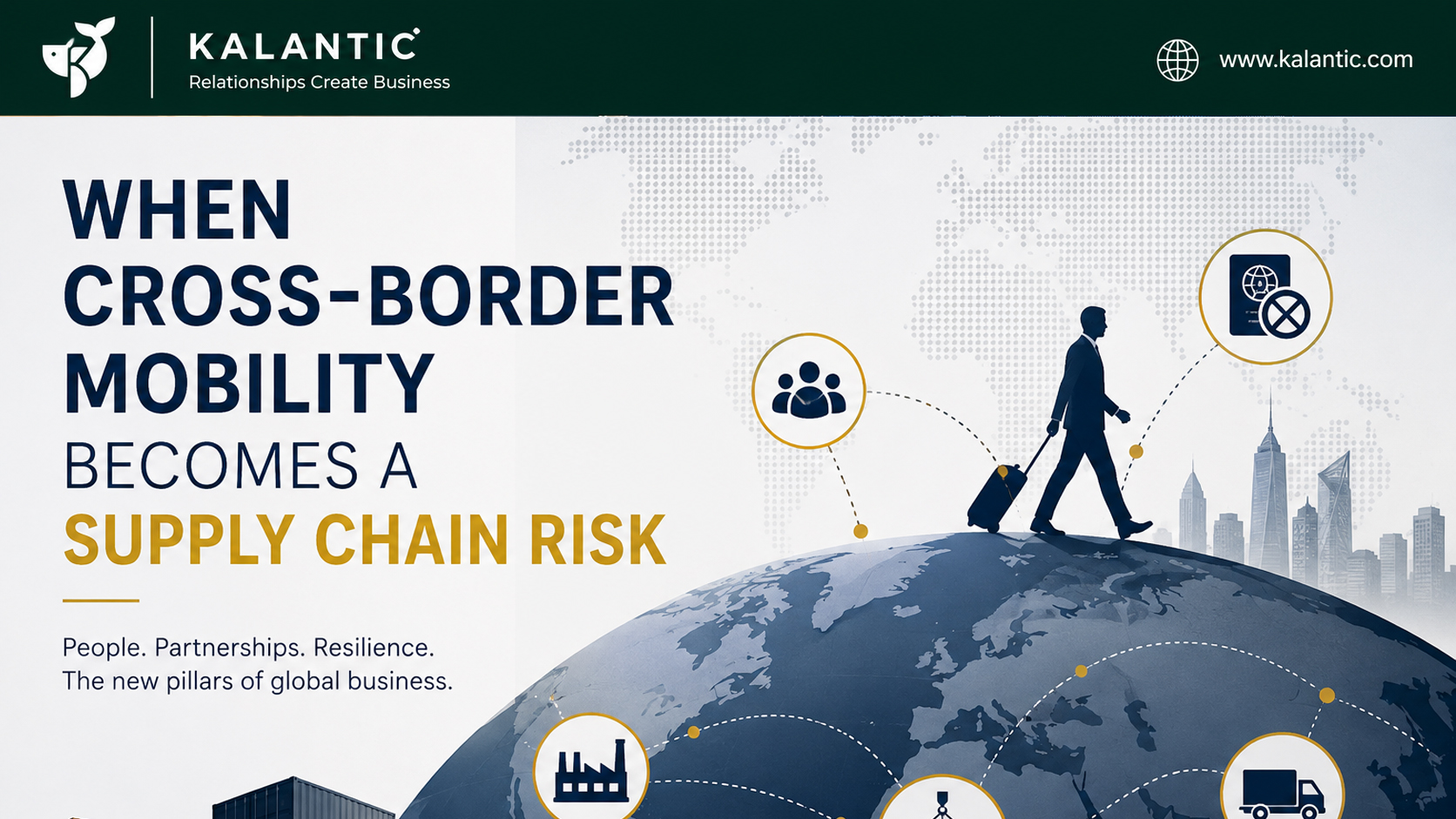
When Cross-Border Mobility Becomes a Supply Chain Risk
For decades, discussions around supply chains focused on products.
Raw materials.
Factories.
Shipping routes.
Ports.
Warehouses.
Today, another factor is becoming equally important.
People.
Engineers travelling to install machinery.
Technical specialists supporting production.
Sales teams meeting customers.
Quality auditors visiting suppliers.
Executives establishing new operations.
International business depends on the movement of people just as much as the movement of goods.
As governments around the world tighten immigration policies and cross-border travel becomes increasingly complex, companies are beginning to recognise a new operational challenge.
Cross-border mobility itself is becoming part of supply chain risk.
Supply Chains Are More Than Logistics
Modern manufacturing operates through highly interconnected global networks.
A production facility may depend on:
Engineers from Germany
Software developers from India
Equipment suppliers from Japan
Component manufacturers from South Korea
Customers across Europe
When one part of this ecosystem becomes difficult to access, projects slow down.
Installation timelines extend.
Customer support becomes more complicated.
Expansion plans are delayed.
For many businesses, these delays can be more expensive than higher manufacturing costs.
Why Businesses Are Reconsidering Global Expansion
The objective is no longer simply to manufacture at the lowest possible cost.
Businesses now seek resilience.
Questions increasingly include:
Can our teams travel when required?
Can we recruit international talent?
Can suppliers respond quickly?
Can customers be supported locally?
Do we have sufficient regional capability?
The companies best prepared for future uncertainty are those that reduce dependence on any single country, supplier or operational model.
India's Opportunity
As companies redesign their global operations, India continues strengthening its position.
The country offers:
A large engineering workforce
Expanding manufacturing capabilities
Strong domestic demand
Growing supplier ecosystems
Improving infrastructure
Competitive operating costs
For many organisations, India is evolving from an outsourcing destination into a strategic regional hub for manufacturing, engineering and commercial operations.
Relationships Matter More Than Ever
Operating across borders becomes easier when trusted relationships already exist.
Reliable distributors.
Experienced logistics partners.
Local legal advisors.
Industry specialists.
Regional business development partners.
Strong local relationships reduce uncertainty and accelerate execution.
Companies entering India often discover that commercial success depends not only on strategy but also on knowing the right people.
Building Resilient International Operations
Resilience is becoming one of the defining characteristics of successful global businesses.
That means:
Diversifying suppliers.
Building regional capabilities.
Investing in local partnerships.
Developing multiple routes to market.
Strengthening customer relationships.
Companies that prepare today are likely to respond more effectively to tomorrow's disruptions.
Frequently Asked Questions
Why is cross-border mobility becoming a business issue?
Changes in immigration policies, visa regulations and geopolitical developments can delay projects, restrict access to skilled talent and increase operational complexity for international businesses.
How does this affect manufacturers?
Manufacturers often rely on international engineers, technical specialists and supplier support. Restrictions on mobility can slow installation, maintenance and production.
Why is India becoming more attractive?
India combines a large engineering workforce, expanding manufacturing capabilities and growing domestic demand, making it an increasingly attractive regional base for global businesses.
What should companies do?
Businesses should build resilient operating models through supplier diversification, trusted local partnerships, regional manufacturing capabilities and long-term market planning.
Final Thoughts
Global business is entering a new phase.
Supply chains are no longer evaluated solely on cost and efficiency.
They are judged by resilience.
Companies that can continue operating despite geopolitical shifts, changing immigration policies and market disruptions will be better positioned for long-term success.
For businesses evaluating international expansion, the question is no longer simply where to manufacture.
It is also where can we build resilient operations for the next decade?
About Kalantic
Kalantic helps international companies build customers, partners and business in India.
From market research and partner identification to customer acquisition and business development, we help organisations establish meaningful commercial relationships in one of the world's fastest-growing economies.
Because markets aren't built through transactions.
They're built through relationships.
Sources
- Reuters – Global coverage of immigration policy, international mobility and geopolitical developments.
- World Economic Forum – Global Risks Report.
- World Bank – Global Economic Prospects.
- OECD – International Migration Outlook.
- McKinsey & Company – Global Supply Chain and Operations Insights.
Ready to Explore India?
Expanding into India requires more than market research—it requires the right customers, partners, and commercial strategy. Kalantic helps international companies validate opportunities, identify customers and channel partners, and build a sustainable business presence in India. Whether you’re evaluating India for the first time or accelerating your expansion, our team can help you make informed decisions with confidence.
Book an India Market Entry Discussion
Or email us at: info@kalantic.com