Foreign Investment Is Changing
Foreign investment has traditionally been viewed through a relatively simple lens.
A company invests.
A factory is built.
Jobs are created.
Capital enters the economy.
But as global supply chains become more complex, that model is becoming incomplete.
A major investment does not operate in isolation.
It needs suppliers.
It needs service providers.
It needs skilled people.
It needs logistics.
It needs technology partners.
It needs customers.
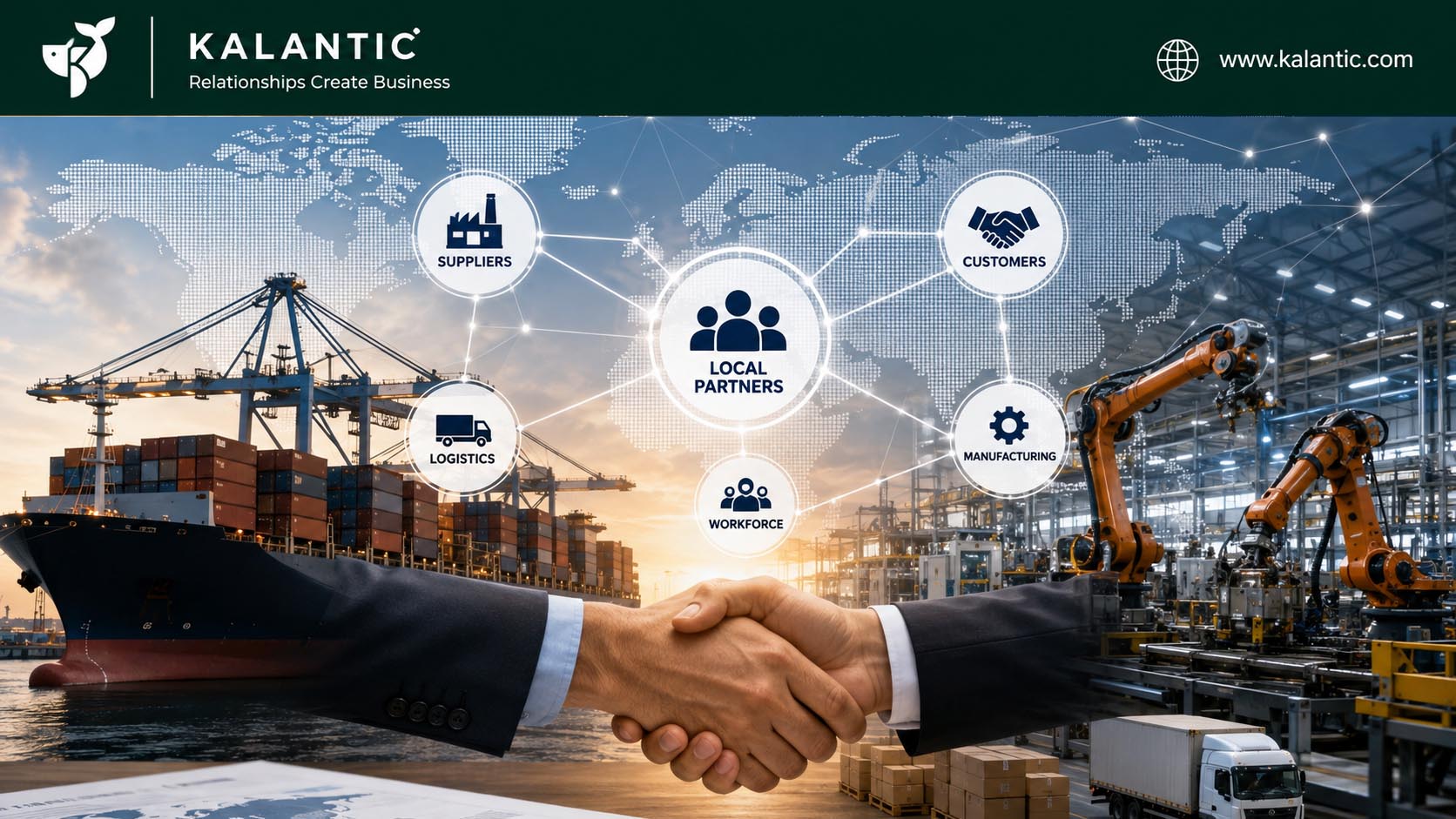
And, increasingly, it needs a network of local businesses capable of supporting the investment as it grows.
A development in the United States this week offers a particularly interesting example.
The US Is Looking Beyond the Investment Itself
US officials are working with foreign investors to identify gaps in domestic manufacturing supply chains and help small and medium-sized businesses scale up to meet rising demand.
The initiative is being supported through a new Strategic Vendor Program under the US Treasury's Office of Investment Security.
The programme is designed to help companies whose foreign investments have cleared the CFIUS review process identify relevant US-based suppliers and vendors.
The objective is straightforward:
Make foreign investment create a stronger domestic ecosystem around it.
The US Treasury describes the programme as a way to connect foreign-invested companies with a resilient network of American suppliers and vendors, while helping complementary businesses scale alongside them. :contentReference[oaicite:1]{index=1}
This is an important shift in how governments can think about foreign investment.
The investment itself is only one part of the economic opportunity.
The network around it matters just as much.
A $5 Billion Example
The timing of the initiative is particularly interesting because of the scale of investment taking place at Philadelphia's shipyard.
South Korea's Hanwha acquired the shipyard in 2024 and has pledged to invest approximately $5 billion in the facility over the coming years.
The company has already invested more than $200 million in upgrading its workforce, capabilities and capacity.
According to Reuters, the expansion could eventually increase employment at the facility from around 2,000 people to approximately 10,000.
But the numbers become even more interesting when the supply chain is considered.
Hanwha's shipyard relies on more than 1,000 suppliers for each large ship it builds, with roughly two-thirds currently based in the United States.
As production expands, that supplier ecosystem could grow further. :contentReference[oaicite:2]{index=2}
The investment therefore has a much larger footprint than the shipyard itself.
It creates demand for hundreds or potentially thousands of other businesses.
That is the multiplier effect of an ecosystem.
The Factory Is Only the Beginning
This lesson applies well beyond shipbuilding.
Imagine an international manufacturer entering a new country.
It establishes a production facility.
That facility may need:
- Component suppliers
- Packaging companies
- Logistics providers
- Engineering services
- Maintenance contractors
- Software providers
- Financial services
- Quality-control specialists
- Distributors
- Recruitment partners
- Local customers
The investment creates the initial demand.
The surrounding ecosystem determines how efficiently that demand can be fulfilled.
This is why successful market entry is rarely just about finding a location.
It is about finding the right network.
Why This Matters for International Companies
For an international company considering a new market, the first question is often:
"What does it cost to enter?"
But a better set of questions may be:
Who are our potential customers?
Who can supply us locally?
Which partners already understand the market?
Who can help us navigate the regulatory environment?
Which distributors have the right reach?
Which local companies could complement our capabilities?
These questions can reveal opportunities that a conventional market-size report cannot.
A market may look attractive on paper.
But if the company cannot build the relationships required to operate effectively, the opportunity can remain theoretical.
The Supplier Search Is Becoming Strategic
One particularly interesting aspect of the US programme is that officials are not simply asking foreign investors to source locally.
They are trying to identify where domestic capacity itself is missing.
Reuters reported that one Finnish-owned company had struggled to find a US supplier for dry compressors.
That is a small example of a much larger problem.
A company can have the capital.
It can have the technology.
It can have the customer.
But if a critical supplier does not exist at the required scale, expansion can still be constrained.
This is why supply-chain mapping is becoming an increasingly important part of international expansion.
Before entering a market, companies need to understand not just who might buy from them, but also who needs to exist around them.
This Has a Direct Parallel for India
The same logic applies to companies looking at India.
India's opportunity is not simply its domestic market size.
Nor is it simply its manufacturing potential.
The larger opportunity lies in the ecosystem.
An international company entering India may need to identify:
Customers
Who are the companies that actually have a problem the product or service can solve?
Partners
Which local organisations already have the relationships, distribution or technical capability required?
Suppliers
Which manufacturers and component suppliers can meet the required standards and volumes?
Service providers
Who can support installation, maintenance, compliance, logistics and after-sales requirements?
Industry relationships
Which associations, chambers, consultants and sector networks can help the company understand the market?
The answers are rarely available in a single database.
They have to be developed through market knowledge and relationships.
Market Entry Is Becoming an Ecosystem Exercise
This is perhaps the most important lesson from the current US development.
International expansion is often described as a sequence:
Research → Investment → Operations → Growth
In reality, the process is more interconnected.
It looks more like:
Research → Relationships → Customers → Partners → Suppliers → Operations → Growth
The relationships begin much earlier.
And they continue long after the initial investment.
This is particularly important for companies entering markets where they do not already have a strong local network.
A company may know its own industry extremely well.
It may know its product.
It may know its global customers.
But it may not know the local market well enough to identify the right first conversations.
That is where local commercial capability becomes valuable.
The New Competitive Advantage: Knowing the Ecosystem
Capital is mobile.
Technology is increasingly accessible.
Manufacturing capabilities can be replicated.
But relationships take time.
A trusted distributor cannot always be replaced by a search result.
A strong supplier relationship cannot always be created through an online directory.
A credible introduction to a major customer can change the speed at which a company enters a market.
And local market knowledge can prevent months of pursuing the wrong opportunities.
This is why relationships increasingly form part of the infrastructure of international business.
Not as a soft benefit.
As a commercial capability.
What This Means for Companies Entering India
For an international company considering India, the strategic question should therefore extend beyond:
"Is India attractive?"
The more useful question is:
"What ecosystem would we need to build in India to succeed?"
That could include customers.
Partners.
Suppliers.
Distributors.
Technology providers.
Service providers.
Industry associations.
And local commercial relationships.
Once those relationships begin to come together, market entry becomes much more tangible.
The company is no longer simply entering a country.
It is becoming part of a market.
The Investment Is Only the Starting Point
The US example is a useful reminder that foreign investment does not exist in isolation.
A $5 billion investment can create thousands of jobs.
But the businesses supplying that investment can create thousands more opportunities.
The same principle applies across industries and countries.
When an international company enters a market, the biggest opportunity may not sit inside its own four walls.
It may exist in the network that forms around it.
For companies evaluating India, this creates an important strategic consideration:
Don't just ask where you should invest.
Ask whom you need around you.
Because international business is rarely built by one company operating alone.
It is built through an ecosystem.
And ecosystems begin with relationships.
Sources
Reuters, August 11, 2026 — "US officials work to close supply chain gaps as foreign investment grows" https://www.reuters.com/world/asia-pacific/us-officials-work-close-supply-chain-gaps-foreign-investment-grows-2026-08-11/
U.S. Department of the Treasury / CFIUS — Strategic Vendor Program https://www.cfius.gov/initiatives/strategic-vendor-program/
DLA Piper, June 3, 2026 — "Treasury launches Strategic Vendor Program pilot and seeks input from market participants" https://www.dlapiper.com/en/insights/publications/2026/06/treasury-launches-strategic-vendor-program
Ready to Explore India?
Expanding into India requires more than market research—it requires the right customers, partners, and commercial strategy. Kalantic helps international companies validate opportunities, identify customers and channel partners, and build a sustainable business presence in India. Whether you’re evaluating India for the first time or accelerating your expansion, our team can help you make informed decisions with confidence.
Book an India Market Entry Discussion
Or email us at: info@kalantic.com