
Central Asia Is Becoming a More Interesting Market for Indian Business
Central Asia has rarely been at the centre of India's international business conversation.
That may be changing.
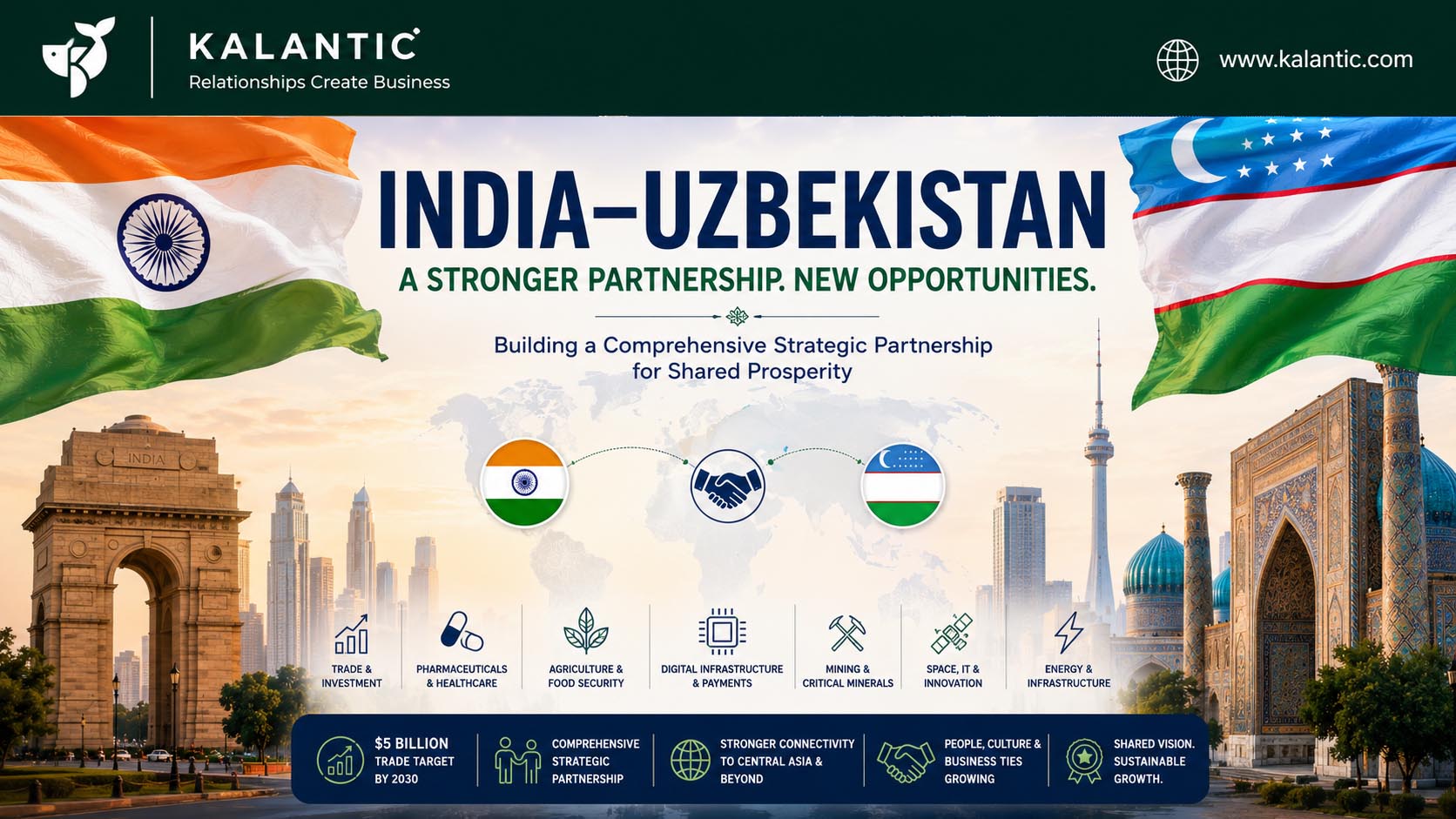
India and Uzbekistan have just elevated their relationship to a Comprehensive Strategic Partnership.
The two countries have also set an ambitious target of increasing annual bilateral trade to $5 billion by 2030.
But the trade target is only one part of the story.
The relationship is expanding across investment, infrastructure, healthcare, pharmaceuticals, agriculture, digital public infrastructure, telecommunications, space, critical minerals and mining.
That creates an interesting question for businesses:
Could Uzbekistan become a gateway for deeper Indian engagement with Central Asia?
Why Uzbekistan Matters
Uzbekistan is Central Asia's most populous country.
It has a growing economy, a young population and an increasingly important position at the intersection of Central Asian trade routes.
For Indian businesses, that makes Uzbekistan interesting for reasons that go beyond bilateral trade.
The country can potentially serve as a starting point for understanding a region that includes Kazakhstan, Kyrgyzstan, Tajikistan and Turkmenistan.
That does not mean Uzbekistan automatically becomes a gateway to every Central Asian market.
But it can provide something valuable:
A place from which companies can begin building regional relationships.
The Relationship Is Becoming More Commercial
The latest India–Uzbekistan discussions covered an unusually broad range of commercial sectors.
These include:
- Trade and investment
- Infrastructure
- Digital public infrastructure
- UPI and digital payments
- Pharmaceuticals
- Healthcare
- Agriculture
- Mining
- Critical minerals
- Energy
- Space
- Information technology
- Innovation and startups
This breadth is significant.
It suggests that the relationship is moving beyond a narrow diplomatic or commodity-based partnership.
There is an attempt to create a broader commercial ecosystem.
A $5 Billion Target Creates a Direction
India and Uzbekistan currently trade at a much smaller level than India does with its largest commercial partners.
The $5 billion target therefore represents a substantial expansion.
But targets alone do not create trade.
Businesses need to find commercially viable reasons to work with each other.
That means identifying:
Customers.
Partners.
Distributors.
Investors.
Technology collaborators.
Manufacturing relationships.
And projects.
The real test of the new relationship will therefore be how many of those connections turn into actual businesses.
Pharmaceuticals Could Be an Important Area
India has a globally competitive pharmaceutical industry.
Uzbekistan has a growing healthcare market and is looking to expand healthcare capabilities.
That creates a natural area of cooperation.
Indian pharmaceutical companies can potentially bring:
- Affordable medicines
- Generic drugs
- Manufacturing expertise
- Healthcare technology
- Medical devices
- Contract manufacturing capabilities
But entering the Uzbek market still requires understanding local regulations, procurement systems, distribution networks and healthcare institutions.
A strong product is only the starting point.
Market access is the real challenge.
Digital Infrastructure Is Another Opportunity
The relationship is also moving into digital infrastructure and India's Unified Payments Interface.
That is particularly interesting because India's digital public infrastructure experience has become an exportable capability.
UPI has already attracted international interest.
For countries developing their own digital economies, India's experience can provide a reference point for payments, digital identity, financial inclusion and public digital infrastructure.
For Indian technology companies, that creates opportunities beyond simply selling software.
It can involve:
- Technology partnerships
- Implementation
- Consulting
- Infrastructure
- Fintech
- Financial services
- Digital government solutions
This is an area where Indian companies can potentially take expertise developed at enormous domestic scale into international markets.
Agriculture Is Another Bridge
India and Uzbekistan are also expanding agricultural cooperation.
The two countries are looking at areas including seed production and drip irrigation, with agricultural centres from both countries working together.
This is commercially interesting because agriculture creates a large ecosystem.
It involves:
- Seeds
- Irrigation
- Farm technology
- Equipment
- Food processing
- Storage
- Logistics
- Agricultural finance
- Technical services
Indian agricultural companies therefore have opportunities beyond simply exporting agricultural products.
They can potentially export know-how and technology.
Critical Minerals Are Part of the Bigger Picture
Critical minerals are another important area of cooperation.
India and Uzbekistan have agreed to deepen cooperation in geology, mining and critical and strategic minerals.
The framework includes exploration, mining, mineral processing, value-added products and recycling.
Indian companies are being encouraged to participate in prospective mineral deposits in Uzbekistan, while Uzbek enterprises can explore collaboration in India. :contentReference[oaicite:1]{index=1}
This is important.
The opportunity is not simply about securing access to a resource.
It can involve companies participating across the wider value chain.
Exploration.
Processing.
Technology.
Equipment.
Recycling.
Investment.
That creates opportunities for specialised businesses rather than only large mining companies.
Uranium Adds Another Strategic Layer
India and Uzbekistan are also working towards a long-term arrangement for uranium supplies.
For India, this has implications for long-term energy security.
For Uzbekistan, it creates another major commercial relationship with a large Asian economy.
But the broader significance is that the relationship is increasingly touching sectors of strategic importance to both countries.
Energy.
Technology.
Minerals.
Infrastructure.
Healthcare.
Digital systems.
That gives the bilateral relationship considerably more depth.
What Does This Mean for Indian Companies?
The obvious question is:
Why should an Indian company care about Uzbekistan?
The answer is not simply that Uzbekistan itself is a growing market.
It is that the country can potentially become one of the places from which Indian companies build experience in Central Asia.
A company may begin with Uzbekistan.
Develop local relationships.
Understand the regulatory environment.
Build a customer base.
Establish a distribution network.
Then evaluate opportunities elsewhere in the region.
That is a very different strategy from trying to enter five countries simultaneously.
Start With One Market
International expansion often becomes unnecessarily complicated.
A company looks at an entire region.
It identifies ten countries.
It prepares ten market studies.
It tries to build ten sets of relationships.
And then struggles to execute.
A more practical approach can be:
Find one market where the fit is strongest.
Build there.
Learn.
Then expand.
Uzbekistan could potentially play that role for some Indian companies looking towards Central Asia.
Not for every business.
But for the right sectors, it could be a useful starting point.
The Opportunity Also Works in Reverse
The relationship is not only about Indian companies entering Uzbekistan.
Uzbek companies can also look towards India.
India offers:
- A huge consumer market
- Pharmaceutical capabilities
- Technology
- Digital infrastructure
- Manufacturing
- Engineering
- Financial services
- Education
- Healthcare
For an Uzbek company with a strong local product or capability, India can be an enormous market.
But again, entering India requires more than identifying demand.
A company needs to understand how the market actually works.
Who buys?
Who distributes?
Who influences purchasing?
Who are the right local partners?
Which cities or regions should come first?
What needs to be localised?
These are questions that relationships can help answer.
Relationships Become More Important as Markets Get Unfamiliar
For an international company entering a familiar Western market, there may already be established systems for customer acquisition, distribution and market research.
In less familiar markets, relationships become disproportionately valuable.
A local business partner can explain:
Why a customer behaves differently than expected.
Which distributor actually has influence.
Which government agency matters.
Which industry association is useful.
Which introduction is worth pursuing.
And which opportunity is not worth pursuing at all.
That knowledge can save months.
Sometimes years.
This Is Where India–Uzbekistan Gets Interesting for Kalantic
The most interesting part of this relationship is not the diplomatic announcement.
It is what happens after it.
The agreements create a framework.
But companies have to populate that framework.
Indian businesses need Uzbek customers and partners.
Uzbek businesses need Indian customers and partners.
Technology companies need implementation partners.
Manufacturers need distributors.
Investors need opportunities.
And companies entering unfamiliar markets need people who understand how those markets work.
That is where international business becomes relationship-driven.
Central Asia Is Changing
Central Asia itself is becoming increasingly important.
The region sits between major economic powers.
China is deeply involved.
Russia remains significant.
Türkiye has expanding interests.
The Gulf states are investing.
Europe is looking for new economic connections.
And countries across the region are attempting to diversify their commercial relationships.
For India, deeper engagement with Central Asia therefore has significance beyond any single bilateral relationship.
It creates another route into a region where Indian companies have considerable room to expand.
India's Opportunity Is Not Always in the Largest Markets
There is a tendency to measure international opportunity by market size.
That is useful.
But it isn't enough.
A smaller market can be strategically valuable if:
- Competition is manageable
- Demand is growing
- The sector fit is strong
- The regulatory environment is workable
- Local partners are available
- The market provides access to a wider region
Uzbekistan may be interesting precisely because of that combination.
The opportunity is not simply the size of Uzbekistan.
It is the possibility of building something there that can grow beyond Uzbekistan.
What Companies Should Do Now
For Indian companies considering Central Asia, the first step should not necessarily be incorporation.
It should be market discovery.
Identify the specific opportunity.
Then identify:
1. The customer
Who actually needs the product or service?
2. The local ecosystem
Which businesses already operate around that customer?
3. Potential partners
Who has complementary capabilities?
4. Regulatory requirements
What needs to be approved, licensed or localised?
5. Commercial viability
Can the business actually make money at the required scale?
6. Regional potential
If Uzbekistan works, where could the business go next?
This creates a much more disciplined approach to international expansion.
The Bigger Opportunity
India–Uzbekistan relations are still developing.
The $5 billion trade target is an ambition.
The new agreements will take time to translate into commercial activity.
And not every proposed area of cooperation will produce major business.
But the direction is important.
The two countries are building a broader economic relationship.
And that relationship is increasingly involving companies rather than just governments.
For Indian businesses, this could be an opportunity to look at Central Asia differently.
Not as a distant and unfamiliar region.
But as a collection of markets where the right relationships can create commercial access.
The Question Is Not "Why Uzbekistan?"
It is:
"What can we build in Uzbekistan that makes sense?"
Then:
"Who should we build it with?"
And finally:
"Could that relationship take us further into Central Asia?"
Those are much more useful questions than simply asking whether Uzbekistan is a large enough market.
Because international expansion is rarely about entering a country for the sake of entering it.
It is about finding a genuine commercial fit.
Finding the right people.
Building trust.
Learning the market.
And then deciding how far the opportunity can go.
India and Uzbekistan have now created a stronger framework for that conversation.
The next chapter will be written by businesses.
And the companies that start building those relationships early may be the ones best positioned to benefit.
Sources
- Government of India, Press Information Bureau, August 30, 2026 — India–Uzbekistan talks covering trade, investment, digital infrastructure, healthcare, pharmaceuticals, critical minerals, agriculture, space and other sectors.
- Prime Minister's Office, Government of India, August 30, 2026 — India–Uzbekistan Joint Statement on trade, investment, critical minerals, mining, energy and regional cooperation.
- The Indian Express, August 30, 2026 — India and Uzbekistan set a $5 billion trade target and discuss long-term uranium supplies.
- The Economic Times, August 30, 2026 — India and Uzbekistan deepen cooperation in mining, geology, uranium and critical minerals.
Ready to Explore India?
Expanding into India requires more than market research—it requires the right customers, partners, and commercial strategy. Kalantic helps international companies validate opportunities, identify customers and channel partners, and build a sustainable business presence in India. Whether you’re evaluating India for the first time or accelerating your expansion, our team can help you make informed decisions with confidence.
Book an India Market Entry Discussion
Or email us at: info@kalantic.com