India’s Global Capability Centre story is entering a new phase.
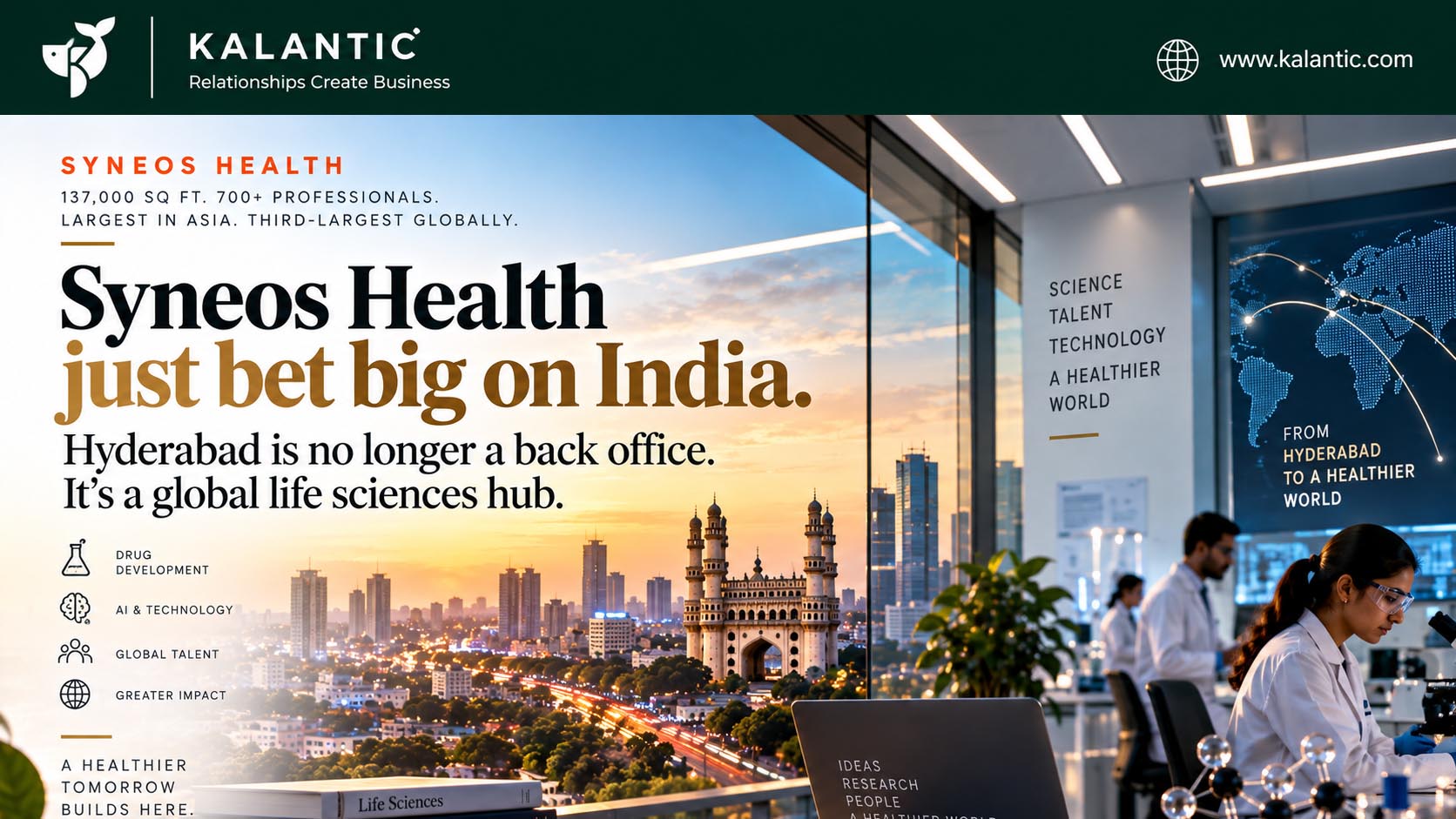
The latest signal comes from Syneos Health, which has opened a 137,000-square-foot Global Life Sciences and Technology Centre in Hyderabad. The facility is the company’s largest in Asia and third-largest globally, with more than 700 professionals expected initially.
But the more important part of the announcement is not the size of the building.
Syneos is positioning the Hyderabad operation as a strategic growth hub supporting drug development, commercialisation, technology, artificial intelligence and global customers.
That distinction captures a broader shift in India.
Global companies are increasingly moving beyond using India for execution and are beginning to use the country to build capabilities that serve the world.
Key Takeaways
- Syneos Health has opened a major global life sciences and technology centre in Hyderabad.
- The centre is the company's largest in Asia and third-largest globally.
- It will bring together clinical development, commercialisation, medical affairs, technology, AI and corporate functions.
- Hyderabad is becoming an increasingly important global hub for healthcare and life sciences capabilities.
- The opportunity for international companies is moving beyond outsourcing towards R&D, innovation, technology and global decision-making.
- For companies considering India, the question is increasingly not “Should we have a team in India?” but “What should our India team build for the world?”
The India GCC story is changing
For years, the Global Capability Centre was often associated with a relatively simple proposition:
Build a team in India, access skilled talent and operate at competitive cost.
That model still exists.
But something more interesting is happening alongside it.
Global companies are increasingly putting higher-value activities into their Indian operations.
Technology.
Product development.
Analytics.
Artificial intelligence.
Research.
Engineering.
Clinical development.
Global business functions.
And increasingly, strategic decision-making.
Syneos Health’s new Hyderabad centre is a useful example of this evolution.
The company describes the facility not simply as another delivery centre, but as a strategic hub bringing together global leaders, clinical and commercial experts, technologists and innovators.
That is a fundamentally different proposition.
Why Hyderabad?
Hyderabad has spent years building an unusually deep combination of capabilities.
Its healthcare and life sciences ecosystem includes pharmaceuticals, APIs, generics, contract development and manufacturing, vaccines, research and discovery.
At the same time, the city has developed a substantial technology talent base.
That combination creates something valuable.
A healthcare company does not necessarily have to choose between scientific talent and technology talent.
It can potentially access both in the same ecosystem.
The Telangana government estimates that Hyderabad accounts for around 20–23% of India's healthcare-biotech GCC market.
With Syneos Health joining the ecosystem, four of the world's five largest Contract Research Organisations are now reported to have a presence in Hyderabad.
That creates a reinforcing effect.
More global companies attract more specialised talent.
More specialised talent attracts more companies.
More companies create more suppliers, service providers, partnerships and institutional capabilities.
Over time, a cluster becomes more than the sum of its individual companies.
From delivery centre to global innovation hub
This is perhaps the most important development for international businesses watching India.
The question is no longer simply:
“Can India provide skilled employees?”
It is:
“What can our India organisation actually own?”
A mature India operation could potentially own:
- Product development
- Technology platforms
- AI initiatives
- Data and analytics
- R&D
- Clinical research
- Engineering
- Global finance
- Digital operations
- Customer experience
- Business process innovation
This changes the economics of market entry.
An international company does not necessarily need to think of India as a country where it establishes a back-office function.
It can think of India as a place where it builds part of its global operating model.
Why this matters beyond life sciences
The Syneos announcement is specific to healthcare and life sciences.
The underlying trend is much broader.
Technology companies are building engineering teams.
Financial institutions are building analytics and technology centres.
Retail companies are building digital capabilities.
Industrial companies are establishing engineering and R&D operations.
Healthcare companies are combining scientific expertise with AI and technology.
The result is an India that increasingly participates in the creation of global products and services.
This matters to international companies because it creates opportunities on both sides.
Companies already operating in India may be able to expand the scope of their operations.
Companies not yet present may need to reconsider what an India entry could look like.
The opportunity is also outside the GCC
There is another layer to this story.
Every major global capability centre creates an ecosystem around itself.
It needs:
- Technology partners
- Consulting firms
- Recruitment specialists
- Training providers
- Real estate and infrastructure
- Data and cybersecurity providers
- Clinical and research partners
- Universities
- Specialist vendors
- Professional services
- Local business networks
A company establishing a 700-person global centre is therefore not simply creating 700 jobs.
It potentially creates demand for an entire network of organisations around it.
That is where the opportunity for Indian businesses—and international companies looking to sell into India—becomes particularly interesting.
International companies should look beyond the obvious cities
India's GCC story is no longer restricted to Bengaluru.
Hyderabad is strengthening its position in healthcare, life sciences and technology.
Chennai is attracting technology and business operations.
Pune remains important for engineering and industrial capabilities.
Delhi-NCR offers a major enterprise and services ecosystem.
Mumbai continues to matter for financial services and corporate functions.
The right location therefore depends on what a company is trying to build.
A company looking for AI and life sciences capabilities may have a very different location strategy from one looking for automotive engineering, financial services or industrial R&D.
The India question needs to become more specific.
The next question: What should India build for us?
This may be the most important shift in thinking.
The old India question was:
“Where can we hire people?”
The next question is:
“What should our India organisation own?”
That could mean a technology platform.
A global analytics function.
An R&D team.
A clinical development capability.
A product engineering organisation.
An AI centre.
A global finance operation.
Or a combination of several of these.
Once that question is answered, the market-entry strategy becomes much clearer.
The company can then determine:
Who needs to be hired?
Which partners are required?
Which city makes sense?
Which institutions should we work with?
Which customers should we develop?
Which government and ecosystem stakeholders matter?
And, critically:
Whom should we know?
Relationships become strategic infrastructure
A market can have excellent talent and infrastructure and still be difficult to enter without the right relationships.
For an international company building a capability in India, relationships may determine:
- Which partners are discovered first
- Which customers are introduced
- Which suppliers are evaluated
- Which talent pools are accessed
- Which institutions become collaborators
- Which opportunities become visible
That makes relationship development part of market-entry infrastructure.
It is not simply networking.
It is commercial execution.
India is becoming part of the global operating model
Syneos Health's Hyderabad announcement is therefore bigger than one new facility.
It is another example of a global company placing high-value capabilities in India and using those capabilities to serve customers and operations around the world.
That is an important distinction.
India is not simply becoming a larger market for global companies.
It is becoming part of how global companies build, operate and innovate.
For international businesses evaluating India, that should change the conversation.
Don't begin with:
“How do we enter India?”
Begin with:
“What part of our global business could India help us build?”
The answer may be considerably larger than expected.
Frequently Asked Questions
What did Syneos Health announce in Hyderabad?
Syneos Health opened a 137,000-square-foot Global Life Sciences and Technology Centre in Hyderabad. The centre is its largest in Asia and third-largest globally, with an initial workforce of more than 700 professionals.
What will the Syneos Hyderabad centre do?
The centre brings together capabilities across clinical development, commercialisation, medical affairs, technology, artificial intelligence and corporate functions, supporting Syneos Health's global customers.
Why is Hyderabad becoming important for global life sciences companies?
Hyderabad combines a strong pharmaceutical and life sciences ecosystem with a large technology talent base. Its ecosystem includes research, discovery, APIs, generics, CDMOs, vaccines and growing healthcare-focused GCCs.
Are GCCs still mainly about cost savings?
Cost efficiency remains relevant, but many GCCs are increasingly being used for higher-value functions such as R&D, engineering, AI, product development, analytics and global business operations.
What does this mean for international companies entering India?
Companies can consider India not only as a sales market or outsourcing location, but as a potential global capability and innovation hub. The appropriate model depends on the company's strategy, sector and operating requirements.
What should companies evaluate before establishing a GCC in India?
Companies should evaluate talent, location, infrastructure, regulatory requirements, ecosystem depth, partner availability, operating costs and—most importantly—the capabilities they want the Indian organisation to own.
Final Thoughts
The most interesting thing about India's GCC story is not how many centres are being opened.
It is what those centres are being asked to do.
If India is increasingly becoming the place where global companies build products, develop technology, conduct research and solve complex business problems for customers around the world, then the opportunity is much larger than the GCC industry itself.
It extends into partnerships, technology, talent, services, R&D and market access.
For international companies, the strategic question is no longer simply whether India belongs in the global operating model.
It is:
What should India own?
And before answering that question, there is another one worth asking:
Whom should we know?
About Kalantic
Kalantic helps international companies develop business opportunities in India through market access, relationship development, partnerships and on-ground business development.
We help companies identify relevant stakeholders, build relationships and turn India market-entry strategies into commercial opportunities.
Whom should we know?
Sources
- Business Standard, “Syneos Health opens global life sciences and technology centre in Hyderabad,” September 23, 2026.
- Moneycontrol, “Syneos Health opens life sciences and tech GCC in Hyderabad; to employ 700 people,” September 23, 2026.
- The Times of India, “Syneos Health opens its largest Asia life sciences and tech hub in Hyderabad,” September 23, 2026.
Ready to Explore India?
Expanding into India requires more than market research—it requires the right customers, partners, and commercial strategy. Kalantic helps international companies validate opportunities, identify customers and channel partners, and build a sustainable business presence in India. Whether you’re evaluating India for the first time or accelerating your expansion, our team can help you make informed decisions with confidence.
Book an India Market Entry Discussion
Or email us at: info@kalantic.com