
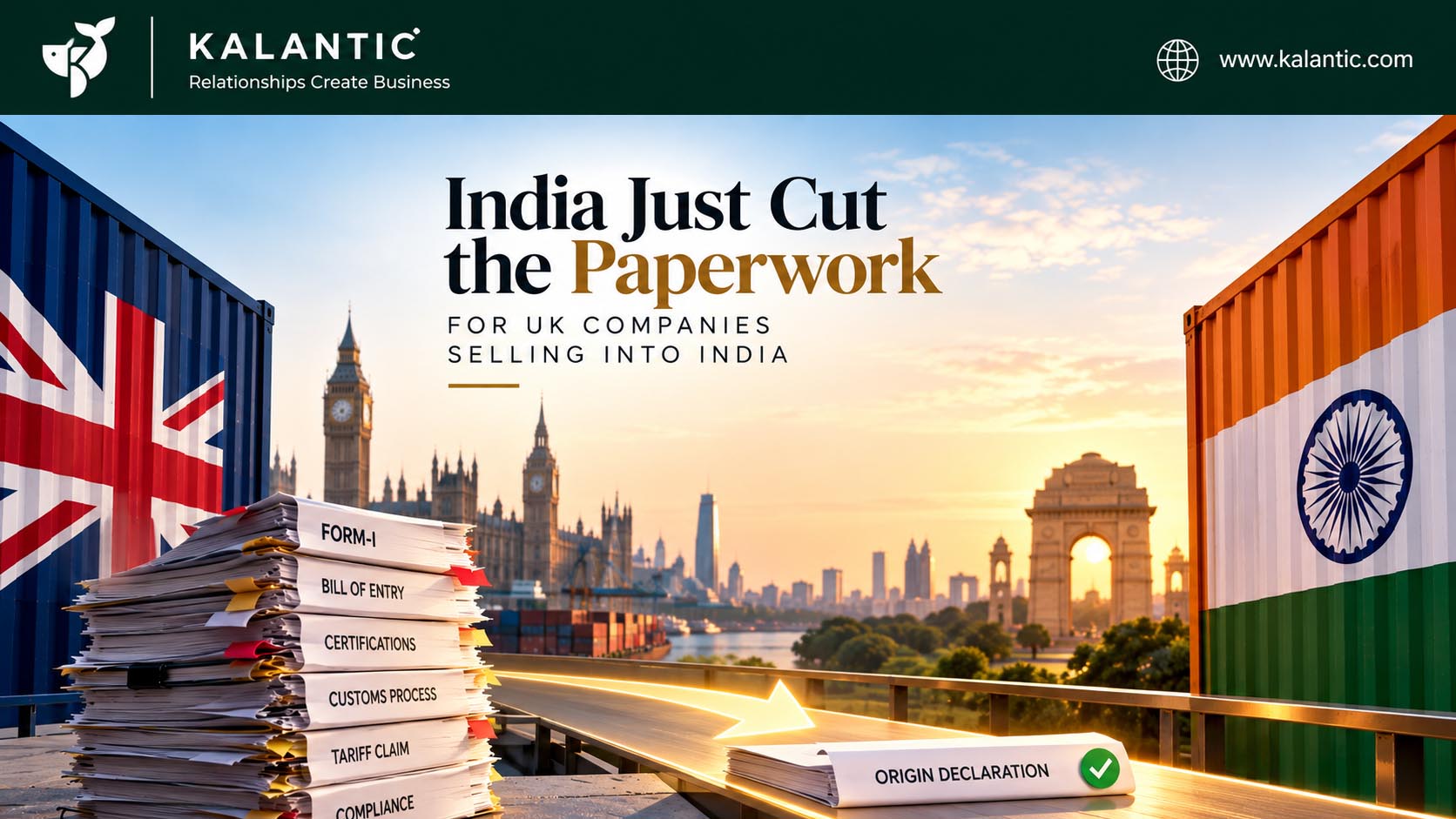
India has just made one part of the India–UK trade agreement easier to use.
The Central Board of Indirect Taxes and Customs (CBIC) has clarified that UK exporters' valid Origin Declaration will generally be sufficient for Indian importers to claim preferential customs duty under the India–UK Comprehensive Economic and Trade Agreement (CETA).
Importers no longer need to routinely submit Form-I with every Bill of Entry. CBIC may still request the form when a shipment is selected for scrutiny.
For UK companies selling into India, this is a small regulatory change with a very practical implication:
The commercial benefit of the India–UK trade agreement is becoming easier to operationalise.
Key Takeaways
- CBIC has simplified documentation for UK imports claiming preferential tariffs under CETA.
- A valid Origin Declaration from the UK exporter or producer can generally establish origin.
- Form-I is no longer a routine precondition for claiming the preferential rate.
- Customs can still request additional information when a shipment is flagged for scrutiny.
- UK companies should ensure their products actually satisfy CETA rules of origin before claiming the tariff benefit.
- The development makes the India–UK trade agreement more practical for companies already selling into India and those evaluating the market.
The India–UK trade deal just became easier to use
Trade agreements are usually announced with big numbers.
Tariff reductions.
Market access.
Export opportunities.
Investment commitments.
But the real test begins at the border.
Can a company actually use the agreement without creating a new layer of administrative complexity?
India has now taken a step in that direction for UK imports.
The CBIC has clarified that importers claiming preferential treatment under the India–UK CETA do not need to routinely submit Form-I with every Bill of Entry.
A valid Origin Declaration from the UK exporter or producer will generally be sufficient.
Form-I can still be requested where customs needs additional verification.
That distinction matters.
What changed?
Under the earlier process, importers claiming preferential treatment had to provide Form-I alongside the Bill of Entry.
The latest clarification changes that routine requirement.
The Origin Declaration becomes the primary proof used for the preferential tariff claim.
This is particularly relevant because the India–UK CETA uses a self-certification approach for origin.
In practical terms, the UK exporter or producer is responsible for declaring that the goods satisfy the agreement's applicable rules of origin.
Indian Customs retains the ability to verify the claim.
The result is a shift from routine documentation towards a more risk-based verification model.
Why does this matter to UK companies?
Because tariff preference only matters if companies can actually use it.
Imagine a UK manufacturer selling equipment into India.
The company may have a tariff advantage under CETA.
But if every shipment creates significant documentation, verification and administrative work, some of that commercial advantage can be diluted.
Reducing routine paperwork can make the preferential tariff easier to incorporate into the company's pricing and distribution strategy.
It can also make smaller or mid-sized exporters more comfortable with entering the Indian market.
For companies that ship repeatedly, even relatively small reductions in administrative friction can compound over hundreds of transactions.
But there is an important catch
Less paperwork does not mean less responsibility.
A company cannot simply issue an Origin Declaration and assume that the tariff concession is guaranteed.
The goods still need to satisfy the applicable CETA rules of origin.
That means UK exporters need to understand:
- Where the product was manufactured.
- Which inputs were sourced from third countries.
- Whether the product satisfies the applicable origin threshold.
- What product-specific rules apply.
- Whether sufficient production or processing occurred in the UK.
- What documentation is available to support the declaration.
This becomes particularly important for companies with complex international supply chains.
A product may be designed in the UK, contain components from several countries, be assembled in another location and then shipped to India.
Determining whether that product qualifies as UK-origin is therefore not necessarily straightforward.
The opportunity is bigger than customs paperwork
This development also highlights a larger opportunity for UK companies.
The India–UK trade agreement is not simply a tariff document.
It can influence how companies think about their entire India strategy.
A UK company may now reconsider:
Pricing
Can preferential tariffs make the product more competitive in India?
Distribution
Does the improved landed cost make working with Indian distributors more attractive?
Manufacturing
Could India become part of the company's regional manufacturing or assembly strategy?
Sourcing
Can the company redesign its supply chain while remaining compliant with the agreement's origin rules?
Market expansion
Could products that previously struggled on price now become commercially viable?
These are strategic questions.
The customs change is simply one of the mechanisms that can influence the answer.
The biggest opportunity may be for mid-sized UK companies
Large multinational companies typically have trade-compliance teams, customs specialists and sophisticated supply-chain systems.
Smaller companies often do not.
For a mid-sized UK manufacturer or technology company, administrative complexity can be a genuine barrier to international expansion.
Simplifying routine documentation can therefore make a difference beyond the actual cost of filling out a form.
It can reduce uncertainty.
And uncertainty is often one of the biggest hidden costs of entering a new market.
A company that knows how its products qualify, what documentation it needs and how its importer will claim the benefit can build a much clearer commercial model.
India is becoming a more interesting market for UK exporters
The timing is important.
The India–UK CETA entered into force in July 2026 after years of negotiations.
The agreement is intended to deepen bilateral trade by reducing barriers across goods and services.
The latest customs clarification is one example of what happens after the headline agreement is signed.
The focus moves from diplomacy to implementation.
That is where businesses actually experience the agreement.
A tariff reduction on paper is one thing.
A tariff reduction that an importer can claim efficiently at the port is another.
What should UK companies do now?
Companies selling into India should not simply assume that the new process applies automatically to every product.
A practical review should cover five areas.
1. Map your products
Identify which products qualify for preferential treatment under the CETA tariff schedule.
2. Check rules of origin
Confirm that each relevant product satisfies the applicable origin requirements.
3. Review your supply chain
Identify third-country inputs that could affect eligibility.
4. Align the UK exporter and Indian importer
The Origin Declaration needs to work within the commercial and customs process on both sides.
5. Recalculate your India economics
Once the applicable tariff benefit is understood, revisit landed cost, pricing, distributor margins and market positioning.
The result could change the attractiveness of India for products that previously had limited price competitiveness.
The real opportunity: moving from agreement to execution
This is where many international businesses struggle.
Signing a trade agreement does not create sales.
Lowering a tariff does not create distribution.
Market access does not automatically create customers.
Companies still need to identify the right distributors, enterprise customers, channel partners, service providers and local stakeholders.
In other words:
Trade policy can open the door. Relationships still get you through it.
For UK companies considering India, the next question should therefore move beyond:
“Do we have preferential tariffs?”
It should become:
“Who can help us turn that advantage into market share?”
The India–UK opportunity is becoming more practical
The latest CBIC clarification may appear to be a technical customs update.
For businesses, it is more useful to view it as another piece of the India–UK commercial infrastructure falling into place.
The agreement exists.
Preferential tariffs are available for qualifying goods.
The process for claiming those benefits is becoming less cumbersome.
Now companies need to work out how to use the opportunity.
That means understanding the market, identifying the right partners and building the relationships required to convert trade access into commercial traction.
For UK companies looking at India, the question is no longer simply whether the trade agreement creates an opportunity.
It is:
What should we do with it?
And, as always:
Whom should we know?
Frequently Asked Questions
What changed for UK imports under India–UK CETA?
CBIC has clarified that a valid Origin Declaration will generally be sufficient to claim preferential customs duty. Form-I no longer needs to be routinely filed with every Bill of Entry.
Does Form-I disappear completely?
No. Customs can still request Form-I or additional information when a shipment is selected for scrutiny or verification.
Does every UK product automatically qualify for preferential tariffs?
No. Products must satisfy the applicable CETA rules of origin and other conditions for preferential treatment.
What is an Origin Declaration?
It is a self-certification by the UK exporter or producer stating that the goods meet the applicable rules of origin under the trade agreement.
What does this mean for UK companies entering India?
It can reduce routine customs administration for qualifying imports and make the preferential tariff mechanism easier to use. Companies should still conduct product-level tariff and origin analysis.
Should UK companies change their India pricing strategy?
Potentially, but the answer depends on the product, applicable tariff, rules of origin, logistics costs, distribution structure and competitive environment. Companies should calculate the complete landed-cost impact before changing pricing.
Final Thoughts
The most important trade developments are often not the ones that make the biggest headlines.
Sometimes they are the small changes that remove friction between an agreement being signed and a business actually using it.
India's latest CETA clarification is one of those changes.
For UK exporters, the message is simple:
The India–UK trade agreement is now moving from policy into execution.
The companies that understand the tariff rules, organise their supply chains and build the right commercial relationships will be in a stronger position to turn preferential market access into actual business.
The paperwork just got lighter.
Now comes the harder part:
Winning the Indian market.
About Kalantic
Kalantic helps international companies develop business opportunities in India through market access, relationship development, partnerships and on-ground business development.
We help companies identify relevant stakeholders, build relationships and turn India market-entry strategies into commercial opportunities.
Whom should we know?
Sources
Business Standard, “CBIC eases paperwork to claim concessional duty on imports from UK,” September 27, 2026. https://www.business-standard.com/economy/news/cbic-eases-paperwork-to-claim-concessional-duty-on-imports-from-uk-126092700646_1.html
The Economic Times, “India-UK trade deal: CBIC eases paperwork for UK imports seeking preferential tariffs,” September 25, 2026. https://economictimes.indiatimes.com/news/economy/foreign-trade/india-uk-trade-deal-cbic-eases-paperwork-for-uk-imports-seeking-preferential-tariffs/articleshow/134489128.cms
Business Standard, “CBIC rolls out process to claim duty concessions under India-UK FTA,” July 14, 2026. https://www.business-standard.com/economy/news/cbic-issues-operational-rules-to-claim-benefits-under-india-uk-trade-pact-126071301202_1.html
Ready to Explore India?
Expanding into India requires more than market research—it requires the right customers, partners, and commercial strategy. Kalantic helps international companies validate opportunities, identify customers and channel partners, and build a sustainable business presence in India. Whether you’re evaluating India for the first time or accelerating your expansion, our team can help you make informed decisions with confidence.
Book an India Market Entry Discussion
Or email us at: info@kalantic.com