
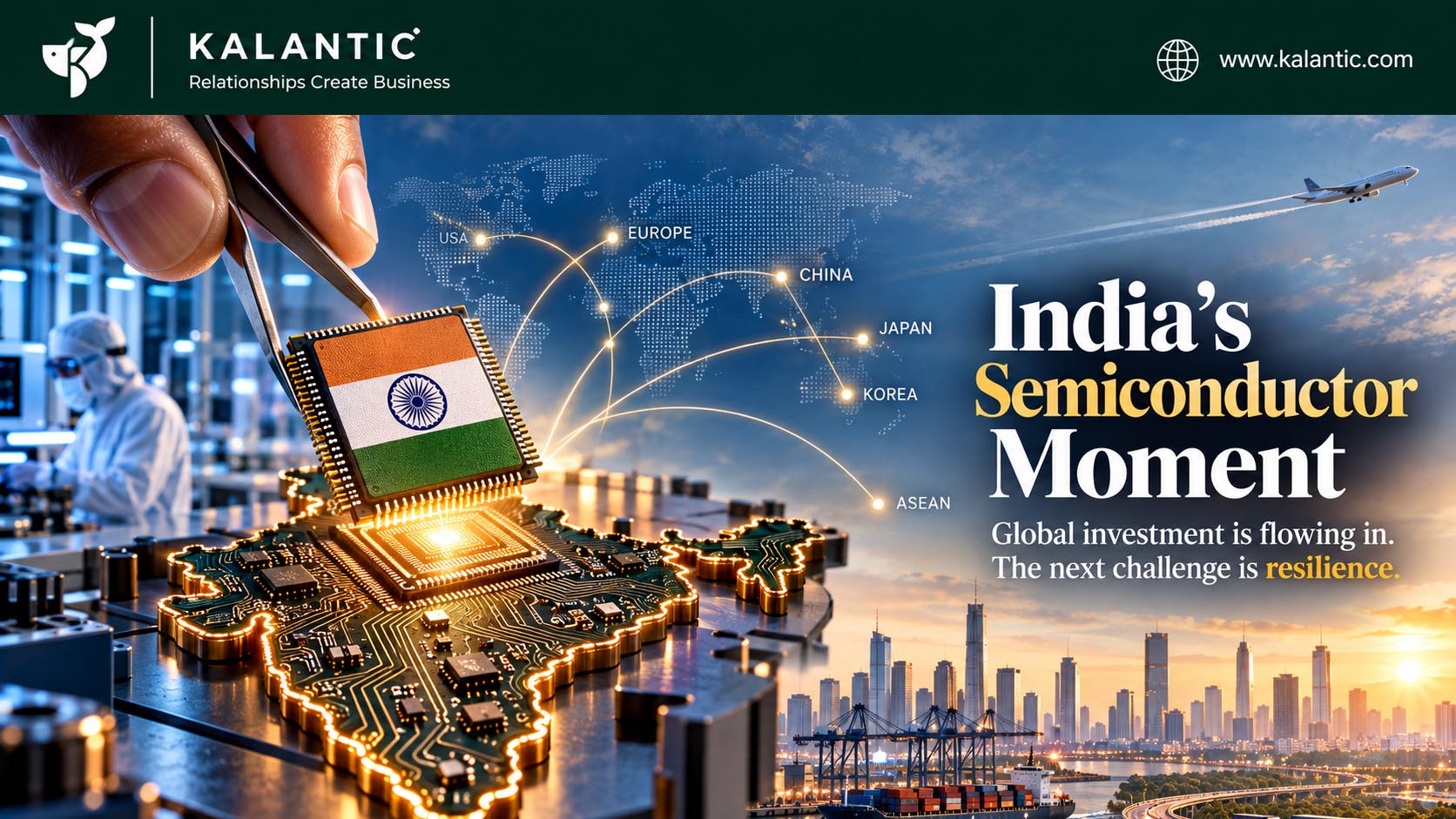
India’s semiconductor story has entered a new phase.
The country is no longer talking only about attracting chip manufacturers. It is building an ecosystem involving fabrication, packaging, design, equipment, materials, research and development, and supporting suppliers.
But a major question is emerging alongside the investment: Can India build a semiconductor ecosystem that is resilient enough to withstand geopolitical, cyber and supply-chain shocks?
That question matters not only to India, but to every international company considering India as part of its semiconductor strategy.
Key Takeaways
- India is attracting significant international semiconductor investment.
- Applied Materials has announced a planned $5 billion investment in India over the next decade.
- The government and industry are increasingly focused on cybersecurity and supply-chain resilience.
- Semiconductor companies entering India will need to look beyond manufacturing capacity.
- Opportunities are emerging across equipment, materials, R&D, engineering, packaging, design, suppliers and specialised services.
- Local relationships and ecosystem partnerships will become increasingly important as the sector develops.
The semiconductor story is changing
For years, India’s semiconductor ambition was primarily discussed in terms of attracting fabs.
That conversation is becoming considerably broader.
At SEMICON India 2026, more than 600 companies from 52 countries participated in an ecosystem that covered chip materials, design, fabrication and packaging.
Then came one of the biggest signals of international confidence.
Applied Materials announced plans to invest $5 billion in India over the next decade, expanding its presence in research, supply-chain development and workforce capabilities.
The significance is larger than the headline investment.
It suggests that international semiconductor companies are beginning to evaluate India not simply as a manufacturing destination, but as part of their broader global technology architecture.
But scale creates a new problem
India’s growing semiconductor ecosystem also creates new vulnerabilities.
In a recent warning, Electronics and IT Minister Ashwini Vaishnaw urged semiconductor companies and deep-tech startups to prepare for cyberattacks and other forms of disruption.
Industry representatives have similarly highlighted risks around geopolitical tensions, supplier concentration and dependence on specialised international inputs.
This is an inherent feature of semiconductor manufacturing.
A modern chip does not emerge from one country or one factory.
It depends on an interconnected network of:
- Semiconductor equipment
- Electronic design automation tools
- Intellectual property
- Wafers
- Specialty chemicals
- Gases and materials
- Fabrication
- Advanced packaging
- Testing
- Logistics
- Engineering talent
- Software and cybersecurity infrastructure
A disruption at one point can affect multiple parts of the chain.
For India, therefore, building semiconductor capacity is only half the challenge.
Building resilience is the other half.
This creates opportunities for international companies
This is where the story becomes particularly interesting for global businesses.
India's semiconductor opportunity is not limited to companies capable of building a fabrication plant.
The emerging ecosystem requires hundreds of specialised capabilities around the core manufacturing process.
That creates potential opportunities for international companies in areas such as:
Equipment
Specialised manufacturing equipment, testing systems, metrology and process technologies will be required as India's semiconductor infrastructure expands.
Materials
Specialty chemicals, gases, wafers, packaging materials and other inputs represent potential areas for localisation and partnerships.
Engineering and R&D
India's large engineering talent pool can support semiconductor design, process engineering, software, product development and research.
Industrial technology
Factories require automation, monitoring, industrial software, robotics, energy management and specialised infrastructure.
Cybersecurity
As semiconductor facilities become increasingly connected, cybersecurity becomes part of manufacturing resilience rather than simply an IT function.
Supply-chain services
Logistics, warehousing, quality assurance, certification and specialised industrial services will also become increasingly important.
The opportunity may be bigger than the fab
This is an important distinction for international businesses.
A company looking at India and asking:
“Where can we build a semiconductor plant?”
may be asking too narrow a question.
A more useful question could be:
“What capabilities will India's semiconductor ecosystem need over the next five to ten years?”
That opens a much larger opportunity set.
A European equipment manufacturer may find an Indian customer.
A Japanese materials company may find a local manufacturing partner.
A Korean technology company may find an engineering ecosystem.
A US semiconductor company may establish an R&D operation.
A specialised software provider may build relationships with fabs and design houses.
A logistics company may develop infrastructure around semiconductor clusters.
The commercial opportunity exists at multiple layers of the ecosystem.
Global companies should start mapping the ecosystem now
For companies considering India, waiting until every semiconductor facility is fully operational may not necessarily be the most useful strategy.
Ecosystems are built through relationships before they become fully visible in revenue numbers.
Companies should begin identifying:
Anchor companies — Which fabs, OSATs, equipment companies and major technology players are establishing operations?
Emerging suppliers — Which Indian companies are building capabilities around these anchors?
Technology gaps — What capabilities will India still need to import?
Decision-makers — Who controls procurement, partnerships, technology adoption and localisation decisions?
Institutional stakeholders — Which government bodies, industry associations and ecosystem organisations influence development?
Regional clusters — Which locations are emerging around semiconductor manufacturing and electronics?
Potential partners — Which Indian organisations could accelerate market access?
This is where market entry becomes a relationship exercise rather than a database exercise.
India does not need complete self-sufficiency
There is also an important strategic distinction.
A resilient semiconductor ecosystem does not necessarily mean producing everything domestically.
Semiconductors are inherently global.
The objective is better described as diversification and resilience.
Multiple suppliers.
Multiple sources.
Alternative technologies.
Local capabilities where strategically important.
Strong cybersecurity.
Contingency planning.
And relationships that allow companies to respond when the global environment changes.
That creates a different opportunity for international companies.
India does not have to replace the global semiconductor ecosystem.
It can become an increasingly important node within it.
The next competitive advantage may be ecosystem access
As India's semiconductor infrastructure develops, the companies that understand the ecosystem early may have an advantage in building commercial relationships.
That means identifying the right people before procurement cycles formally begin.
It means understanding which Indian companies are likely to become strategic suppliers.
It means knowing which global companies are already building a presence.
And it means developing relationships across the ecosystem rather than approaching India through a single customer or distributor.
The semiconductor opportunity is therefore not simply about where to manufacture.
It is increasingly about whom to know.
Frequently Asked Questions
Why is India investing heavily in semiconductors?
India is seeking to develop domestic capabilities across semiconductor manufacturing, design, packaging, equipment, materials and related technologies while strengthening its role in global electronics supply chains.
What recent investment highlights international interest in India?
Applied Materials announced plans to invest $5 billion in India over the next decade. The announcement was made during SEMICON India 2026.
What are the biggest risks facing India's semiconductor ecosystem?
Recent industry discussions have highlighted cybersecurity, geopolitical disruption, supplier concentration and dependence on specialised global inputs.
Do international companies need to build manufacturing facilities to participate?
No. Opportunities can exist across equipment, materials, engineering, R&D, software, cybersecurity, logistics, testing, packaging and specialised industrial services.
What should an international company do before entering India's semiconductor ecosystem?
It should map the ecosystem, identify anchor companies and potential customers, understand technology gaps, assess local partners and begin developing relationships with relevant decision-makers.
Final Thoughts
India's semiconductor story is moving from ambition to infrastructure.
The next stage will be about making that infrastructure commercially viable, technologically capable and resilient.
For international companies, this creates an opportunity that extends far beyond the construction of fabs.
The bigger opportunity may be the ecosystem being built around them.
The companies that start understanding that ecosystem early will have more options when the market matures.
And the first question to ask is still the simplest:
Whom should we know?
About Kalantic
Kalantic helps international companies develop business opportunities in India through market access, relationship development, partnerships and on-ground business development.
We help companies identify relevant stakeholders, develop relationships and turn India market-entry strategies into commercial opportunities.
Whom should we know?
Sources
- Financial Express, “India’s semiconductor push faces new risks: How can government secure supply chain?”, September 22, 2026.
- Reuters, “Applied Materials to invest $5 billion in India as Modi’s flagship chip event kicks off”, September 17, 2026.
- Mint, “Applied Materials’ $5 billion India plan to build chip R&D lab, supply chain”, September 17, 2026.
- India Briefing, “India’s Semiconductor Sector: Tracking Government Support and Investment Trends”, July 16, 2026.
Ready to Explore India?
Expanding into India requires more than market research—it requires the right customers, partners, and commercial strategy. Kalantic helps international companies validate opportunities, identify customers and channel partners, and build a sustainable business presence in India. Whether you’re evaluating India for the first time or accelerating your expansion, our team can help you make informed decisions with confidence.
Book an India Market Entry Discussion
Or email us at: info@kalantic.com