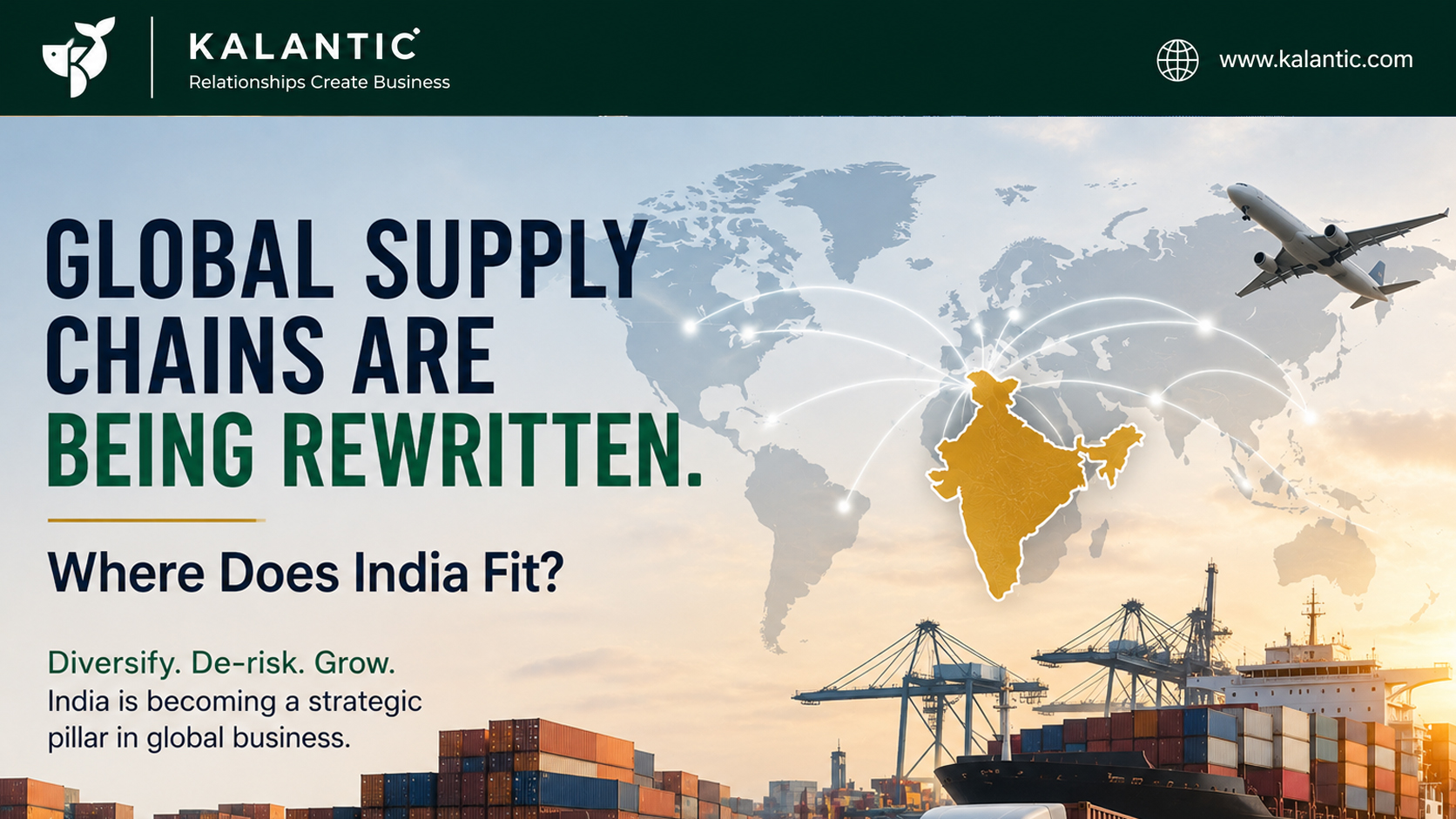
The Global Supply Chain Is Entering a New Phase
For decades, global supply chains were largely built around one principle:
Produce where it is most efficient.
Cost, scale and access to established manufacturing ecosystems often determined where companies sourced components, manufactured products and built supplier networks.
That model is changing.
Trade policy is becoming more dynamic. Companies are paying greater attention to geopolitical exposure. And businesses are increasingly looking at diversification not simply as a cost decision, but as a strategic one.
For India, this creates an important opportunity.
The question is no longer simply whether India can become another manufacturing destination.
It is whether India can become a meaningful part of the global operating model of international companies.
From Cost Optimisation to Strategic Diversification
The traditional approach to global sourcing was relatively straightforward:
Find the most competitive supplier.
Build scale.
Optimise costs.
Keep the supply chain efficient.
Today, companies are increasingly asking additional questions:
What happens if one market becomes inaccessible?
Can we source critical components from more than one geography?
Where should our next manufacturing facility be?
Which markets can serve both local demand and exports?
Where can we build a reliable supplier ecosystem over the next decade?
This is creating greater interest in diversified manufacturing footprints.
The objective isn't necessarily to replace one country with another.
It is to build a network that gives businesses more options.
India Is Building More Connections to Global Markets
India's opportunity is strengthened by the expansion of its trade network.
During 2025–26, India concluded or advanced several major trade agreements and frameworks, including arrangements involving the European Union, the United Kingdom, New Zealand, Oman and the United States. The government's own summary identifies these agreements as part of India's expanding trade architecture. (commerce.gov.in)
Several of these developments have already moved from negotiation to implementation.
The India–UK Comprehensive Economic and Trade Agreement entered into force on 15 July 2026, providing preferential access covering nearly 99% of India's exports to the UK. (pib.gov.in)
The India–Oman CEPA also entered into force on 1 June 2026, creating new market-access opportunities for Indian exporters. (pib.gov.in)
India's trade relationships are therefore becoming increasingly important to the country's role in global commerce.
For international companies, this matters because a manufacturing or sourcing decision is rarely just about the domestic market.
It is also about where that production can go next.
India Is More Than a Manufacturing Destination
The most interesting opportunity may lie in combining several advantages.
India has a large domestic consumer market.
It has a substantial engineering and technical talent base.
Its manufacturing ecosystem is expanding across electronics, automotive, pharmaceuticals, chemicals, machinery, textiles and other sectors.
And its connections to international markets are growing.
This creates the possibility of a different kind of India strategy.
A company could manufacture for India.
It could source from India.
It could build partnerships in India.
And, depending on the sector and product, it could use India as part of a broader export strategy.
That is fundamentally different from viewing India simply as a low-cost production location.
The "China + 1" Conversation Is Evolving
The China + 1 strategy became popular as companies looked for ways to reduce excessive concentration in a single manufacturing geography.
But diversification is becoming more sophisticated.
Companies are no longer asking only:
"Where can we move production?"
They are asking:
"Where can we build a complete ecosystem?"
That includes suppliers.
Manufacturing partners.
Technology providers.
Logistics companies.
Distributors.
Customers.
Service providers.
Talent.
And increasingly, local business relationships.
A factory without an ecosystem can be expensive.
An ecosystem can create an advantage that is much harder to replicate.
India's Domestic Market Makes the Equation Different
One of India's biggest advantages is that international companies do not necessarily have to choose between manufacturing and market access.
The country itself represents a substantial and increasingly sophisticated market.
That changes the economics of entering India.
A company can potentially establish a presence to serve Indian customers while simultaneously developing local suppliers, partners and export capabilities.
This creates a powerful feedback loop:
Market → Investment → Suppliers → Production → Exports → More Market Opportunity
The companies that understand this broader ecosystem may have an advantage over those approaching India purely as a sourcing destination.
But Entering India Still Requires Local Understanding
The opportunity is significant.
But opportunity does not automatically translate into market success.
India is not one uniform market.
Customer behaviour varies across regions.
Distribution structures differ by industry.
Regulatory requirements can be sector-specific.
Procurement processes vary.
And finding a credible local partner can make a substantial difference to the speed at which a business gains traction.
This is why market entry is ultimately a relationship exercise as much as a strategy exercise.
A company can identify a market from thousands of kilometres away.
But building the right relationships requires being closer to the market.
The Next Competitive Advantage May Be Optionality
The global supply chain conversation is moving beyond simple cost optimisation.
The companies that succeed over the next decade may be those that can create optionality.
Multiple suppliers.
Multiple markets.
Multiple production locations.
Multiple routes to customers.
Multiple commercial relationships.
India has an opportunity to become an important part of that network.
Its growing trade relationships, manufacturing capabilities and domestic market give international businesses several reasons to look at the country strategically.
The question for global companies is therefore changing.
It is no longer simply:
"Is India a good market?"
It is:
"What role could India play in our global business?"
Could it be a market?
A sourcing base?
A manufacturing hub?
An export platform?
A technology and engineering centre?
A regional headquarters?
Or potentially, several of these at once?
The Opportunity Is in the Details
Global supply chains are not being rebuilt overnight.
They are being adjusted company by company, sector by sector and relationship by relationship.
For international businesses evaluating India, the opportunity is therefore not just about understanding macroeconomic numbers.
It is about understanding where the company fits.
Which market to enter.
Which customers to approach.
Which partners to evaluate.
Which relationships to build.
And which opportunities are worth pursuing first.
Because ultimately, a global strategy is only as strong as the local execution behind it.
And local execution begins with knowing the market—and knowing whom to know.
SOURCES:
Ministry of Commerce & Industry — India's Free Trade Agreements (2025–26): Key Highlights https://www.commerce.gov.in/wp-content/uploads/2026/03/FTAs-achievement.pdf
Press Information Bureau — India–UK Comprehensive Economic and Trade Agreement Comes Into Force https://www.pib.gov.in/PressReleasePage.aspx?PRID=2285085
Press Information Bureau — India–Oman Comprehensive Economic Partnership Agreement Comes Into Force https://www.pib.gov.in/PressReleasePage.aspx?PRID=2268595
EY India — India's US$1 Trillion Export Ambition: Is the Milestone Within Reach? https://www.ey.com/en_in/insights/tax/economy-watch/india-s-us-dollor-1-trillion-export-ambition-is-the-milestone-within-reach
Deloitte — India Economic Outlook: India's Trade Deals and Global Uncertainty https://www.deloitte.com/us/en/insights/topics/economy/asia-pacific/india-economic-outlook.html
Ready to Explore India?
Expanding into India requires more than market research—it requires the right customers, partners, and commercial strategy. Kalantic helps international companies validate opportunities, identify customers and channel partners, and build a sustainable business presence in India. Whether you’re evaluating India for the first time or accelerating your expansion, our team can help you make informed decisions with confidence.
Book an India Market Entry Discussion
Or email us at: info@kalantic.com