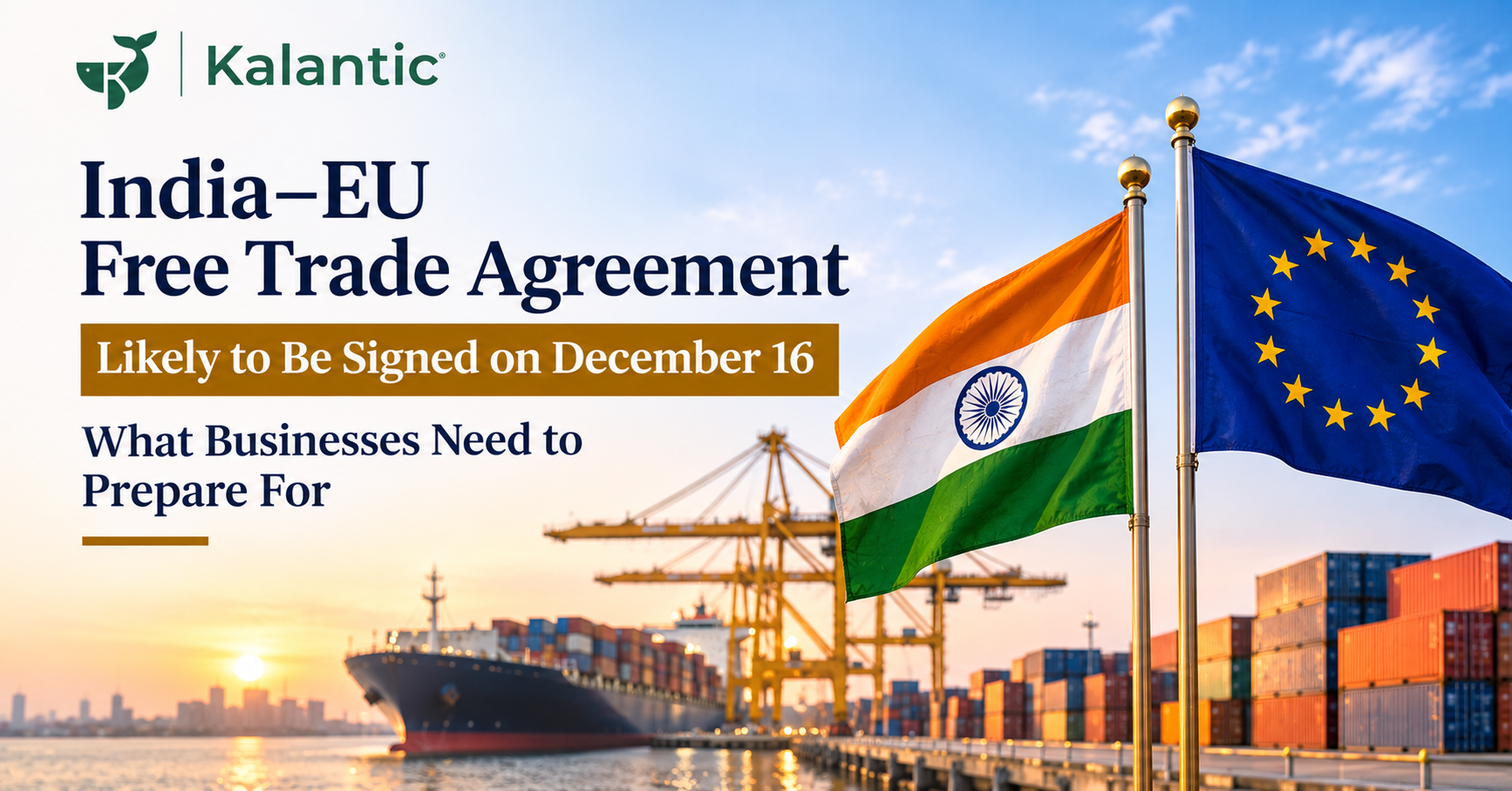
India and the European Union are likely to sign their long-pending Free Trade Agreement (FTA) on 16 December 2026, according to an official quoted by Press Trust of India.
The signing is expected to take place in Brussels during Prime Minister Narendra Modi's anticipated visit.
The negotiations were concluded on 27 January 2026, and the European Commission has already submitted proposals to the Council of the European Union seeking authorisation to sign and conclude the agreement.
The proposed agreement is expected to provide substantial tariff benefits:
- Around 93% of Indian shipments are reported to receive duty-free access to the European Union.
- The EU's official proposal provides for full liberalisation of 91.4% of imports from India by trade value, with partial liberalisation of a further 7.7%.
- India will fully liberalise 93% of its current imports from the EU by trade value, with partial liberalisation of another 3.6%.
- The agreement includes provisions covering goods, services, investment, customs procedures and technical barriers to trade.
The agreement is not yet signed or in force. It will require further approval and implementation procedures on both sides.
For businesses, however, the important question is already emerging: how should Indian and European companies position themselves to benefit from the new trading framework?
Key Takeaways
- Expected signing: 16 December 2026, subject to confirmation and completion of the required procedures.
- Market scale: India and the EU together account for approximately 25% of global GDP and around one-third of international trade, according to the reported figures.
- Indian exporters: Significant tariff reductions could improve access to European customers.
- European companies: Lower Indian import duties could make several European products more competitive in India.
- Manufacturing: The agreement could support sourcing, component procurement, technology partnerships and cross-border manufacturing.
- SMEs: Simplified and digitised customs procedures and improved market information could reduce some trade barriers.
- Business priority: Companies should start evaluating product classifications, tariff schedules, rules of origin and potential buyers.
1. A trade agreement more than two decades in the making
India and the European Union have been negotiating a comprehensive trade agreement for years.
Negotiations were relaunched in 2022 and concluded at the political level on 27 January 2026, following 14 rounds of negotiations.
The agreement is strategically important for both sides.
For India, the European Union represents a large, high-value export market with substantial demand for manufactured products, engineering goods, textiles, chemicals, pharmaceuticals and services.
For Europe, India offers a large consumer market, an expanding manufacturing ecosystem, skilled talent and opportunities to diversify commercial relationships.
The proposed FTA is intended to establish a more predictable trading environment by reducing tariffs, addressing non-tariff barriers and improving access for businesses operating in both markets.
The European Commission has described the agreement as a major step in strengthening economic relations and diversifying trade partnerships.
2. What does the agreement offer Indian exporters?
One of the most significant features is the proposed reduction or elimination of tariffs on Indian exports entering the European Union.
According to the latest reporting, around 93% of Indian shipments are expected to receive duty-free access.
The European Commission's official proposal provides a more detailed breakdown: full liberalisation of 91.4% of EU imports from India by trade value, alongside partial liberalisation of another 7.7%.
This distinction matters because tariff-line coverage and trade-value coverage are not the same measurement.
For Indian exporters, lower tariffs could improve price competitiveness in several categories.
Potentially relevant sectors include:
Textiles and apparel
Indian textile and garment manufacturers could gain improved access to European buyers, subject to the applicable product schedules and rules of origin.
Engineering goods
Manufacturers of industrial components, machinery and engineered products could benefit from improved tariff access and more predictable trading conditions.
Chemicals and pharmaceuticals
The agreement could support trade in chemical products, pharmaceutical goods and related manufacturing inputs, subject to applicable regulatory and product-specific requirements.
Leather and footwear
Indian manufacturers could become more competitive in European sourcing arrangements if the relevant tariff reductions apply to their products.
Marine products and processed foods
Exporters may find opportunities to expand their European customer base, although food safety, traceability and product certification requirements will remain important.
The practical benefit will vary by product category. Exporters should not assume that every product receives immediate duty-free treatment.
3. What European companies could gain in India
The agreement is not just an export opportunity for India.
It also creates opportunities for European manufacturers, technology companies and service providers looking at the Indian market.
The European Commission's proposal indicates substantial tariff liberalisation by India.
India will fully liberalise 93% of its current imports from the EU by trade value, with partial liberalisation covering a further 3.6%.
Potentially important categories include:
- Industrial machinery and electrical equipment.
- Chemicals and specialised industrial inputs.
- Pharmaceuticals.
- Automotive products.
- Selected food and beverage products.
- Technology and engineering solutions.
The agreement also provides for reductions in certain duties on products such as motor vehicles, where current Indian tariffs can be as high as 110%.
The automotive sector will have specific conditions and tariff arrangements, so businesses must examine the actual schedules rather than assume universal tariff elimination.
For European companies, the opportunity extends beyond selling finished products.
India could become a destination for manufacturing partnerships, component sourcing, technology collaboration and regional business development.
4. The opportunity goes beyond tariffs
A free trade agreement is often discussed primarily in terms of customs duties.
But the commercial impact can extend much further.
The India–EU agreement also addresses trade facilitation, services, investment and technical barriers.
Several areas deserve particular attention.
Customs procedures
Simplified and digitised customs processes can help reduce administrative friction and improve the predictability of cross-border shipments.
Technical standards
Greater cooperation and more compatible technical requirements can make it easier for businesses to navigate product compliance.
This does not mean that European or Indian certification requirements automatically disappear.
Services
The agreement seeks to provide a more predictable trading environment for service providers from both economies.
Small and medium-sized enterprises
A dedicated SME chapter addresses information exchange and cooperation, potentially making it easier for smaller businesses to understand opportunities and participate in cross-border trade.
For smaller companies, access to reliable information can be as important as tariff reductions.
5. A potential boost to manufacturing and sourcing partnerships
One of the most interesting implications is the possibility of deeper manufacturing cooperation.
European companies have established capabilities in advanced engineering, industrial machinery, automotive technology, chemicals and specialised manufacturing.
Indian companies offer manufacturing capacity, engineering talent, a growing industrial base and access to a large domestic market.
A more predictable trade framework could encourage businesses to examine complementary capabilities.
Consider a few possible commercial models:
| Business model | Potential opportunity |
|---|---|
| Component sourcing | European manufacturers sourcing components from Indian suppliers |
| Technology partnerships | European technology providers collaborating with Indian manufacturers |
| Contract manufacturing | Indian facilities producing goods for European customers |
| Joint ventures | Indian and European companies establishing shared manufacturing operations |
| Distribution partnerships | Indian distributors representing European manufacturers |
| Market expansion | Indian companies appointing European importers and distributors |
These are potential opportunities, not automatic outcomes of the agreement.
Each arrangement will depend on product economics, regulatory requirements, investment conditions and the commercial suitability of the partners involved.
6. What Indian exporters should do before the agreement comes into force
Businesses should not wait until the agreement is implemented to begin preparing.
There are several practical steps exporters can take now.
Step 1: Identify relevant product categories
Start with the HS codes of products currently exported or planned for export to Europe.
The Harmonized System classification determines how a product is categorised for customs purposes and is essential for identifying the applicable tariff schedule.
Step 2: Examine the tariff commitments
Identify whether the relevant product receives immediate tariff elimination or a phased reduction.
Some products may have transition periods of three, five or seven years. Others may have specific conditions or partial liberalisation.
Step 3: Understand rules of origin
A product does not automatically qualify for preferential tariff treatment merely because it is shipped from India.
It must satisfy the applicable rules of origin.
Businesses should examine sourcing arrangements, manufacturing processes and documentation requirements.
Step 4: Assess European demand
Identify which European countries and customer segments offer the best commercial prospects.
Demand, competition, distribution structures and customer expectations can vary significantly across EU member states.
Step 5: Build a buyer pipeline
Identify importers, wholesalers, distributors, manufacturers and institutional buyers.
A tariff advantage has limited commercial value without access to customers.
Step 6: Prepare compliance documentation
Review applicable product standards, labelling, testing, certification, packaging and documentation requirements.
Tariff concessions do not remove all non-tariff requirements.
7. What European companies should do before entering India
European businesses should approach the agreement as an opportunity to reassess their Indian market-entry strategy.
The first step is to identify which products and services could become more competitive following tariff reductions.
Companies should then evaluate:
- Indian importers and distributors.
- Potential manufacturing and technology partners.
- Industrial buyers and procurement teams.
- Local regulatory and certification requirements.
- Import economics and landed costs.
- After-sales service and distribution infrastructure.
- Opportunities for local production or joint ventures.
For industrial manufacturers, appointing a capable Indian distributor or commercial representative may be a practical starting point.
For technology companies, a local strategic partner may provide access to customers, technical capabilities and implementation networks.
For companies considering manufacturing in India, a more detailed assessment of sourcing, investment requirements and local operations will be necessary.
8. The challenge: Converting market access into actual business
Trade agreements create opportunities, but they do not create business relationships automatically.
An Indian manufacturer may become eligible for lower tariffs in Europe, yet still struggle to identify credible importers.
A European machinery manufacturer may benefit from reduced duties in India, but still need to identify the right industrial distributors and procurement decision-makers.
This is where market-entry execution becomes important.
Companies need answers to practical questions:
- Who are the largest importers of the relevant product?
- Which distributors already serve the target industry?
- Who are the decision-makers within procurement organisations?
- Which companies are looking for new suppliers?
- What local partnerships are required?
- How should the first commercial engagement be structured?
The answers will differ by sector and country.
A textile exporter entering Germany will need a different commercial approach from an industrial machinery company entering Poland or a pharmaceutical manufacturer exploring France.
The opportunity is not simply to access a market of hundreds of millions of consumers.
It is to identify the right commercial ecosystem within that market.
Frequently Asked Questions
When will India and the EU sign the free trade agreement?
The agreement is likely to be signed on 16 December 2026, according to an official quoted by Press Trust of India. The proposed signing is expected during Prime Minister Narendra Modi's visit to Brussels.
Has the India–EU FTA already been signed?
No. Negotiations concluded on 27 January 2026, but the agreement is still going through the required approval and signing procedures.
What percentage of Indian exports will receive duty-free access to the EU?
Recent reporting indicates that around 93% of Indian shipments will receive duty-free access. The European Commission's proposal separately specifies full liberalisation of 91.4% of imports from India by trade value, with partial liberalisation of a further 7.7%.
What will India gain from the agreement?
India is expected to gain improved access for its exporters to the European market, alongside opportunities for services trade, investment, manufacturing cooperation and more predictable trading conditions.
Will European products become cheaper in India?
Many European products are expected to benefit from tariff reductions. The extent and timing will depend on the product-specific tariff schedule and applicable transition periods.
Will the agreement eliminate all non-tariff barriers?
No. The agreement includes provisions to improve cooperation and address technical barriers, but product standards, safety regulations, certification and other compliance requirements will continue to apply.
How can Indian SMEs benefit from the India–EU FTA?
SMEs may benefit from lower tariffs, improved market information, simplified customs procedures and opportunities to participate in international supply chains. They will still need to meet rules of origin and applicable product requirements.
How can a European company find business partners in India?
European companies can identify Indian importers, distributors, manufacturers, technology partners and potential joint-venture counterparts through targeted market research and structured business development.
Final Thoughts
The proposed India–EU Free Trade Agreement represents an important development in India's international trade strategy.
For Indian exporters, it could improve access to one of the world's largest high-value consumer and industrial markets.
For European businesses, it could create a more attractive framework for selling into India, sourcing from Indian manufacturers and establishing long-term commercial partnerships.
But the agreement's real impact will not be measured only by the number of tariff lines liberalised.
It will be measured by the businesses that successfully enter new markets, establish partnerships, develop customers and build sustainable cross-border trade.
The signing may take place in December. The commercial preparation should begin much earlier.
Because market access creates the opportunity. Relationships convert it into business.
About Kalantic
Kalantic helps international businesses explore, enter and develop commercial opportunities in India.
From identifying potential distributors and business partners to facilitating strategic relationships and supporting market-level engagement, Kalantic works at the intersection of market access and commercial execution.
Because entering a new market is not just about identifying opportunities. It is about knowing whom to engage, how to build trust and how to turn relationships into business.
Whom should you know to build your business in India?
Explore more at Kalantic.
Sources
Business Standard / Press Trust of India — India-EU free trade pact likely to be signed on Dec 16 in Brussels, 22 November 2026.
https://www.business-standard.com/external-affairs-defence-security/news/india-eu-free-trade-pact-likely-to-be-signed-on-dec-16-in-brussels-126112200436_1.htmlEuropean Commission / EUR-Lex — Proposal for a Council Decision on the signing of the Free Trade Agreement between the European Union and the Republic of India, COM(2026) 483 final, 11 September 2026.
https://eur-lex.europa.eu/legal-content/EN/TXT/?uri=COM%3A2026%3A0483%3AFINBusiness Standard — India-EU FTA heads to EU Council for approval, signing likely in December, 11 September 2026.
https://www.business-standard.com/economy/news/india-eu-fta-heads-to-eu-council-for-approval-signing-likely-in-december-126091101402_1.html
Ready to Explore India?
Expanding into India requires more than market research—it requires the right customers, partners, and commercial strategy. Kalantic helps international companies validate opportunities, identify customers and channel partners, and build a sustainable business presence in India. Whether you’re evaluating India for the first time or accelerating your expansion, our team can help you make informed decisions with confidence.
Book an India Market Entry Discussion
Or email us at: info@kalantic.com