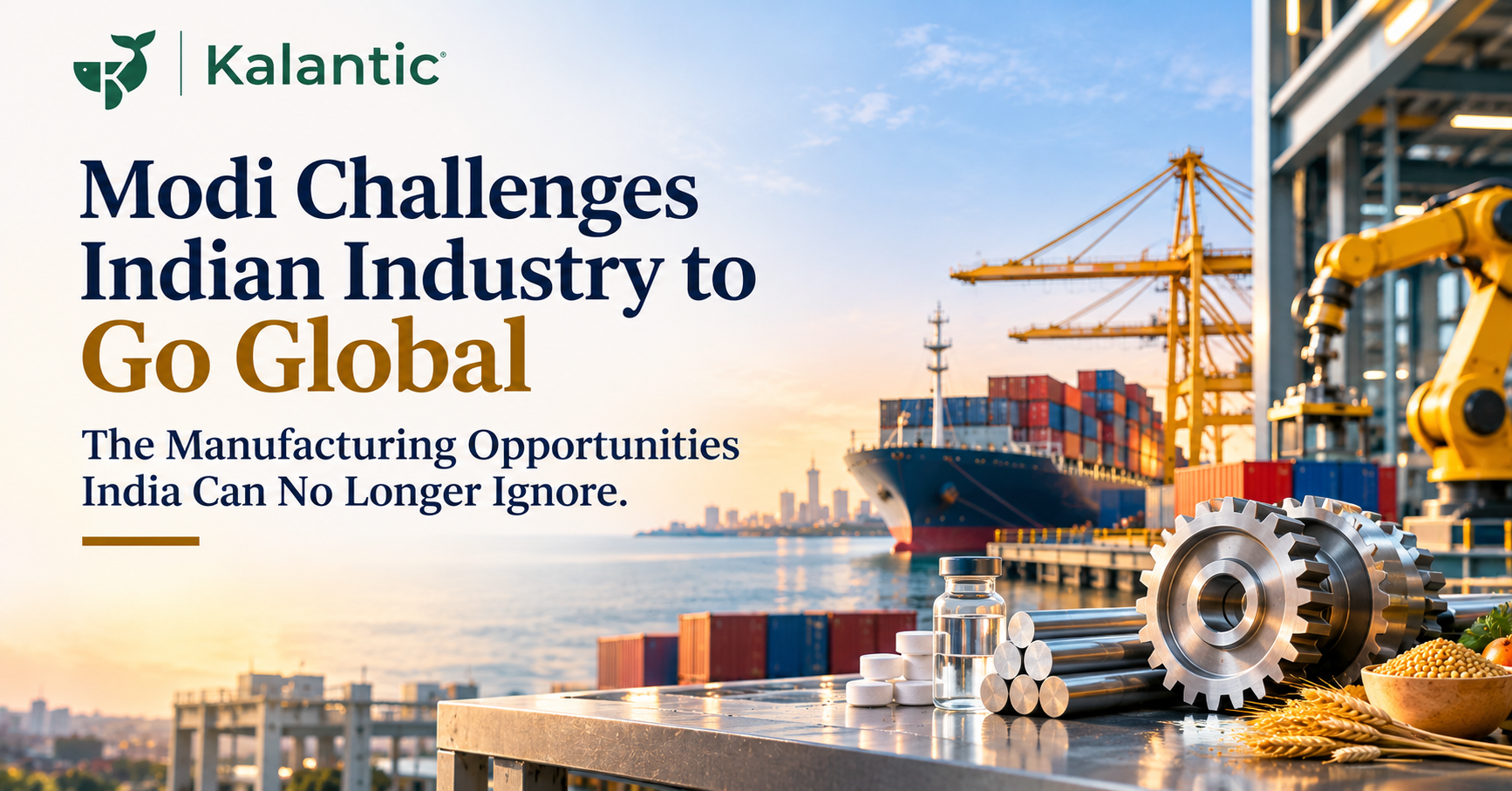
Prime Minister Narendra Modi has called on Indian businesses to stop treating the domestic market as their primary comfort zone and build the capabilities required to compete internationally.
Speaking at the Federation of Indian Chambers of Commerce and Industry's (FICCI) 100th annual meeting in New Delhi on 19 November 2026, he urged industry leaders to deepen manufacturing, increase value addition, reduce import dependence and take advantage of India's expanding network of trade agreements.
More importantly, he identified specific industrial gaps that could become significant business opportunities:
- Pharmaceutical ingredients and active pharmaceutical ingredients (APIs).
- Specialised steel and aluminium products.
- Agricultural processing and value-added food products.
- Hand tools, power tools and industrial machinery.
- Packaging equipment, irrigation systems and factory machinery.
The message is significant because it connects two objectives: building stronger domestic manufacturing capabilities and making Indian businesses more competitive in international markets.
For companies looking to expand internationally, the challenge is no longer simply increasing production. It is developing products, quality standards, procurement networks and distribution relationships that meet the requirements of global customers.
Key Takeaways
- A direct challenge to industry: Modi urged businesses not to depend exclusively on India's large domestic consumer market.
- Manufacturing gaps: Pharmaceuticals, steel, aluminium, agriculture and engineering goods were identified as areas with opportunities for greater domestic production and value addition.
- Food processing: Processed food's share of India's agri-food exports has increased from 13% to more than 20% over the past 12 years, according to the Prime Minister's remarks.
- Machinery exports: India could develop machinery for emerging economies, particularly across the Global South.
- Trade agreements: Businesses were urged to make practical use of improved market access created by India's trade agreements.
- A new business priority: Companies must invest in overseas market research, product development, quality and distribution infrastructure.
1. The message: India's domestic market should be a launchpad, not a destination
India's large domestic market has long been one of its greatest commercial advantages.
With a population of approximately 1.4 billion, businesses can build substantial scale without immediately looking overseas.
But Modi's message to industry leaders at FICCI's centenary meeting was that domestic demand should provide the confidence to compete internationally—not become a reason to avoid global competition.
He challenged companies to manufacture products according to international demand, improve quality and establish reliable supply mechanisms.
He also questioned whether businesses were adequately preparing to use the opportunities created by India's trade agreements.
The distinction is important.
A company can become successful in India without necessarily becoming globally competitive. International expansion requires a different level of product development, operational consistency, pricing discipline and customer understanding.
The next phase of Indian manufacturing will depend partly on how effectively businesses bridge that gap.
2. Pharmaceuticals: Moving beyond finished medicines
India is widely recognised for its pharmaceutical manufacturing capabilities, particularly in generic medicines.
However, a significant opportunity remains in the upstream pharmaceutical value chain.
During his speech, Modi highlighted India's continued dependence on imported active pharmaceutical ingredients, bulk drugs and drug intermediates.
He urged pharmaceutical companies to invest in technologies and production facilities that can strengthen domestic capabilities in these areas.
The commercial opportunity extends across:
- Active pharmaceutical ingredients.
- Key starting materials.
- Pharmaceutical intermediates.
- Bulk drug manufacturing.
- Advanced manufacturing technologies.
- Specialised chemical inputs.
For Indian businesses, developing these capabilities could strengthen domestic supply chains while creating opportunities to serve international pharmaceutical manufacturers.
For international companies, India could become an increasingly important manufacturing, sourcing and technology partnership destination.
The opportunity, however, requires investment in quality systems, regulatory compliance, technical capabilities and reliable production at scale.
3. Steel and aluminium: The opportunity lies in value addition
Another important theme was the gap between India's resource base and its industrial output.
Modi pointed to the contrast between exporting iron ore while importing finished steel products, and possessing substantial bauxite resources while depending on imports of specialised aluminium alloys and other products.
His argument was that India needs to move further up the value chain.
This has implications for several segments:
Specialised steel
Manufacturers could develop capabilities in grades and applications where domestic demand is currently served by imports.
Aluminium alloys
There are opportunities in specialised alloys and higher-value products used in automotive, aerospace, engineering and industrial applications.
Metal processing
Additional capabilities in processing, finishing and precision engineering can help Indian manufacturers supply more sophisticated industrial customers.
Downstream manufacturing
The opportunity extends to components, fabricated products and engineered solutions rather than remaining limited to raw materials.
The important commercial question is whether manufacturers can develop products that meet the technical specifications and quality requirements of international buyers.
4. Food processing: Turning agricultural strength into export value
Agriculture was another major area highlighted during the address.
Modi observed that India's share of global agricultural exports remains around 2–2.5%, despite the country's size and agricultural production base.
He also pointed to the increase in processed food's share of India's agri-food exports, from 13% to more than 20% over the past 12 years.
The message was clear: greater value addition can create more opportunities than exporting agricultural commodities alone.
Potential areas include:
- Processed fruits and vegetables.
- Ready-to-eat and ready-to-cook products.
- Frozen foods.
- Food ingredients.
- Packaged agricultural products.
- Processing and packaging technologies.
However, food exports are particularly dependent on the requirements of individual destination markets.
Product standards, food safety certification, traceability, packaging, shelf life and cold-chain infrastructure can all influence commercial viability.
Modi also emphasised the importance of dependable procurement networks and products designed for the requirements of overseas customers.
This is a particularly important point for Indian food businesses: export success begins well before the product reaches the port.
5. Machinery: An opportunity in the Global South
One of the more interesting areas of the speech was the potential for India to develop machinery for other developing economies.
Modi identified hand tools, power tools and machinery as segments with significant export potential.
He also referred to opportunities in:
- Packaging equipment.
- Irrigation systems.
- Factory-related machinery.
- Industrial tools.
- Equipment suited to the requirements of developing markets.
This presents a different kind of export opportunity.
Rather than competing exclusively in highly sophisticated machinery segments dominated by established industrial economies, Indian manufacturers could develop cost-effective equipment suited to the needs of emerging markets.
Many developing economies are expanding their manufacturing, agricultural processing and infrastructure capabilities.
They require machinery that is reliable, maintainable, affordable and suited to local operating conditions.
Indian manufacturers could compete in these segments by combining engineering capabilities with a strong understanding of customer requirements.
Large Indian companies also have a potential role in helping smaller manufacturers improve quality, scale and technical capabilities so they can participate in international supply chains.
6. Trade agreements are opening doors—but are businesses prepared?
India has expanded its network of trade agreements with major trading partners.
These agreements can improve market access, reduce certain tariff barriers and create new opportunities for exporters.
But an agreement does not automatically produce customers.
A manufacturer looking to enter a new market still needs to understand:
- Which products are in demand?
- Who are the major importers and buyers?
- What are the applicable tariffs and rules of origin?
- Which certifications and technical standards apply?
- How is the product distributed?
- What price can the market support?
- Which local partners can help establish commercial access?
Modi questioned whether Indian industry had developed sufficiently detailed plans to take advantage of the market-access opportunities created by these agreements.
This is arguably one of the most important business development challenges facing Indian exporters.
The opportunity may exist on paper, but companies need the market intelligence and relationships to convert it into orders.
7. The international business development gap
For a company planning to expand internationally, manufacturing capacity is only one part of the equation.
Consider an Indian machinery manufacturer looking to enter a new market.
It may have a competitive product, sufficient production capacity and the required technical specifications.
But it still needs to identify:
| Requirement | Potential business connection |
|---|---|
| Market access | Importers and distributors |
| Direct sales | Industrial buyers and procurement teams |
| Local presence | Sales representatives and commercial agents |
| Technical support | Service and maintenance partners |
| Product localisation | Engineering and technology partners |
| Regional expansion | Strategic investors and joint-venture partners |
The same applies to pharmaceutical manufacturers, food processors, engineering companies and component suppliers.
Export development is not simply about finding a country with demand.
It requires understanding how that market operates and identifying the organisations capable of connecting a manufacturer with actual commercial opportunities.
This is where many otherwise capable businesses struggle.
They know what they can manufacture, but may not know which international buyers to approach, which distributors are credible or which partnerships could accelerate market entry.
8. What this means for international companies looking at India
The message also has implications for foreign businesses.
As India seeks to strengthen domestic production and reduce dependence on imported industrial inputs, international companies may find opportunities to participate in this transition.
Potential routes include:
Technology partnerships: Supplying specialised technologies, manufacturing processes and technical know-how.
Joint ventures: Collaborating with Indian companies to establish local manufacturing capabilities.
Component sourcing: Identifying Indian manufacturers capable of supplying industrial inputs and components.
Local manufacturing: Evaluating India as a production base for domestic and international markets.
Distribution partnerships: Building relationships with Indian importers, dealers and institutional buyers.
For international companies, the opportunity is not limited to selling into India. It can also involve becoming part of India's evolving manufacturing ecosystem.
The right entry strategy will depend on the sector, regulatory environment, investment requirements and commercial objectives.
Frequently Asked Questions
What did Narendra Modi ask Indian businesses to do on 19 November 2026?
At FICCI's 100th annual meeting, Modi urged businesses to move beyond dependence on the domestic market, strengthen manufacturing, increase value addition and compete more actively in international markets.
Which manufacturing sectors did Modi identify as opportunities?
He highlighted pharmaceuticals, steel, aluminium, agriculture, food processing, engineering goods, hand tools, power tools and machinery.
Why did Modi highlight pharmaceutical ingredients?
India has established capabilities in finished medicines but continues to import significant quantities of APIs, bulk drugs and pharmaceutical intermediates. Building domestic production capabilities in these areas could reduce import dependence and strengthen the pharmaceutical value chain.
What is the opportunity in food processing?
India can increase the value of agricultural exports by developing processed products, improving procurement networks and manufacturing according to the requirements of overseas customers.
Why is machinery manufacturing important for Indian exports?
Developing economies require affordable and reliable machinery for manufacturing, agriculture, packaging and industrial operations. Indian manufacturers could develop products suited to these markets.
How can Indian companies benefit from trade agreements?
Trade agreements can improve access to foreign markets, subject to their specific provisions. Businesses must still understand tariffs, rules of origin, certification, buyer requirements and distribution networks.
How can international companies participate in India's manufacturing growth?
They can explore technology partnerships, joint ventures, local manufacturing, component sourcing and distribution partnerships with Indian businesses.
Final Thoughts
Modi's message to Indian industry is ultimately a challenge to move from domestic scale to global competitiveness.
India has manufacturing capacity, engineering talent, agricultural resources and a large network of industrial enterprises.
But these advantages do not automatically translate into international market share.
The next stage requires deeper value addition, better product development, internationally competitive quality and a much stronger understanding of overseas customers.
For Indian manufacturers, the question is no longer simply how much they can produce.
It is whether they can produce what the world wants, meet the standards it expects and build the relationships required to sell it.
For international companies, this transition creates an opportunity to identify Indian manufacturers, technology providers and strategic partners before these capabilities become more widely established.
Global expansion is not just a manufacturing decision. It is a relationship-building exercise.
About Kalantic
Kalantic helps international businesses explore, enter and develop commercial opportunities in India.
From identifying potential distributors and business partners to facilitating strategic relationships and supporting market-level engagement, Kalantic works at the intersection of market access and commercial execution.
Because entering a new market is not just about identifying opportunities. It is about knowing whom to engage, how to build trust and how to turn relationships into business.
Whom should you know to build your business in India?
Explore more at Kalantic.
Sources
Reuters — Modi pushes Indian industry to expand globally, take advantage of policy measures, 19 November 2026.
https://www.reuters.com/world/india/modi-pushes-indian-industry-expand-globally-take-advantage-policy-measures-2026-11-19/The Week / Press Trust of India — Modi urges Indian Inc to shed domestic-market comfort, step up manufacturing and exports, 19 November 2026.
https://www.theweek.in/wire-updates/business/2026/11/19/modi-urges-indian-inc-to-shed-domestic-market-comfort-step-up-manufacturing-and-exports.html
Ready to Explore India?
Expanding into India requires more than market research—it requires the right customers, partners, and commercial strategy. Kalantic helps international companies validate opportunities, identify customers and channel partners, and build a sustainable business presence in India. Whether you’re evaluating India for the first time or accelerating your expansion, our team can help you make informed decisions with confidence.
Book an India Market Entry Discussion
Or email us at: info@kalantic.com