
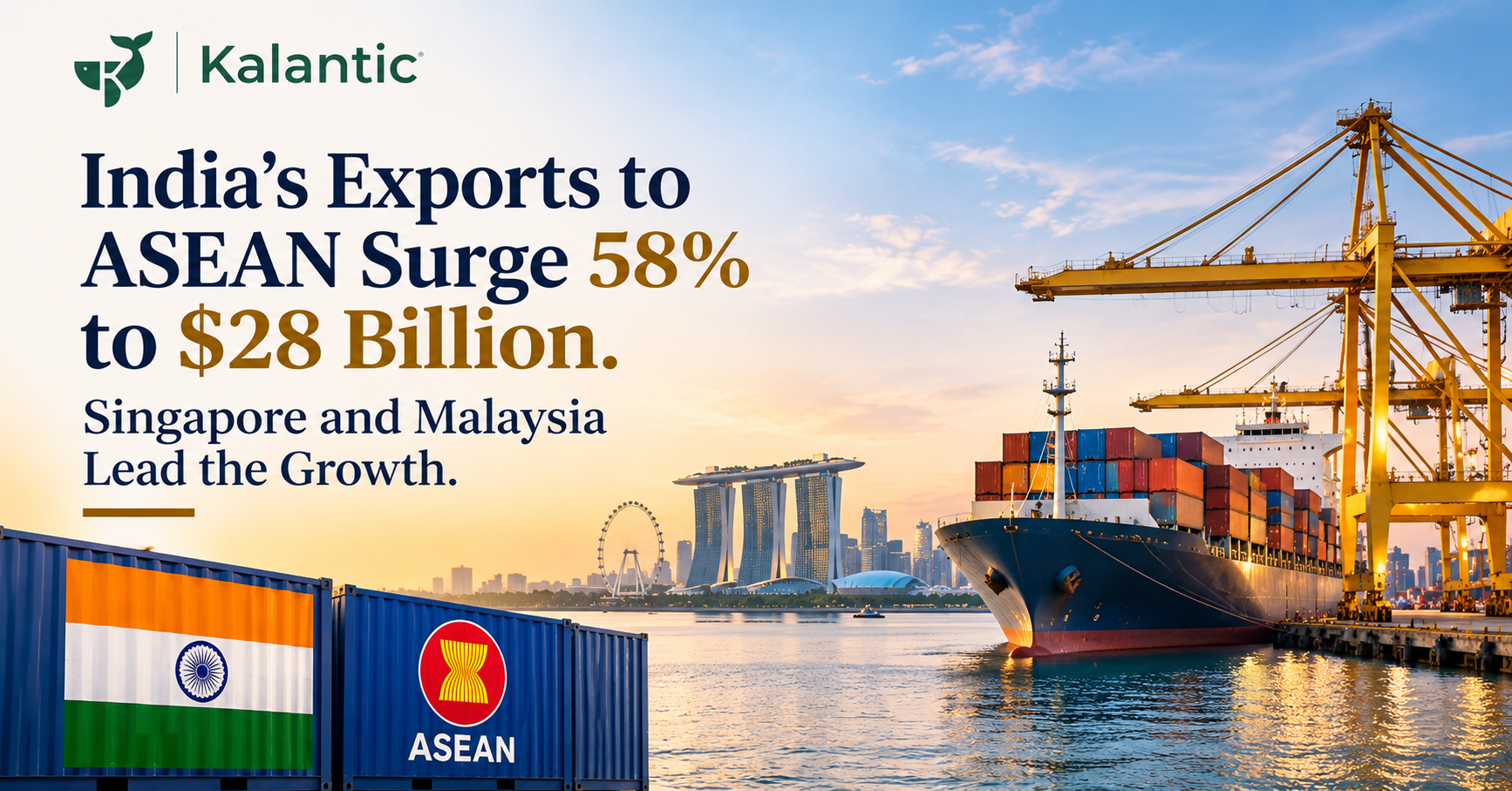
India's exports to the Association of Southeast Asian Nations (ASEAN) increased by 58% to US$28.06 billion during April–September FY2026–27, compared with US$17.75 billion in the corresponding period a year earlier.
The growth was particularly strong in Singapore and Malaysia:
- Singapore: Exports increased 103% to US$11.07 billion.
- Malaysia: Exports increased 83% to US$5.58 billion.
- Vietnam: Exports increased 36% to US$3.83 billion.
- Indonesia: Exports increased 36% to US$2.98 billion.
The figures were published by India's Ministry of Commerce and Industry on 18 November 2026.
The development highlights the growing importance of Southeast Asia in India's export strategy. For Indian manufacturers and exporters, it also raises a practical question: which regional markets should they prioritise, and how can they build the right commercial relationships to enter them?
Key Takeaways
- India's exports to ASEAN reached US$28.06 billion in April–September FY2026–27, up 58% year-on-year.
- Singapore became a particularly strong destination, with exports more than doubling to US$11.07 billion.
- Malaysia recorded 83% growth, reaching US$5.58 billion.
- Exports to Vietnam and Indonesia each grew 36%.
- India's exports to SAFTA partners increased 22%, while exports to the European Union rose 5%.
- The figures indicate a geographically broadening export footprint, although individual companies still need to assess product-level demand, competition and market-entry requirements.
1. India's export growth is increasingly visible across Southeast Asia
India's export performance is attracting attention for more than its aggregate value.
The geographical distribution of growth is becoming an important part of the story.
According to the Ministry of Commerce and Industry, exports to ASEAN increased from US$17.75 billion in April–September FY2025–26 to US$28.06 billion in the corresponding period of FY2026–27.
That represents a 58% increase.
The growth was not concentrated in just one destination. Several important Southeast Asian markets recorded substantial increases.
| Export destination | April–September FY2026–27 exports | Year-on-year growth |
|---|---|---|
| Singapore | US$11.07 billion | 103% |
| Malaysia | US$5.58 billion | 83% |
| Vietnam | US$3.83 billion | 36% |
| Indonesia | US$2.98 billion | 36% |
| Thailand | US$2.65 billion | Not specified in the release |
Singapore and Malaysia together accounted for a substantial share of India's exports to the region.
For Indian exporters, these markets deserve closer attention when evaluating Southeast Asian expansion.
2. Why Singapore's 103% growth matters
Singapore's position in India's export landscape is particularly interesting.
Exports from India to Singapore more than doubled, rising from US$5.45 billion to US$11.07 billion during the reported period.
Singapore is not simply a consumer market. It is also an important regional business, financial, logistics and distribution centre.
For companies looking at Southeast Asia, Singapore can serve several commercial functions:
Regional distribution
Businesses may use Singapore as a base for managing regional customers, distributors and commercial relationships.
Trade and logistics
Its established port and logistics infrastructure make it an important node in international trade.
Financial and business services
Companies expanding internationally may find opportunities to engage regional financial institutions, professional services firms and business networks.
Regional headquarters
Some businesses use Singapore as a coordination point for operations across multiple Southeast Asian markets.
However, using Singapore as a regional base is a business strategy, not an automatic consequence of export growth. Companies must evaluate the economics, customer base and operating requirements of each market.
3. Malaysia is emerging as another important destination
India's exports to Malaysia increased 83%, reaching US$5.58 billion.
The scale of this growth makes Malaysia an important market to examine alongside Singapore.
Malaysia offers Indian businesses opportunities across manufacturing, industrial supply chains, electronics, chemicals, food products and other commercial segments.
For exporters, the opportunity may lie in identifying:
- Malaysian importers and distributors.
- Industrial buyers and procurement teams.
- Local manufacturing partners.
- Sector-specific trading companies.
- Businesses seeking alternative suppliers.
- Potential joint-venture partners.
The right route to market will depend on the product, regulatory requirements, local competition and the nature of the buyer.
An exporter of industrial components, for instance, may require a very different market-entry strategy from a food-processing company or a consumer-products brand.
4. The growth extends beyond two markets
The broader ASEAN figures also reveal growth in Vietnam and Indonesia.
Exports to Vietnam increased 36% to US$3.83 billion, while exports to Indonesia grew 36% to US$2.98 billion.
Thailand recorded exports worth US$2.65 billion.
These markets should not be treated as interchangeable.
Each has its own industrial structure, import requirements, distribution networks, business practices and competitive landscape.
For Indian companies, this means Southeast Asia should not be approached as one homogeneous market.
A successful regional strategy requires country-specific research and a clear understanding of where the product has a genuine commercial advantage.
5. India's export diversification extends beyond ASEAN
The Ministry's update also highlights growth across other trading regions.
| Region or market | April–September FY2026–27 exports | Growth |
|---|---|---|
| ASEAN | US$28.06 billion | 58% |
| SAFTA partners | US$15.29 billion | 22% |
| European Union | US$38.79 billion | 5% |
| European Free Trade Association | US$1.03 billion | Approximately 5% |
Several individual markets recorded notable increases:
- Sri Lanka: Exports increased 73% to US$3.94 billion.
- Japan: Exports increased 40% to US$4.10 billion.
- South Korea: Exports increased 24% to US$3.91 billion.
- Oman: Exports increased 47% to US$3.29 billion.
- Spain: Exports increased 45% to US$4.68 billion.
- Italy: Exports increased 25% to US$4.55 billion.
- Germany: Exports increased 12% to US$6.34 billion.
The figures suggest that India's export expansion is not restricted to one geography.
Southeast Asia is an important growth contributor, but South Asia, East Asia, the Gulf and Europe also offer meaningful opportunities.
6. What does this mean for Indian exporters?
Export growth at the national level does not automatically translate into new business for every Indian company.
The opportunity becomes meaningful only when an exporter identifies a market where its products are competitive and where there is an accessible buyer base.
For Indian businesses considering Southeast Asia, five areas deserve attention.
A. Reassess target markets
Companies that traditionally focus on the United States, Europe or the Middle East may want to evaluate Singapore, Malaysia, Vietnam and Indonesia as additional destinations.
This does not mean shifting away from established markets. It means examining whether regional diversification can improve long-term resilience.
B. Identify the right buyers
A company needs to distinguish between importers, distributors, wholesalers, retailers, manufacturers and institutional buyers.
The correct target depends on the product and its route to market.
C. Understand local competition
Strong national export growth does not necessarily mean that every product category is growing at the same rate.
Exporters should evaluate product-level import data, competing suppliers, price points and customer requirements before investing in market entry.
D. Build local relationships
A distributor may provide access to a customer network. An industrial partner may help with localisation. A local representative may improve market intelligence and facilitate commercial engagement.
The quality of these relationships can materially influence the success of an overseas expansion strategy.
E. Evaluate the complete cost of market entry
Freight, duties, certification, local compliance, distribution margins, payment terms and after-sales support all affect commercial viability.
An attractive export destination is not necessarily a profitable one for every business.
7. The role of trade agreements and regional connectivity
India's trade relationship with ASEAN is supported by the India–ASEAN economic cooperation framework, including the ASEAN–India Trade in Goods Agreement.
Such arrangements can influence tariff treatment and market access, subject to product classification, rules of origin and applicable conditions.
But an agreement does not remove every barrier to trade.
Exporters still need to understand:
- Applicable customs duties.
- Rules of origin.
- Product-specific standards.
- Import licensing requirements.
- Labelling and certification.
- Local tax and distribution arrangements.
Businesses should also monitor developments in regional trade and connectivity, particularly as supply chains become increasingly interconnected across Asia.
Trade agreements can create an enabling environment. Commercial execution remains the responsibility of individual businesses.
8. From export statistics to actual business opportunities
The most useful insight from the latest export figures may be the number of potential commercial relationships they point towards.
Consider the ecosystem surrounding a single Indian exporter entering Malaysia.
It may need to identify:
| Business requirement | Potential partner |
|---|---|
| Market access | Local distributor or importer |
| Industrial customers | Manufacturers and procurement teams |
| Warehousing | Logistics and fulfilment providers |
| Regulatory compliance | Local consultants and certification agencies |
| Sales development | Commercial representatives |
| Strategic expansion | Joint-venture or investment partners |
The same process applies to Singapore, Vietnam and Indonesia, although the relevant partners and operating models will differ.
This is why international business development cannot be reduced to collecting a list of companies.
Businesses need to identify relevant organisations, understand their commercial role, reach the right decision-makers and build relationships that can produce measurable outcomes.
For many Indian MSMEs and mid-sized manufacturers, this can be the difference between exporting occasionally and developing a repeatable international sales channel.
Frequently Asked Questions
How much did India's exports to ASEAN grow in FY2026–27?
India's exports to ASEAN increased 58% to US$28.06 billion during April–September FY2026–27, compared with US$17.75 billion in the corresponding period of FY2025–26.
Which ASEAN country recorded the highest growth in Indian exports?
Singapore recorded the highest growth among the ASEAN destinations highlighted in the Ministry's release. India's exports to Singapore increased 103% to US$11.07 billion.
How much did India's exports to Malaysia increase?
Exports to Malaysia increased 83%, reaching US$5.58 billion during April–September FY2026–27.
Are Indian exports also growing in Europe?
Yes. India's exports to the European Union increased 5% to US$38.79 billion during the reported period. Spain recorded 45% growth, while Italy recorded 25%.
Which other Asian markets recorded strong growth?
Exports to Japan increased 40% to US$4.10 billion, while exports to South Korea increased 24% to US$3.91 billion. Exports to Sri Lanka rose 73% to US$3.94 billion.
Does export growth mean every Indian exporter should enter ASEAN?
No. Aggregate export growth does not guarantee demand for every product. Companies should assess product-level demand, competition, import requirements, distribution costs and local buyer networks before entering a market.
How can an Indian company find buyers in Southeast Asia?
Companies can use trade data, industry associations, trade fairs, local distributors, commercial networks and targeted business development to identify potential buyers. The next step is to qualify those prospects and establish direct relationships with relevant decision-makers.
Final Thoughts
India's 58% export growth to ASEAN is an important signal.
Singapore and Malaysia are particularly strong destinations, while Vietnam and Indonesia are also contributing to the region's momentum.
But the bigger story is geographical diversification.
Indian companies have opportunities to build commercial relationships across multiple markets rather than relying exclusively on a small number of established destinations.
For exporters, the next step is not simply to identify which country is growing fastest.
It is to determine where their products fit, which buyers are relevant, what local partnerships are required and whether the economics support sustainable business.
National export figures tell us where trade is growing.
Business development determines who captures the opportunity.
About Kalantic
Kalantic helps international businesses explore, enter and develop commercial opportunities in India.
From identifying potential distributors and business partners to facilitating strategic relationships and supporting market-level engagement, Kalantic works at the intersection of market access and commercial execution.
Because entering a new market is not just about identifying opportunities. It is about knowing whom to engage, how to build trust and how to turn relationships into business.
Whom should you know to build your business in India?
Explore more at Kalantic.
Sources
Press Information Bureau, Government of India — From ASEAN to Europe: India's Exports Gain Momentum Across FTA Partners and Beyond, 18 November 2026.
https://static.pib.gov.in/WriteReadData/specificdocs/documents/2026/nov/doc_10521_20261118_15540801.pdfMinistry of Commerce and Industry, Government of India — Trade and export information.
https://www.commerce.gov.in/
Ready to Explore India?
Expanding into India requires more than market research—it requires the right customers, partners, and commercial strategy. Kalantic helps international companies validate opportunities, identify customers and channel partners, and build a sustainable business presence in India. Whether you’re evaluating India for the first time or accelerating your expansion, our team can help you make informed decisions with confidence.
Book an India Market Entry Discussion
Or email us at: info@kalantic.com