India is increasingly positioning itself as a destination for the physical infrastructure required to power the global artificial intelligence economy.
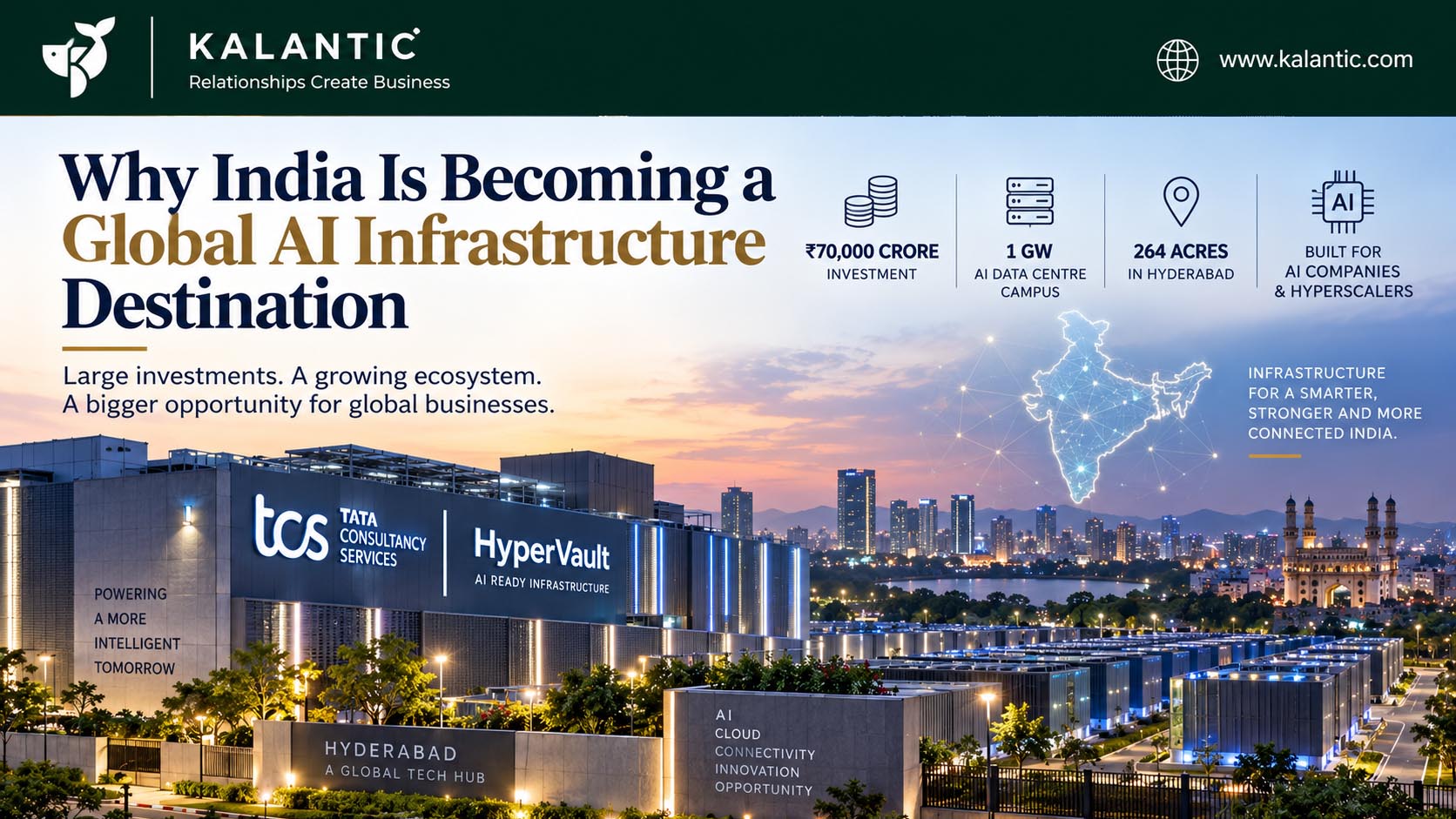
The latest signal comes from Tata Consultancy Services and its data-centre subsidiary HyperVault, which plan to develop a 1-gigawatt AI data-centre campus in Hyderabad with investment of up to ₹70,000 crore.
The project is planned across 264 acres and will be developed in phases, with the infrastructure designed for high-density GPU deployments supporting AI training, inference and advanced computing workloads.
For international companies, the significance goes beyond the size of the investment.
India is beginning to position itself not only as a market for AI products and services, but also as a place where the infrastructure behind the global AI economy can be built.
Key Takeaways
- TCS's HyperVault plans to develop a 1 GW AI data-centre campus in Hyderabad.
- Investment in the project could reach ₹70,000 crore.
- The campus will be developed in phases according to customer demand and technology requirements.
- The infrastructure is designed for AI companies, hyperscalers and high-density GPU workloads.
- Hyderabad is increasingly positioning itself as an AI and technology infrastructure hub.
- The opportunity extends beyond data-centre operators to power, cooling, networking, engineering, cybersecurity and other technology providers.
- International companies may increasingly view India as both an AI market and an AI infrastructure base.
Main Article
The AI Race Is Becoming an Infrastructure Race
The artificial intelligence conversation has largely focused on models.
Who has the best model?
Who has the most capable AI?
Who has the largest number of users?
But underneath every AI model is something much less glamorous and considerably more physical.
Computing infrastructure.
AI requires enormous amounts of computing power, specialised chips, data storage, networking, electricity and cooling.
As AI adoption accelerates, the availability of this infrastructure is becoming a strategic issue.
That is why TCS's latest move in Hyderabad matters.
The company is planning one of India's largest AI infrastructure projects, with a potential capacity of 1 GW.
₹70,000 Crore Is More Than a Data-Centre Investment
At up to ₹70,000 crore, the proposed investment is substantial.
But the more important point is what the investment represents.
India is attempting to move further up the technology value chain.
For decades, India's technology story was strongly associated with software services and engineering talent.
That remains important.
But the next opportunity could involve something much more fundamental:
Building the infrastructure on which the world's digital and AI economy runs.
This includes data centres, cloud infrastructure, high-performance computing, networking, power systems, cooling systems and specialised engineering.
That creates an entirely different category of opportunity for international businesses.
Why Hyderabad?
Hyderabad already has one of India's strongest technology ecosystems.
It has a large pool of technology talent, established global technology companies, research institutions, infrastructure providers and a growing data-centre ecosystem.
TCS itself has described Hyderabad as offering the scale, talent and ecosystem required to serve global customers.
The proposed HyperVault campus builds on that existing foundation.
This is important because technology infrastructure does not develop in isolation.
A large AI data centre needs an ecosystem around it.
It needs:
- Reliable power
- Renewable energy
- High-capacity connectivity
- Fibre networks
- Cooling technology
- Construction and engineering
- Cybersecurity
- Hardware maintenance
- Cloud infrastructure
- Skilled technical talent
- Enterprise customers
The economic opportunity therefore extends far beyond the company operating the data centre.
India Could Become Part of the Global AI Infrastructure Map
The world's largest AI companies are investing heavily in computing infrastructure.
The United States remains the dominant centre of this activity, but demand is increasingly global.
India has several characteristics that make it interesting.
It has a large technology workforce.
It has a rapidly digitising economy.
It has growing domestic AI demand.
It has a large enterprise technology sector.
And it has increasingly ambitious plans around digital infrastructure.
TCS's HyperVault project is therefore part of a broader shift.
India is not simply consuming AI.
It is building capacity to produce and support it.
The Opportunity for International Companies
This is where the story becomes particularly relevant for companies outside India.
A company does not necessarily need to build a ₹70,000 crore data centre to participate in India's AI infrastructure opportunity.
There are hundreds of businesses that can become part of the surrounding ecosystem.
Consider companies specialising in:
- Data-centre cooling
- Power management
- Renewable energy
- Backup power
- Fibre connectivity
- Networking equipment
- Semiconductor infrastructure
- Physical security
- Cybersecurity
- Data-centre construction
- AI hardware
- Cloud services
- Engineering
- Monitoring and maintenance
For many of these businesses, India could become an important growth market.
And some may eventually find India useful as a regional or global delivery base.
The Market Entry Question Is Changing
For an international technology company, the traditional India question might have been:
“Can we sell our product here?”
That question is still relevant.
But the AI infrastructure opportunity introduces another one:
“Can we become part of the ecosystem being built here?”
That could mean becoming a supplier.
A technology partner.
An engineering provider.
A systems integrator.
A customer.
A joint-venture partner.
Or eventually, an investor.
This is a much broader way of thinking about market entry.
Local Relationships Become Even More Important
Large infrastructure projects involve complex networks of stakeholders.
Government agencies.
Infrastructure developers.
Technology companies.
Energy providers.
Telecom operators.
Construction companies.
Financial institutions.
Global technology companies.
Local enterprises.
International suppliers.
For a foreign company trying to enter this ecosystem, knowing the market is only the beginning.
Knowing the right people can be equally important.
The question becomes:
Who already has access to the ecosystem?
Who understands the decision-makers?
Who knows the local suppliers?
Who can make the introduction?
Who can help navigate the market?
These relationships can significantly reduce the distance between having an opportunity and actually accessing it.
India's AI Opportunity May Be Bigger Than AI Software
One of the biggest mistakes businesses can make is treating AI as a software-only opportunity.
The AI economy requires physical infrastructure.
And physical infrastructure creates second-order opportunities.
A new data centre can create demand for power infrastructure.
Power infrastructure can create demand for engineering companies.
AI computing can create demand for networking.
Growing data volumes can create demand for cybersecurity.
More computing capacity can create demand for specialised cooling.
More AI adoption can create demand for implementation and integration services.
The ecosystem compounds.
That is what makes India's emerging AI infrastructure story particularly interesting.
From IT Services to AI Infrastructure
The move is also strategically significant for TCS.
TCS has historically been one of India's best-known IT services companies.
Its expansion into AI infrastructure suggests that the boundaries of the technology-services industry are changing.
AI is creating opportunities across the entire stack.
From chips to data centres.
From infrastructure to models.
From models to applications.
From applications to enterprise implementation.
Companies that can participate across multiple layers of this ecosystem may have an increasingly important role to play.
The Bigger Message for Global Businesses
India's technology opportunity is evolving.
It is no longer simply about having access to a large pool of engineers.
It is increasingly about participating in a technology ecosystem that includes infrastructure, capital, talent, customers and global technology companies.
That makes the market more interesting for international businesses.
A company that enters India today looking only for customers may eventually discover opportunities as a technology partner, supplier, investor or ecosystem participant.
The opportunity is becoming broader.
And the companies that understand the ecosystem early may have an advantage.
Frequently Asked Questions
What is TCS planning to build in Hyderabad?
TCS's HyperVault subsidiary is planning a large-scale AI data-centre campus with capacity of up to 1 GW.
How much is TCS investing?
HyperVault and its partners plan to invest up to ₹70,000 crore in developing the campus.
Why is the project important for India?
It strengthens India's position as a location for AI computing infrastructure and could attract additional technology, infrastructure and investment activity around the AI ecosystem.
Why was Hyderabad selected?
Hyderabad already has a strong technology ecosystem, skilled workforce and infrastructure base, making it suitable for large-scale technology infrastructure.
What opportunities could this create for international companies?
Opportunities can emerge across data-centre technology, power, renewable energy, cooling, networking, cybersecurity, engineering, construction, cloud services and AI infrastructure.
Does this mean India is becoming an AI hub?
The investment is one important signal of that direction. India's growing AI infrastructure, talent base, enterprise technology market and global partnerships are increasingly positioning the country as a significant part of the global AI ecosystem.
Final Thoughts
The most important part of TCS's ₹70,000 crore announcement is not the number.
It is the direction.
India is moving from being primarily a consumer and service provider in the global technology economy toward becoming a place where critical technology infrastructure is built.
That creates a much larger opportunity for international companies.
The question is no longer simply:
“Who will buy from us in India?”
It is:
𝗪𝗵𝗲𝗿𝗲 𝗱𝗼 𝘄𝗲 𝗳𝗶𝘁 𝗶𝗻𝘁𝗼 𝗜𝗻𝗱𝗶𝗮’𝘀 𝗴𝗿𝗼𝘄𝗶𝗻𝗴 𝘁𝗲𝗰𝗵𝗻𝗼𝗹𝗼𝗴𝘆 𝗲𝗰𝗼𝘀𝘆𝘀𝘁𝗲𝗺?
And perhaps even more importantly:
𝗪𝗵𝗼 𝘀𝗵𝗼𝘂𝗹𝗱 𝘄𝗲 𝗸𝗻𝗼𝘄?
About Kalantic
Kalantic helps international companies build customers, partners and business in India.
From market intelligence and customer acquisition to partner development and ongoing business relationships, Kalantic helps companies navigate the human and commercial side of entering and growing in India.
Because markets are built through conversations, relationships and persistence.
Sources
- Reuters — TCS/HyperVault's planned ₹70,000 crore AI data-centre campus
- Financial Express — Details of the Hyderabad AI infrastructure project
- Times of India — HyperVault's 1 GW Hyderabad campus
- TCS — HyperVault and OpenAI AI infrastructure partnership
Ready to Explore India?
Expanding into India requires more than market research—it requires the right customers, partners, and commercial strategy. Kalantic helps international companies validate opportunities, identify customers and channel partners, and build a sustainable business presence in India. Whether you’re evaluating India for the first time or accelerating your expansion, our team can help you make informed decisions with confidence.
Book an India Market Entry Discussion
Or email us at: info@kalantic.com