
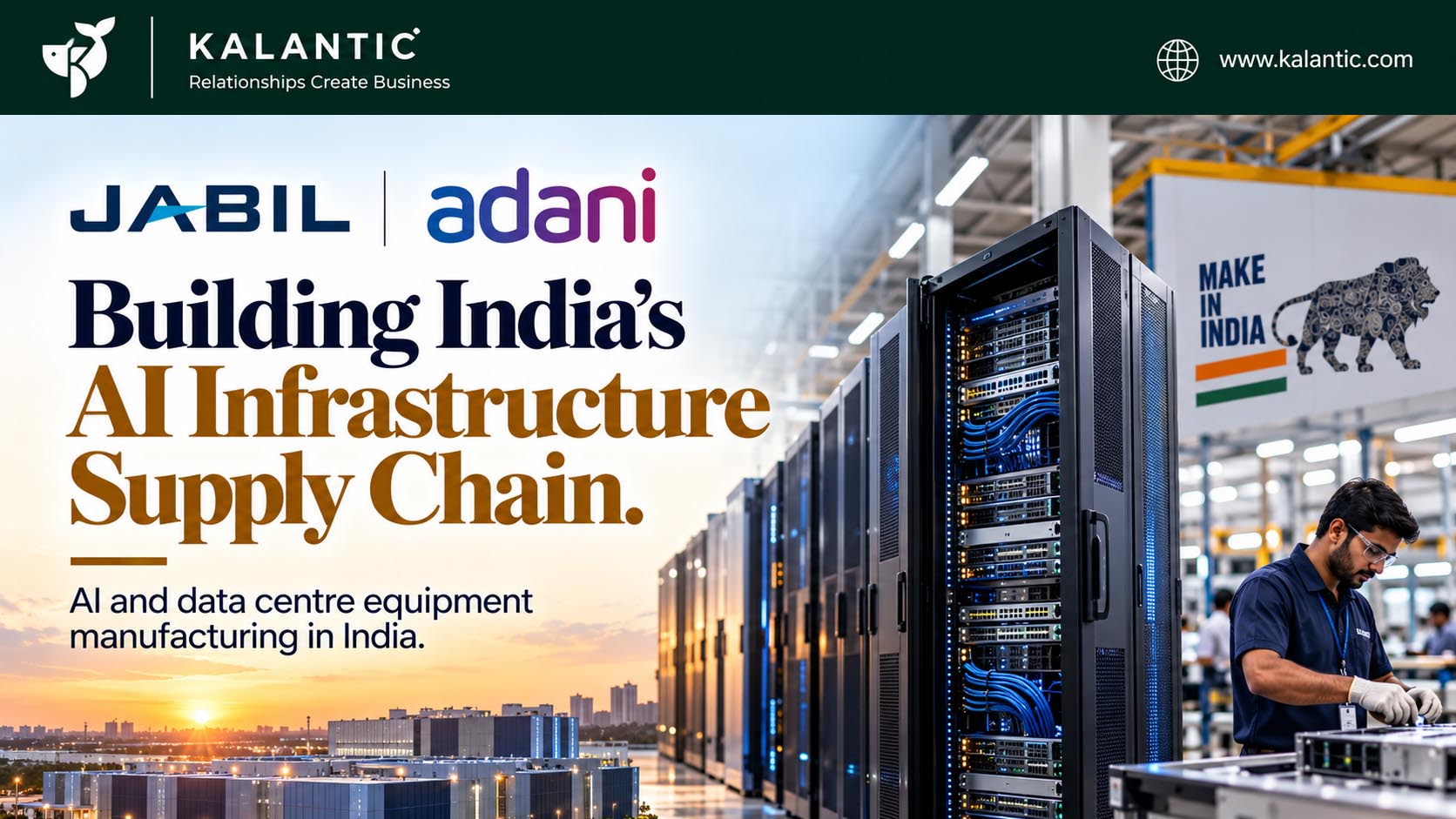
Jabil and Adani Enterprises have signed a non-binding agreement outlining a proposed 50:50 joint venture to manufacture AI and data-centre equipment in India.
The proposed venture would cover AI racks, servers, storage and networking equipment, alongside supporting infrastructure such as power-distribution units, liquid-cooling systems and transformers. The companies have described a potential manufacturing platform with multi-gigawatt AI-rack capacity.
The development matters because it could expand India's role in the AI infrastructure value chain beyond building and operating data centres to manufacturing the equipment used inside them.
For international technology companies, component suppliers and industrial businesses, this creates a reason to examine where their capabilities fit into India's emerging AI infrastructure ecosystem.
The joint venture remains proposed rather than a completed manufacturing operation. Its eventual scale, timelines, investment and sourcing requirements will depend on further agreements and execution.
Key Takeaways
- Jabil and Adani Enterprises announced a non-binding agreement on October 13, 2026, outlining a proposed 50:50 joint venture.
- The proposed venture would manufacture AI racks, servers, storage, networking equipment and supporting power-and-cooling systems.
- The companies envisage multi-gigawatt AI-rack manufacturing capacity.
- India's expanding data-centre sector creates potential demand for equipment, components, power systems, cooling technology, testing and engineering services.
- International suppliers may find opportunities through the proposed venture and the wider ecosystem, but no specific third-party supplier contracts have been announced.
- Companies exploring India should map the actual equipment requirements, qualification processes and decision-makers before committing resources.
India's AI infrastructure story is moving into manufacturing
India's artificial intelligence opportunity is often discussed in terms of software, applications, cloud services and data-centre investment.
But every AI workload depends on physical infrastructure.
Behind an AI model are racks of computing equipment, servers, networking systems, storage devices, power-distribution infrastructure and cooling systems capable of handling demanding workloads.
These systems have to work together reliably. Their design affects energy consumption, operating costs, performance and the ability to expand capacity.
That is why the proposed Jabil–Adani joint venture deserves attention.
On October 13, Jabil and Adani Enterprises announced a non-binding agreement outlining a proposed 50:50 partnership to manufacture AI and data-centre equipment in India.
The proposed product range includes AI racks, servers, storage and networking equipment, as well as power-distribution units, liquid-cooling systems and transformers.
The companies expect the platform to have multi-gigawatt AI-rack manufacturing capacity.
This is not simply a story about assembling servers.
It is a potential move towards building a broader industrial base around the infrastructure required to operate AI systems.
Why the equipment layer matters
Data centres are complex industrial environments.
They require computing hardware, power delivery, thermal management, network connectivity, physical infrastructure and systems that monitor and manage operations.
As AI workloads become more demanding, these requirements can become more specialised.
High-density computing racks generate substantial heat. Power systems must deliver electricity reliably. Cooling solutions must maintain operating conditions while managing energy consumption.
The commercial ecosystem therefore extends beyond the companies that own the data centres.
It includes manufacturers of:
- Server and storage systems
- Rack structures and enclosures
- Networking equipment
- Power-distribution units
- Transformers and electrical components
- Liquid-cooling systems
- Thermal-management equipment
- Sensors and monitoring systems
- Cabling and connectivity products
- Industrial automation and control systems
Some of these products are highly specialised; others depend on established industrial capabilities that can be adapted to data-centre applications.
The proposed Jabil–Adani venture could create demand across parts of this ecosystem. The actual opportunity for individual suppliers will depend on the venture's eventual product specifications, sourcing strategy and customer requirements.
Why the Jabil–Adani combination is significant
The two companies bring different capabilities to the proposed arrangement.
Jabil is a global manufacturing-services company with experience producing complex electronic and industrial products for customers across multiple sectors.
Adani Enterprises operates across infrastructure and industrial businesses and has interests that connect with India's expanding digital infrastructure market.
A partnership combining electronics manufacturing capabilities with an Indian industrial platform could help address the practical challenge of producing sophisticated data-centre equipment at scale.
However, a proposed joint venture is not the same as an operational factory.
The agreement is non-binding, and the commercial structure, implementation timeline and final investment arrangements remain subject to further steps.
For potential suppliers, the appropriate response is to monitor the venture's development while assessing the broader demand for AI infrastructure equipment in India.
The opportunity is bigger than one joint venture
The proposed Jabil–Adani arrangement is one development within a larger investment cycle.
India is attracting substantial interest in data-centre infrastructure as cloud computing and AI workloads expand.
On October 14, the government also signalled plans for a dedicated data-centre policy, with a stated concern that the sector's power consumption should not increase costs for ordinary electricity consumers.
That policy direction matters because data-centre development depends on more than access to land and capital.
It also depends on reliable electricity, cooling infrastructure, water management, connectivity, regulatory approvals and the ability to operate sustainably.
For manufacturers, these constraints influence which equipment is required and which technologies can be competitive.
For international companies, they create several distinct entry points: supplying hardware, providing specialist components, licensing technology, offering engineering services or partnering with Indian businesses that already understand the local industrial environment.
The opportunity is not uniform across every category. Some equipment may be sourced from established global suppliers, while other components may be candidates for local production or localisation over time.
The commercial task is to identify where actual demand, technical requirements and supplier capabilities intersect.
Where international suppliers could find opportunities
For overseas companies considering India, the first question should not be whether the Jabil–Adani venture will buy their products.
No specific supplier contracts have been announced.
Instead, companies should identify the equipment categories in which their capabilities are relevant and determine how those products could enter India's wider data-centre ecosystem.
1. Power infrastructure
Data centres require dependable power distribution and electrical protection.
Companies with expertise in transformers, switchgear, power-management systems, monitoring equipment and high-reliability electrical components may find relevant applications.
2. Thermal management
AI workloads can create demanding cooling requirements.
Specialists in liquid cooling, heat exchangers, pumps, thermal monitoring and fluid-management systems may be relevant to future infrastructure projects.
3. Electronics and connectivity
Servers and AI racks depend on electronic components, high-speed connectivity, cabling, connectors and networking hardware.
Suppliers need to demonstrate compatibility, reliability and compliance with customer specifications.
4. Mechanical engineering
Rack structures, enclosures, precision-fabricated components and thermal-management assemblies require manufacturing quality and repeatable tolerances.
Established industrial suppliers may be able to adapt relevant capabilities to data-centre applications.
5. Testing and engineering services
As equipment becomes more complex, manufacturers and operators need testing, validation, quality assurance and engineering support.
Specialist service providers may find opportunities where they can meet the required technical and certification standards.
These are potential opportunity areas across the wider ecosystem, not confirmed procurement categories for the proposed joint venture.
The real challenge is qualification, not just market access
For a global supplier, identifying a potential customer is only the beginning.
Data-centre equipment must satisfy demanding performance, reliability, safety and compatibility requirements.
A supplier may need to demonstrate manufacturing consistency, traceability, technical support, warranty capability and the ability to scale production.
For critical power and cooling systems, failures can have serious operational consequences.
That means procurement decisions are unlikely to be driven by price alone.
Companies should be prepared to answer five questions:
- Does the product meet the relevant technical specifications?
- Can the supplier demonstrate reliability and quality at scale?
- Can it provide local technical support?
- Can it meet delivery schedules as capacity expands?
- Can its pricing remain competitive after logistics, duties and other costs?
For international companies, a local partner may help with distribution, servicing, manufacturing or customer relationships. But the partner must add genuine value and meet the relevant qualification requirements.
A generic reseller relationship will not necessarily be enough for a specialised industrial product.
How companies should approach India
The most practical strategy is to start with a specific product or capability rather than a broad ambition to enter the Indian AI market.
Step 1: Define the product opportunity.
Identify the precise equipment, component or service that the company can provide.
Step 2: Map the ecosystem.
Look beyond the proposed Jabil–Adani venture to data-centre developers, equipment manufacturers, system integrators, electrical contractors and other relevant buyers.
Step 3: Understand qualification requirements.
Determine the technical standards, testing, documentation and local support expected for the target application.
Step 4: Identify the correct commercial entry point.
The relevant contact may be a procurement team, engineering function, manufacturing partner, project developer or systems integrator.
Step 5: Build a partner strategy.
Evaluate whether direct selling, distribution, licensing, contract manufacturing or a technical partnership offers the strongest route to market.
Step 6: Validate the economics.
Compare local manufacturing, importing and partnership options, accounting for production costs, duties, working capital, service requirements and expected demand.
This process reduces the risk of treating a major investment announcement as an automatic sales opportunity.
The Kalantic perspective: the opportunity sits in the ecosystem
The proposed Jabil–Adani venture illustrates a broader point about doing business in India.
Large investments often create commercial opportunities beyond the organisations making them.
The next opportunity may belong to a component supplier, an engineering company, a specialist technology provider or an industrial business capable of meeting a new requirement.
But those opportunities are rarely distributed evenly.
They depend on product specifications, procurement decisions, technical approvals, relationships and timing.
For an international company, the important question is therefore not simply whether India is investing in AI infrastructure.
It is:
Which part of this ecosystem needs what we can provide—and whom should we know to reach it?
That is a much more actionable starting point for market entry.
Frequently Asked Questions
What are Jabil and Adani proposing to manufacture in India?
Their proposed joint venture would manufacture AI racks, servers, storage and networking equipment, together with supporting power-and-cooling infrastructure such as power-distribution units, liquid-cooling systems and transformers.
Is the Jabil–Adani joint venture operational?
The companies announced a non-binding agreement outlining a proposed 50:50 joint venture on October 13, 2026. The announcement should not be interpreted as confirmation that the venture is already operational.
What does multi-gigawatt AI-rack manufacturing capacity mean?
It describes the scale of manufacturing capacity envisaged by the companies. It is not, by itself, a guarantee of actual production volumes, customer orders or completed facilities.
Which international companies could benefit?
Potential opportunities may exist for suppliers of power systems, cooling technology, electronic components, networking products, mechanical assemblies and engineering services. Actual opportunities depend on procurement requirements and supplier qualification.
Does this mean India will manufacture all its AI data-centre equipment locally?
No. The announcement concerns a proposed manufacturing platform and does not establish that all equipment will be made domestically. The extent of local sourcing will depend on product specifications, economics, capabilities and sourcing decisions.
How can a foreign supplier enter India's data-centre market?
A supplier should identify relevant customers and projects, understand technical and certification requirements, validate pricing and delivery economics, and decide whether direct sales, distribution, local manufacturing or a technical partnership offers the most appropriate route.
Final Thoughts
The proposed Jabil–Adani venture is worth watching because it connects India's AI ambitions with a tangible manufacturing opportunity.
Data centres need much more than computing power. They need electrical systems, cooling technology, electronics, mechanical components, connectivity and specialist engineering.
As the sector expands, companies that can supply these capabilities reliably may find opportunities in India.
But investment announcements alone do not create business. Companies still need to identify the right buyers, qualify their products, understand commercial requirements and build credible relationships.
For international businesses, the opportunity is to enter the ecosystem with a clear value proposition rather than chase the headline.
The question is not just where India is investing. It is where your company fits—and whom you need to know.
About Kalantic
Kalantic helps international companies build business in India through market intelligence, partner identification, relationship development and on-ground commercial support.
We help businesses move from broad market interest to specific commercial opportunities by identifying relevant companies, decision-makers and potential partners.
Because successful market entry is not just about knowing the market.
It is about knowing whom to know.
Sources
- Reuters, October 13, 2026 — “Apple supplier Jabil, Adani sign pact for AI data centre equipment venture in India.” https://www.streetinsider.com/Reuters/Apple%2Bsupplier%2BJabil%2C%2BAdani%2Bsign%2Bpact%2Bfor%2BAI%2Bdata%2Bcentre%2Bequipment%2Bventure%2Bin%2BIndia/27178824.html
- Reuters, October 14, 2026 — “India to roll out data centre policy as concerns grow over power use.” https://ca.marketscreener.com/news/india-to-roll-out-data-centre-policy-as-concerns-grow-over-power-use-ce785dd2da8bfe20
Ready to Explore India?
Expanding into India requires more than market research—it requires the right customers, partners, and commercial strategy. Kalantic helps international companies validate opportunities, identify customers and channel partners, and build a sustainable business presence in India. Whether you’re evaluating India for the first time or accelerating your expansion, our team can help you make informed decisions with confidence.
Book an India Market Entry Discussion
Or email us at: info@kalantic.com