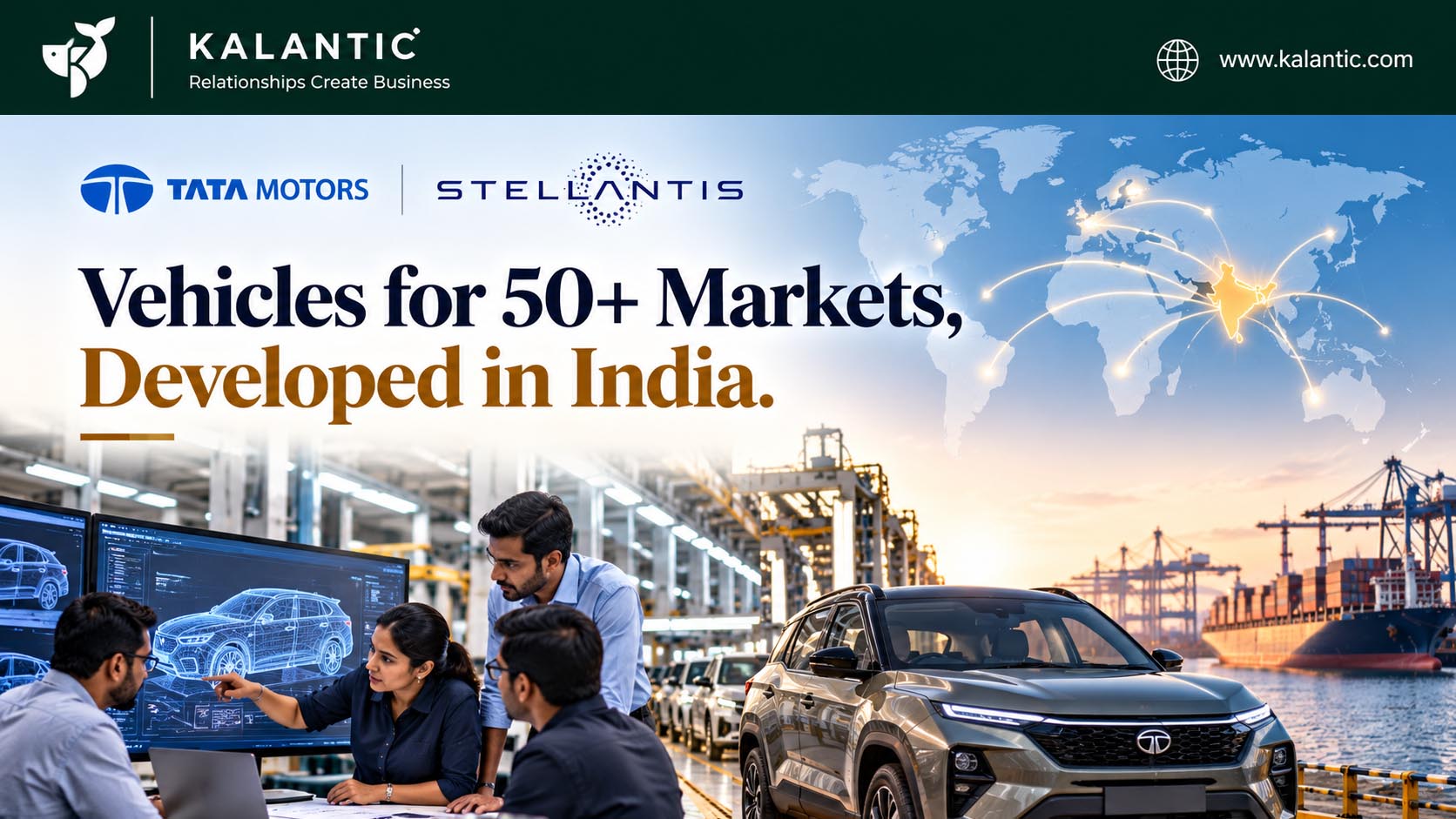
Tata Motors Passenger Vehicles and Stellantis have signed an agreement to expand their long-standing partnership into advanced vehicle technology, vehicle architecture and product development.
Vehicles developed under the agreement will be manufactured in India for more than 50 global markets.
The agreement matters because it extends India's role beyond vehicle assembly and manufacturing into the engineering and development activities that determine how vehicles are designed and adapted for international customers.
For global automotive companies, the development also illustrates the strategic value of partnerships that combine local engineering and manufacturing capabilities with international product expertise and distribution networks.
The wider opportunity extends to Indian component manufacturers, engineering-service providers, testing specialists and technology companies capable of supporting increasingly sophisticated automotive programmes.
Key Takeaways
- Tata Motors Passenger Vehicles and Stellantis signed a definitive agreement on October 12, 2026.
- The expanded partnership covers advanced vehicle technology, architecture and product development.
- Vehicles developed under the agreement are intended for more than 50 global markets.
- Production is planned at Fiat India Automobiles, the companies' existing 50:50 joint venture.
- The agreement builds on a relationship spanning more than two decades.
- Indian automotive suppliers and engineering businesses could find opportunities as international vehicle programmes expand, although specific supplier contracts have not been announced.
- The development reinforces the importance of India as a potential base for global product development, not merely a manufacturing destination.
A manufacturing partnership is becoming a product-development partnership
On October 12, Tata Motors Passenger Vehicles and Stellantis announced a definitive agreement expanding their existing relationship into advanced vehicle technology and product development.
The agreement builds on a partnership that has operated for more than two decades, including through Fiat India Automobiles, their 50:50 joint venture.
Under the expanded arrangement, Tata Motors will provide access to its vehicle technology and architecture capabilities. Stellantis will combine these with its international product-development and engineering expertise to develop vehicles for different customer requirements, regulations and operating conditions.
The vehicles developed through the collaboration will be manufactured in India for more than 50 global markets.
The companies have not disclosed the specific models, investment commitments or production timelines associated with the agreement.
Nevertheless, the strategic shift is significant.
The partnership is moving beyond the question of where a vehicle is manufactured to include how its underlying technology and architecture are developed.
Why this matters for India's automotive industry
Manufacturing a vehicle for the domestic market is different from developing a vehicle intended for customers across multiple countries.
International programmes must accommodate varying safety standards, emissions requirements, road conditions, customer preferences, price points and regulatory frameworks.
That creates demand for engineering capabilities that extend well beyond the factory floor.
These include:
- Vehicle architecture and platform engineering
- Powertrain development
- Electrical and electronic systems
- Software and embedded systems
- Testing, validation and certification
- Component engineering
- Manufacturing process optimisation
- Quality assurance
- Homologation and regulatory compliance
The Tata Motors–Stellantis agreement places Indian capabilities within a broader international product-development arrangement.
It does not mean every component or engineering activity will automatically be sourced in India. However, it demonstrates how Indian technology, engineering and manufacturing capabilities can contribute to products intended for international markets.
For Indian businesses, that distinction creates an important commercial question: which capabilities will global manufacturers need as their programmes become more integrated?
The global automotive industry is becoming more partnership-driven
Vehicle development has become increasingly complex and expensive.
Manufacturers must invest in electrification, software, electronics, safety systems, powertrain technologies and changing regulatory requirements while continuing to compete on price and product quality.
Developing every capability independently can be costly.
Partnerships offer another route.
One company may contribute vehicle architecture, manufacturing capacity or access to a particular market. Another may contribute engineering expertise, technology, product-development processes or an established international brand portfolio.
When those capabilities complement each other, the combined arrangement can improve the economics of development and production.
The Tata Motors–Stellantis agreement illustrates this model: Indian engineering and vehicle technology are being combined with international product-development expertise and market reach.
For other international automotive companies, the lesson is not necessarily to replicate this specific arrangement.
It is to examine which capabilities are best developed internally and which can be accessed through strategic partnerships.
What this could mean for Indian suppliers
The immediate announcement concerns Tata Motors and Stellantis. It does not confirm new contracts for individual component manufacturers or engineering-service providers.
However, expanded product-development programmes can create opportunities across the supporting ecosystem, depending on sourcing decisions and technical requirements.
Potential areas include:
1. Precision components
International vehicle programmes require suppliers capable of meeting demanding specifications, quality standards and delivery schedules.
2. Electronics and embedded systems
Modern vehicles depend on electronic control units, sensors, connectivity systems and increasingly sophisticated software.
3. Engineering services
Companies providing computer-aided engineering, simulation, testing, validation and product-development support may be relevant to international programmes.
4. Testing and certification
Vehicles destined for multiple markets must meet applicable technical and regulatory requirements. This creates demand for specialised testing and compliance capabilities.
5. Manufacturing technology
Automation, industrial software, tooling and quality-control systems can become important as manufacturers scale production for multiple markets.
6. Supply-chain services
International programmes require dependable procurement, logistics, inventory management and supplier coordination.
These are potential opportunity areas, not confirmed beneficiaries of this particular agreement. Actual opportunities will depend on the partners' programme requirements and supplier-selection processes.
The opportunity for international companies entering India
For an overseas automotive supplier, the most obvious approach might be to identify the largest vehicle manufacturers in India and approach their procurement teams.
But a more targeted strategy could begin with a specific capability.
Does an Indian manufacturer need a technology that the overseas supplier provides?
Is a global vehicle programme expanding its requirements for a particular component?
Are there gaps in local testing, engineering or manufacturing capabilities?
Can a foreign company offer technology transfer, technical support or joint development alongside its products?
These questions help identify opportunities that are more concrete than a general decision to enter the Indian market.
A supplier with a specialised product may find that its best route into India is through an existing vehicle programme rather than by building a direct sales operation from scratch.
Similarly, an Indian engineering company may be able to work with an international manufacturer by demonstrating a capability that is difficult to source elsewhere.
The opportunity depends on identifying the right requirement, decision-maker and commercial relationship.
How companies should approach this opportunity
For international businesses exploring India's automotive ecosystem, five steps can make market entry more practical.
Step 1: Identify the capability gap.
Determine whether the opportunity involves components, software, engineering services, testing, manufacturing technology or another specialised requirement.
Step 2: Map the relevant programmes.
Identify the vehicle manufacturers, joint ventures, engineering teams and suppliers connected to the relevant product category.
Step 3: Understand qualification requirements.
Automotive suppliers may need to meet demanding quality-management, validation, traceability and production-capacity requirements before receiving business.
Step 4: Identify the right commercial entry point.
The appropriate contact could be a procurement team, engineering function, programme manager, technology partner or established local supplier.
Step 5: Build a relationship around a defined business case.
A credible approach should demonstrate how the proposed capability addresses a specific requirement, improves performance or reduces cost and risk.
This is particularly important in automotive manufacturing, where qualification processes and product-development cycles can be lengthy.
India is becoming more than a production location
The larger significance of this agreement lies in the combination of capabilities it brings together.
India's automotive ecosystem offers manufacturing capacity, engineering talent and an established supplier base. International manufacturers bring product-development experience, global market access and established customer relationships.
Partnerships can connect these strengths.
For India, the potential benefit is deeper participation in the development of vehicles for international markets.
For global companies, the attraction is access to engineering and manufacturing capabilities that can support their wider product strategies.
The extent to which India captures more value from these programmes will depend on the depth of local engineering, supplier participation, technology development and the ability to meet global requirements.
The direction, however, is worth watching.
The Kalantic perspective: opportunities sit inside relationships
For international businesses, the announcement raises a practical question.
If India is becoming a stronger base for global vehicle development, which Indian companies should an overseas supplier, engineering firm or technology provider know?
The answer will not be the same for every company.
A software specialist may need relationships with engineering teams. A component manufacturer may need access to supplier-development and procurement functions. A testing company may need to understand programme-specific certification requirements.
In each case, the opportunity depends on finding the right point of entry.
That requires more than a list of companies. It requires understanding the ecosystem, identifying relevant decision-makers and building relationships around specific commercial needs.
This is where disciplined business development can turn an industry development into an actionable market-entry opportunity.
Frequently Asked Questions
What did Tata Motors Passenger Vehicles and Stellantis announce?
On October 12, 2026, the companies signed a definitive agreement expanding their partnership into advanced vehicle technology, vehicle architecture and product development.
Will the vehicles be manufactured in India?
Yes. The agreement provides for vehicles developed under the collaboration to be manufactured in India for more than 50 global markets.
Where will production take place?
Production is planned at Fiat India Automobiles Private Limited, the 50:50 joint venture between Tata Motors Passenger Vehicles and Stellantis.
Does this mean India will design all vehicles for Stellantis?
No. The agreement concerns a collaborative arrangement that combines Tata Motors' vehicle technology and architecture capabilities with Stellantis' product-development and engineering expertise. It does not establish that all Stellantis vehicles will be developed in India.
Which Indian businesses could benefit?
Potential opportunity areas include automotive components, embedded systems, engineering services, testing, certification, manufacturing technology and supply-chain services. Actual opportunities will depend on supplier requirements and commercial agreements.
Why is the agreement important for international companies?
It illustrates how international manufacturers can combine Indian engineering and manufacturing capabilities with global product expertise and market access. For suppliers and technology companies, this can create potential routes into international automotive programmes.
Final Thoughts
The Tata Motors–Stellantis agreement is a useful signal of how international manufacturing partnerships are evolving.
The relationship now extends beyond producing vehicles to include the technologies and architectures behind them.
That creates a broader set of questions for Indian suppliers and international businesses: which capabilities will global manufacturers need, where can Indian companies provide value, and which relationships will connect the two?
For companies considering India, the opportunity is not simply to establish a presence.
It is to identify where their capabilities fit into an existing commercial ecosystem—and to build the relationships required to participate in it.
About Kalantic
Kalantic helps international companies develop business in India through market intelligence, partner identification, relationship development and on-ground commercial support.
We focus on turning market opportunities into actionable business relationships.
Because entering a market is only the beginning.
The real question is: whom should you know?
Sources
- Reuters, October 12, 2026 — “Stellantis, Tata Motors Passenger Vehicles to develop vehicles in India.” https://www.reuters.com/world/india/indias-tata-motors-pv-expands-partnership-with-stellantis-global-vehicle-2026-10-12/
- Business Standard, October 12, 2026 — “Tata Motors PV, Stellantis expand tie-up for global vehicle development.” https://www.business-standard.com/companies/news/tata-motors-pv-stellantis-expand-tie-up-for-global-vehicle-development-126101200728_1.html
- The New Indian Express, October 12, 2026 — “Stellantis and Tata Motors PV sign agreement to jointly develop vehicles in India.” https://www.newindianexpress.com/business/2026/Oct/12/stellantis-and-tata-motors-pv-sign-agreement-tojointly-develop-vehicles-in-india
Ready to Explore India?
Expanding into India requires more than market research—it requires the right customers, partners, and commercial strategy. Kalantic helps international companies validate opportunities, identify customers and channel partners, and build a sustainable business presence in India. Whether you’re evaluating India for the first time or accelerating your expansion, our team can help you make informed decisions with confidence.
Book an India Market Entry Discussion
Or email us at: info@kalantic.com