
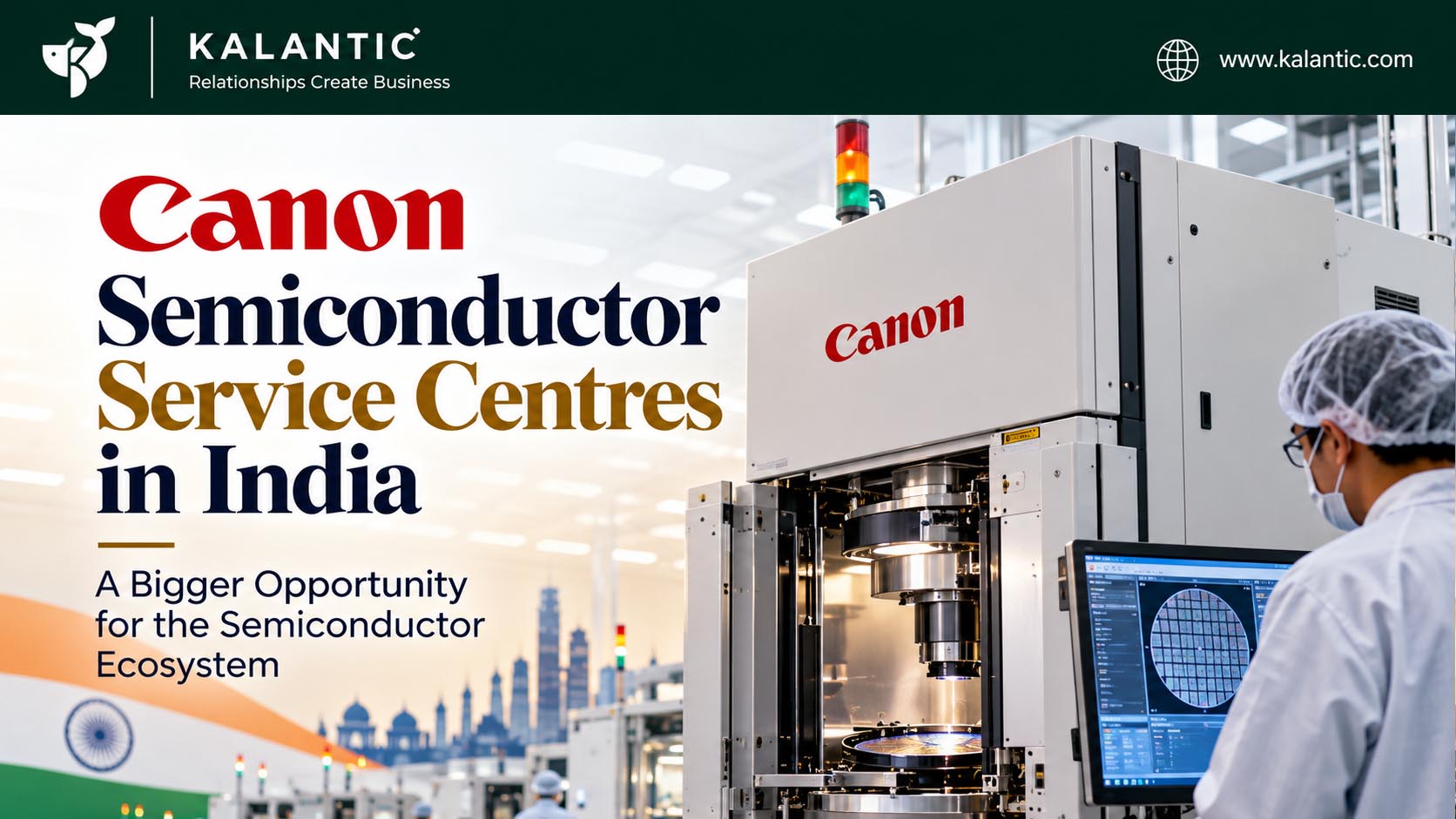
Canon's plan to bring semiconductor lithography technology and potentially dedicated service centres to India is an important signal for international companies considering the Indian market.
The opportunity is no longer limited to companies that want to manufacture chips in India.
It is increasingly extending to the companies that make, maintain, support and service the infrastructure required to manufacture those chips.
That distinction could create a much larger ecosystem of commercial opportunities.
Key Takeaways
- Canon has held discussions with companies involved in key semiconductor projects in India.
- The Japanese technology company supplies lithography systems used in semiconductor manufacturing.
- Canon plans to establish dedicated service infrastructure in India as projects progress.
- India has approved 12 semiconductor projects across six states, involving about ₹1.64 lakh crore in investment commitments.
- The emerging ecosystem includes fabrication, packaging, testing, equipment, materials, logistics, technical services and specialised talent.
- For international companies, India's semiconductor opportunity may therefore be as much about becoming an ecosystem partner as building a factory.
The semiconductor story is getting bigger
India's semiconductor ambitions are often described through a simple headline:
Build semiconductor manufacturing capacity in India.
But manufacturing a chip is not a single-company activity.
A semiconductor facility requires highly specialised equipment, materials, chemicals, gases, maintenance, testing, packaging, logistics, engineering expertise and technical support.
That is why Canon's latest India plans are worth watching.
The Japanese technology company is not announcing a chip fabrication plant.
Instead, it is looking at how its semiconductor equipment and technical-support capabilities can become part of India's emerging manufacturing ecosystem.
Canon India President and CEO Toshiaki Nomura said the company has discussed its technology with key semiconductor manufacturers whose projects are under development in India.
He also said Canon plans to bring its lithography technology to support chip manufacturing and could establish dedicated service centres once projects are confirmed.
For semiconductor equipment, that support is not optional.
The equipment has to operate reliably, and Canon expects to provide 24×7 support to chip manufacturers using its systems.
This changes how international companies should look at India
India's semiconductor strategy is already moving beyond the idea of building fabs.
As of mid-2026, 12 semiconductor projects had been approved across six states, with investment commitments of approximately ₹1.64 lakh crore.
The projects span fabrication, packaging and other parts of the semiconductor value chain.
And that creates a multiplier effect.
A new semiconductor facility can create demand for:
- Semiconductor manufacturing equipment
- Equipment maintenance
- Technical support
- Specialty chemicals
- Industrial gases
- Cleanroom infrastructure
- Precision engineering
- Testing equipment
- Packaging technology
- Logistics
- Industrial automation
- Power management
- Water and waste-treatment systems
- Engineering and consulting services
- Skilled technical manpower
In other words:
The factory is only the centre of the ecosystem.
The commercial opportunity surrounds it.
Canon is an example of the second-order opportunity
Canon's position illustrates an important distinction for companies evaluating India.
A foreign company does not necessarily need to build a giant manufacturing facility to participate in India's industrial expansion.
It can become a supplier.
A technology provider.
A maintenance partner.
A systems integrator.
A specialised engineering company.
A distributor.
A local service provider.
Or a partner to one of the companies already investing in India.
This is particularly relevant for companies from Japan, Europe, South Korea, Taiwan and the United States that possess highly specialised industrial capabilities.
India's semiconductor programme is deliberately trying to create an integrated ecosystem covering design, fabrication, assembly, testing, packaging, equipment and materials.
The government's own description of the programme recognises that a globally competitive semiconductor industry requires much more than fabs.
The question is no longer simply "Should we manufacture in India?"
For international companies, the more interesting question may be:
"Where do we fit into India's semiconductor ecosystem?"
That requires a different approach to market entry.
Instead of beginning with a broad India market report, a company could map:
- Which semiconductor projects are under development?
- Who are the technology partners?
- Which equipment and materials are being imported?
- Which suppliers are already serving those projects?
- Which capabilities must eventually be localised?
- Which Indian companies could become distribution or service partners?
- Which global companies are already building relationships with Indian semiconductor manufacturers?
- Where are the gaps in the emerging ecosystem?
This is where commercial intelligence becomes more valuable than generic market research.
Japan has an interesting position
Canon's interest also reinforces the growing importance of Japan-India technology and manufacturing relationships.
Japanese companies have significant expertise in precision engineering, semiconductor materials, industrial machinery, optics, automation and manufacturing technology.
India, meanwhile, is trying to build domestic capabilities across a semiconductor value chain that has historically been heavily dependent on international suppliers.
The intersection is potentially significant.
But opportunity does not automatically translate into market access.
A company needs to know which projects are real, who is involved, where decisions are being made, who the local partners are and which relationships actually matter.
The opportunity extends beyond semiconductors
There is a broader lesson here for international companies entering India.
When a large industrial investment arrives, don't look only at the company making the investment.
Look around it.
Who supplies it?
Who services it?
Who distributes to it?
Who provides technology?
Who manages its logistics?
Who supplies its customers?
Who helps it navigate India?
Who already has the relationships?
That second layer can sometimes provide a more accessible entry point into the market.
What this means for companies considering India
For a global technology or industrial company, India entry does not necessarily have to begin with a large capital commitment.
A smarter progression could be:
Identify the ecosystem → map the decision-makers → identify potential partners → test commercial demand → establish a local presence → scale.
Canon's semiconductor plans are still dependent on the progress and confirmation of individual projects. The company has not announced a specific service-centre rollout or confirmed equipment contracts for particular projects.
But the direction is clear.
As India's semiconductor ecosystem develops, an increasing number of companies will need to figure out not just whether India is a market for them, but where exactly they can plug into the ecosystem.
And that is often where the real business-development opportunity begins.
Frequently Asked Questions
Is Canon manufacturing semiconductors in India?
No. Canon supplies lithography systems used in semiconductor manufacturing. Its current India plans focus on bringing this technology to support chip manufacturers and potentially establishing dedicated service infrastructure.
Why does Canon need service centres in India?
Semiconductor manufacturing equipment requires continuous technical support. Canon has indicated that dedicated support, including 24×7 assistance, would be required as semiconductor projects become operational.
How many semiconductor projects has India approved?
India had approved 12 semiconductor projects across six states by mid-2026, with cumulative investment commitments of around ₹1.64 lakh crore.
Does India's semiconductor opportunity extend beyond chip fabs?
Yes. The ecosystem includes equipment, materials, packaging, testing, logistics, engineering, maintenance, technical services and specialised talent in addition to fabrication.
What should international semiconductor companies look for in India?
They should look beyond direct manufacturing opportunities and map the entire ecosystem around India's approved and emerging semiconductor projects, including potential customers, suppliers, technology partners and local service providers.
Final Thoughts
Canon's India plans are interesting not because they represent another foreign company entering India.
They are interesting because they show how an industrial ecosystem creates opportunities far beyond the headline investment.
India's semiconductor story will not be built by chip manufacturers alone.
It will be built by hundreds of companies that supply, support, service and connect the ecosystem.
For international businesses, that creates a very different India question:
Not "Should we enter India?"
But:
"Where can we create value in the ecosystem that India is building?"
That is a much more actionable question.
About Kalantic
Kalantic helps international companies build business in India through market intelligence, relationship development, partner identification and on-ground business development.
Because entering a market is not just about knowing the market.
It is about knowing whom to know.
Sources
- Business Standard — "Canon in talks with key chip project players, plans local service centres", October 4, 2026.
- Economic Times — "Canon in talks with those engaged in key chip projects in India, plans local service centres", October 4, 2026.
- Press Information Bureau — India's Semiconductor Ecosystem, 2026.
- India Semiconductor Mission — Government of India.
Ready to Explore India?
Expanding into India requires more than market research—it requires the right customers, partners, and commercial strategy. Kalantic helps international companies validate opportunities, identify customers and channel partners, and build a sustainable business presence in India. Whether you’re evaluating India for the first time or accelerating your expansion, our team can help you make informed decisions with confidence.
Book an India Market Entry Discussion
Or email us at: info@kalantic.com