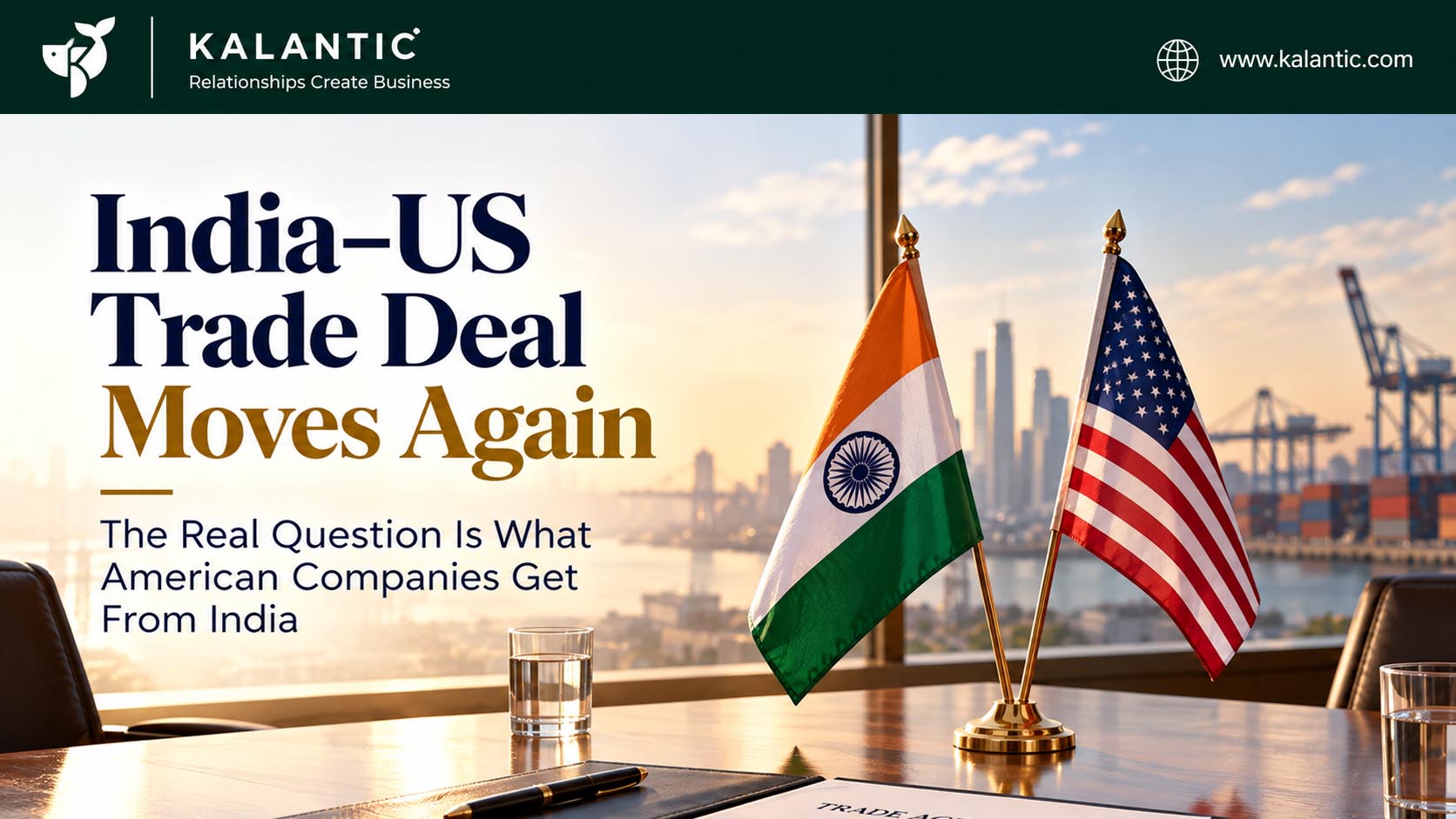
India and the United States are continuing negotiations on an interim trade agreement.
Commerce and Industry Minister Piyush Goyal met US Trade Representative Jamieson Greer on the sidelines of the G20 Trade Ministers' Meeting in Milwaukee. Goyal described the discussion as productive and said it was focused on an early conclusion of a mutually beneficial interim agreement.
However, there is an important qualification.
Greer said that an agreement was not imminent, while also saying that both sides had identified the remaining sticking points and were working through them.
For businesses, that distinction matters.
The next India-US trade agreement is not simply about tariff rates.
It could influence where American companies manufacture, source, distribute, invest and build partnerships in India.
Key Takeaways
- India and the US are continuing negotiations on an interim trade agreement.
- Piyush Goyal and USTR Jamieson Greer discussed an early conclusion of the interim pact at the G20 Trade Ministers' Meeting.
- Greer said a deal is not imminent, although the remaining sticking points have been identified.
- India has been seeking competitive market access for its exporters in the US.
- The negotiations also matter to American companies considering India as a manufacturing, sourcing, technology and investment base.
- The commercial impact of any agreement will depend on the final terms, implementation and sector-specific market access.
- For US companies, the opportunity is not limited to exporting to India. It also includes building operations and partnerships inside India.
The Deal Is Moving. But It Isn't Done.
India and the United States have been negotiating a broader Bilateral Trade Agreement.
This week, the talks moved back into focus.
Commerce Minister Piyush Goyal met USTR Jamieson Greer in Milwaukee during the G20 Trade Ministers' Meeting.
Goyal said the two sides had a productive discussion aimed at concluding an interim agreement early.
Then came an important qualification from Washington.
Greer said the agreement was not imminent, while noting that negotiators had identified the remaining sticking points and were working through them.
So the story today is not:
"India and the US have reached a trade deal."
They haven't.
It is:
"India and the US are working through the commercial issues standing between negotiation and implementation."
For companies, that distinction is crucial.
Why American Companies Should Be Watching
Trade agreements are usually discussed through the lens of exporters.
But the bigger commercial story can sit elsewhere.
An American company looking at India has at least four possible strategies.
It can export into India.
It can manufacture in India.
It can source from Indian suppliers.
Or it can build a local business around India's domestic market.
A trade agreement can affect all four.
Lower barriers can improve the economics of importing.
Greater certainty can support investment.
Improved market access can make local partnerships more attractive.
And stronger bilateral trade can create new commercial relationships across industries.
India Is Not Just an Export Destination
This is where the conversation around India needs to become more sophisticated.
For an American company, entering India does not necessarily mean:
"How can we sell our existing American product here?"
The more interesting question can be:
"How should India fit into our global business model?"
India could become:
- A manufacturing base
- A sourcing hub
- An engineering centre
- A software and technology centre
- A regional services hub
- A distribution market
- An R&D location
- Or several of these simultaneously
The trade agreement can influence the economics.
But the underlying opportunity exists beyond the agreement itself.
The Competitive Question Is Bigger Than India-US Trade
American companies are not evaluating India in isolation.
They are comparing India with other locations across Asia and beyond.
If an American manufacturer is deciding where to establish its next production base, it may compare:
- India
- Vietnam
- Mexico
- Thailand
- Malaysia
- China
- Eastern Europe
The decision involves much more than tariffs.
It involves:
- Labour availability
- Supplier ecosystems
- Infrastructure
- Energy
- Logistics
- Domestic demand
- Technology capabilities
- Regulatory complexity
- Intellectual property
- Local partnerships
- Speed of execution
That means India's opportunity from an eventual trade agreement will depend partly on what businesses can actually do with the improved market access.
The Biggest Opportunity May Be Partnerships
Consider an American technology company entering India.
The company may have excellent technology.
It may have capital.
It may have an established global customer base.
But it may still need:
- A local implementation partner
- A distributor
- A systems integrator
- A manufacturing partner
- A regulatory advisor
- A hiring network
- An enterprise sales channel
- An Indian company with existing relationships in its target industry
This is why market access and relationship access are increasingly connected.
The trade agreement can open a door.
A local relationship can determine what happens after the door opens.
What American Companies Should Be Doing Before the Deal Is Signed
Waiting for the final text of an agreement may be too late to start preparing.
Companies considering India can already begin mapping:
1. The sectors where India changes the economics
Not every industry will benefit equally from trade liberalisation.
Companies need to identify the specific products, services and business models where India becomes more commercially attractive.
2. The Indian companies that could become partners
This means going beyond a competitor list.
Look for distributors, manufacturers, technology companies, service providers, joint-venture candidates and strategic partners.
3. The customers already buying similar products
Understanding existing demand can reveal where an American company's proposition fits and where it needs localisation.
4. The people who control market access
In many industries, knowing the right decision-makers, ecosystem players and channel partners can materially reduce the time required to establish commercial traction.
5. The India strategy beyond tariffs
A tariff advantage can improve economics.
A strong India operating model can create a business.
Frequently Asked Questions
Has India and the US signed the new trade agreement?
No.
The two countries are still negotiating an interim agreement. Goyal and Greer discussed efforts to conclude it, while Greer said an agreement was not imminent.
What is the purpose of the interim agreement?
The interim agreement is intended to address an initial phase of the broader India-US Bilateral Trade Agreement and improve the terms governing bilateral trade.
Why does this matter to American companies?
The eventual terms could affect the economics of exporting to India, sourcing from India, manufacturing in India and investing in Indian operations.
Does an India-US trade deal automatically mean more US investment in India?
No.
Investment decisions depend on many factors, including market demand, costs, regulation, infrastructure, talent, supply chains and expected returns.
A trade agreement can change some of those variables but does not determine investment outcomes by itself.
What should US companies do before the agreement is finalised?
They can begin identifying Indian customers, suppliers, distributors, technology partners, manufacturers and other ecosystem participants relevant to their sector.
Final Thoughts
The most important development in the India-US trade story today is not that a deal has been signed.
It hasn't.
It is that both sides are continuing to work through the issues standing between negotiation and implementation.
For American companies, that is a signal worth watching.
Because the eventual agreement will not only determine how much companies pay at the border.
It could influence where they manufacture.
Where they source.
Where they invest.
And which Indian companies they choose to work with.
But companies do not need to wait for the final signature to understand the opportunity.
The smarter question is already:
If India becomes more commercially accessible, who should we know before everyone else starts looking?
That is where market research ends.
And business development begins.
About Kalantic
Kalantic helps international companies build business in India through market access, partnerships, relationships and on-ground business development.
Because entering a market is one thing.
Knowing how to build business in it is another.
Sources
Reuters — US-India trade deal not imminent, Greer says, October 1, 2026
Economic Times — Piyush Goyal and USTR Jamieson Greer discuss early conclusion of India-US interim trade deal, October 1, 2026
Business Standard — Goyal meets Greer, pushes for early conclusion of India-US trade deal, October 1, 2026
The White House — United States-India Joint Statement, February 6, 2026
Ready to Explore India?
Expanding into India requires more than market research—it requires the right customers, partners, and commercial strategy. Kalantic helps international companies validate opportunities, identify customers and channel partners, and build a sustainable business presence in India. Whether you’re evaluating India for the first time or accelerating your expansion, our team can help you make informed decisions with confidence.
Book an India Market Entry Discussion
Or email us at: info@kalantic.com