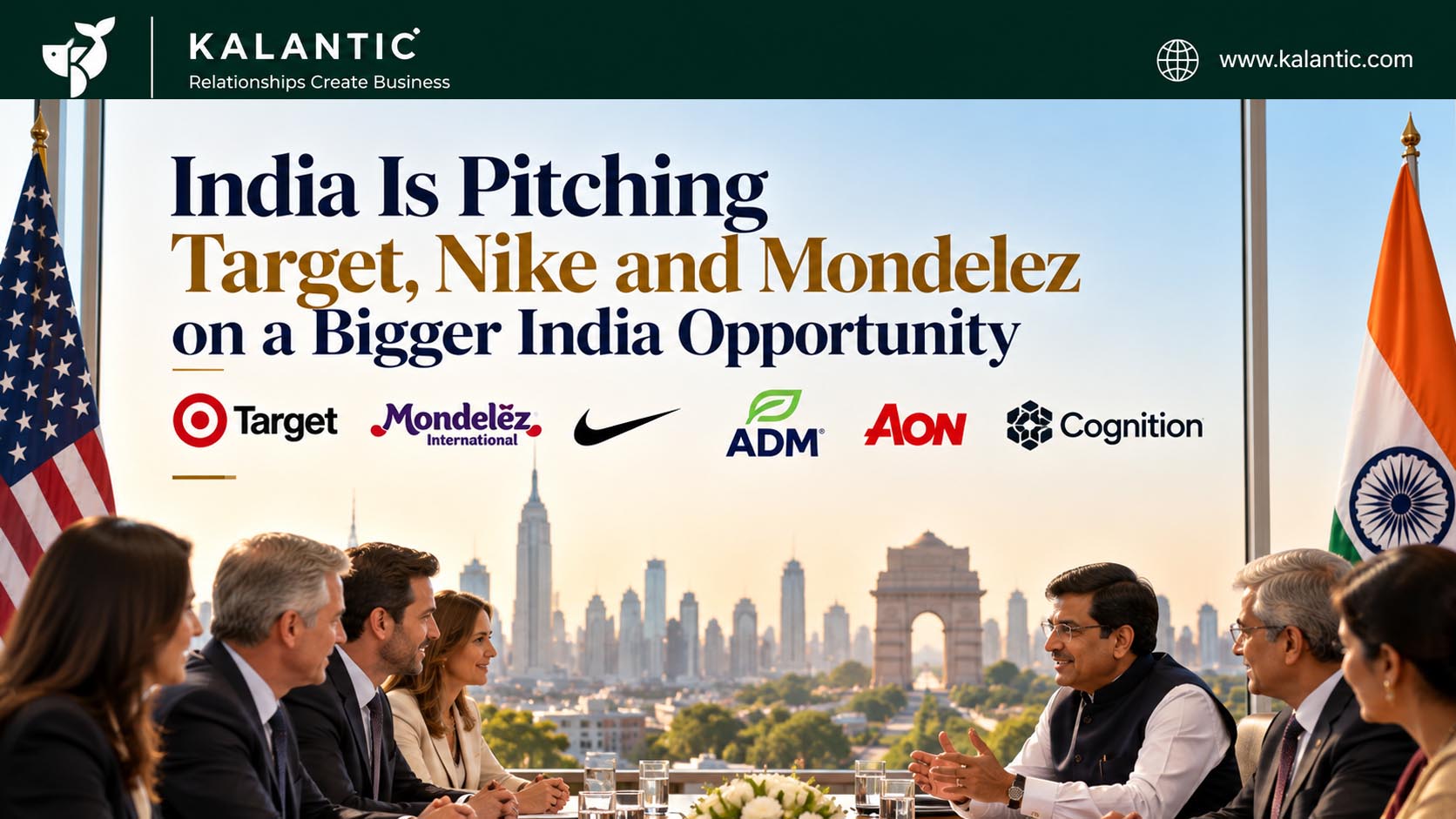
India is making a direct investment and market-entry pitch to some of America's biggest companies.
During his current US visit, Commerce and Industry Minister Piyush Goyal has held discussions with senior executives from Target, Mondelez International, Nike, Archer Daniels Midland, Aon and AI company Cognition.
The conversations covered manufacturing, sourcing, investment, consumer demand, professional services, artificial intelligence, food processing and India's sports ecosystem.
That breadth is the interesting part.
India's pitch to American companies is no longer simply:
"Come manufacture in India."
It is increasingly:
"Build part of your global business in India."
That is a much bigger proposition.
Key Takeaways
- India is actively courting major American companies for deeper investment and operations.
- Target discussed expanding sourcing from India and leveraging India's manufacturing ecosystem.
- Mondelez discussed opportunities around manufacturing, sourcing and investment.
- Nike discussed manufacturing, local sourcing and the broader Indian sports ecosystem.
- ADM discussed expansion opportunities linked to food processing and agricultural value chains.
- Aon discussed its existing Indian operations and potential future growth.
- AI company Cognition discussed expanding its presence and deploying AI capabilities in India.
- The common thread is that India is being positioned simultaneously as a market, production base, talent hub and technology ecosystem.
- For international companies, the opportunity may increasingly lie in combining these roles rather than treating India as a single-purpose location.
Look at Who India Is Talking To
There is a useful way to understand India's latest investment outreach.
Don't start with the government.
Start with the companies sitting across the table.
Target.
Nike.
Mondelez.
Archer Daniels Midland.
Aon.
Cognition.
These are very different businesses.
One is a retailer.
One is a sports brand.
One is a global food company.
One is an agricultural commodities and processing giant.
One is a professional services company.
One is an AI company.
Yet India is having a commercial conversation with all of them.
That tells us something about how the country's opportunity is evolving.
Target: India as a Manufacturing and Sourcing Base
Target's relationship with India is already substantial, particularly through sourcing and its India operations.
In his meeting with Target executive Grant McGee, Goyal discussed opportunities for the retailer to leverage India's manufacturing ecosystem, deepen its presence and expand sourcing from India.
That is significant because a global retailer's sourcing ecosystem touches thousands of businesses.
Manufacturers.
Component suppliers.
Packaging companies.
Quality-control firms.
Logistics providers.
Design companies.
Technology providers.
And increasingly, Indian suppliers capable of serving markets outside India.
The opportunity therefore isn't limited to Target itself.
It sits around Target.
Mondelez: India as Market + Manufacturing Base
The conversation with Mondelez illustrates another model.
Mondelez has had a presence in India for seven decades.
The discussion focused on expanding manufacturing, sourcing and investment.
But there is another variable that makes India particularly interesting for a company like Mondelez:
consumption.
India is simultaneously a large manufacturing base and one of the world's largest consumer markets.
That creates a potentially powerful combination.
A company can manufacture in India.
Source from India.
Sell to India.
And potentially export from India.
That is a very different proposition from simply looking for a lower-cost manufacturing location.
Nike: The Opportunity Goes Beyond Factories
Nike's conversation was even broader.
The discussions covered manufacturing, local sourcing and the broader sports ecosystem.
This matters because India's sports economy extends well beyond apparel and footwear.
It includes:
- Sporting goods
- Fitness
- Sports infrastructure
- Events
- Athlete development
- Digital platforms
- E-commerce
- Sponsorship
- Media
- Technology
- Consumer communities
A global sports company can therefore participate in India's growth without treating manufacturing as the only entry point.
ADM: India's Food Economy Is Becoming More Interesting
The discussion with Archer Daniels Midland points toward another opportunity.
India's food-processing industry is expanding while agricultural value chains are being modernised.
For global agribusiness companies, this creates opportunities across the value chain.
Processing.
Storage.
Logistics.
Ingredients.
Technology.
Food manufacturing.
Exports.
And domestic consumption.
Again, the important point is that the opportunity is not a single industry.
It is an ecosystem.
Aon: India's Talent Economy Is Part of the Investment Story
Then there is Aon.
The discussion with the global professional services company focused on its existing Indian operations and opportunities for future expansion.
This represents a different version of India's investment proposition.
India is not only competing for factories.
It is competing for:
- Global capability centres
- Engineering
- Consulting
- Analytics
- Technology
- Finance
- Professional services
- R&D
- Corporate functions
For many international companies, India's biggest asset may not be what can be manufactured here.
It may be what can be designed, engineered, analysed or managed here.
Cognition: The AI Opportunity Is Different Again
The meeting with Cognition adds another dimension.
Goyal discussed opportunities to leverage the company's AI solutions and deepen its presence in India, while highlighting India's engineering ecosystem and startup culture.
This is particularly relevant because AI is changing the traditional definition of a market.
A company doesn't necessarily need to establish a large physical manufacturing operation to build a major business in India.
It can build:
Technology teams.
Engineering teams.
R&D.
Enterprise partnerships.
Developer ecosystems.
Customer operations.
AI deployment capabilities.
And potentially use India as a base for serving markets beyond India.
The Pattern Is More Important Than Any Individual Meeting
Taken separately, each meeting is interesting.
Taken together, they reveal a broader strategy.
India is presenting itself to American companies through multiple doors.
For Target:
Manufacturing + sourcing.
For Mondelez:
Manufacturing + sourcing + consumption.
For Nike:
Manufacturing + local sourcing + sports ecosystem.
For ADM:
Food processing + agricultural value chains + consumption.
For Aon:
Talent + professional services + business operations.
For Cognition:
AI + engineering + startups + technology deployment.
The message is becoming much broader than:
"India is a low-cost manufacturing destination."
It is:
"India can become part of your global business architecture."
This Changes How Foreign Companies Should Evaluate India
A company evaluating India often begins with a market-size question.
How many consumers?
What is GDP growth?
How large is the sector?
How much is the market worth?
Those questions matter.
But they aren't enough.
A better framework is:
What can India do for our global business?
Can it manufacture?
Can it source?
Can it sell?
Can it engineer?
Can it provide talent?
Can it host R&D?
Can it support regional operations?
Can it provide technology partners?
Can it become a long-term growth market?
The companies that answer those questions collectively may find that India is much more valuable than the original market-entry thesis suggested.
And This Is Where Relationships Become Commercially Important
There is another layer that rarely appears in investment announcements.
A global company may know that India is attractive.
It may even know the sector it wants to enter.
But then comes the difficult part.
Who should it partner with?
Which Indian manufacturer is credible?
Which distributor actually has access to the target market?
Which technology company can integrate with the existing operation?
Which state or regional ecosystem makes sense?
Which local decision-makers matter?
Which companies are already serving the same customers?
The answers are rarely found in a generic market report.
They require local intelligence and relationships.
The Opportunity Is Bigger Than the Companies Being Courted
This is perhaps the most important takeaway from the latest US outreach.
Target does not create an opportunity only for Target.
Nike does not create an opportunity only for Nike.
Mondelez does not create an opportunity only for Mondelez.
Every large multinational entering, sourcing or expanding in India creates an ecosystem around itself.
Suppliers.
Partners.
Distributors.
Technology companies.
Service providers.
Logistics companies.
Consultants.
Manufacturers.
Investors.
And competitors.
That ecosystem is where many of the next opportunities will emerge.
Frequently Asked Questions
Which American companies did Piyush Goyal meet?
Recent meetings included senior executives from Target, Mondelez International, Aon, Cognition, Archer Daniels Midland and Nike.
What was discussed with Target?
The discussions covered opportunities to leverage India's manufacturing ecosystem, deepen Target's presence in India and expand sourcing from the country.
What was discussed with Nike?
The discussions covered manufacturing, local sourcing and opportunities across India's broader sports ecosystem.
Why is Mondelez important to the India story?
Mondelez has had a seven-decade presence in India. The latest discussions focused on expanding manufacturing, sourcing and investment while leveraging India's growing consumer market.
Is India's opportunity limited to manufacturing?
No.
The recent discussions span manufacturing, sourcing, consumer markets, food processing, professional services, AI, engineering, technology and sports.
What does this mean for international companies?
It suggests that India is increasingly being positioned not as a single-purpose market, but as a combination of consumer market, manufacturing base, sourcing hub, technology ecosystem and talent centre.
Final Thoughts
The most interesting part of India's latest US outreach isn't the list of companies.
It is the diversity of the list.
Retail.
Food.
Sports.
Agribusiness.
Professional services.
AI.
Different industries.
One market.
India's proposition is becoming increasingly multidimensional.
For global companies, that creates a different strategic question.
Not:
"Should we enter India?"
But:
"How many different parts of our global business could India support?"
Manufacturing?
Sourcing?
Technology?
Talent?
R&D?
Sales?
And then comes the question that usually determines how quickly the strategy becomes reality:
Whom should we know?
That is where market intelligence becomes market access.
And where business development begins.
About Kalantic
Kalantic helps international companies build business in India through market access, partnerships, relationships and on-ground business development.
Because entering a market is one thing.
Knowing how to build business in it is another.
Sources
Business Standard — Goyal holds bilateral meetings with top officials of several US firms, October 3, 2026
Economic Times — Commerce Minister Piyush Goyal meets US corporate leaders to push India investment opportunities, October 3, 2026
NDTV Profit — Piyush Goyal pushes India investment pitch in meetings with US companies, October 3, 2026
Press Information Bureau — Commerce Minister Piyush Goyal's US visit and engagement with American industry, September 28, 2026
Ready to Explore India?
Expanding into India requires more than market research—it requires the right customers, partners, and commercial strategy. Kalantic helps international companies validate opportunities, identify customers and channel partners, and build a sustainable business presence in India. Whether you’re evaluating India for the first time or accelerating your expansion, our team can help you make informed decisions with confidence.
Book an India Market Entry Discussion
Or email us at: info@kalantic.com