
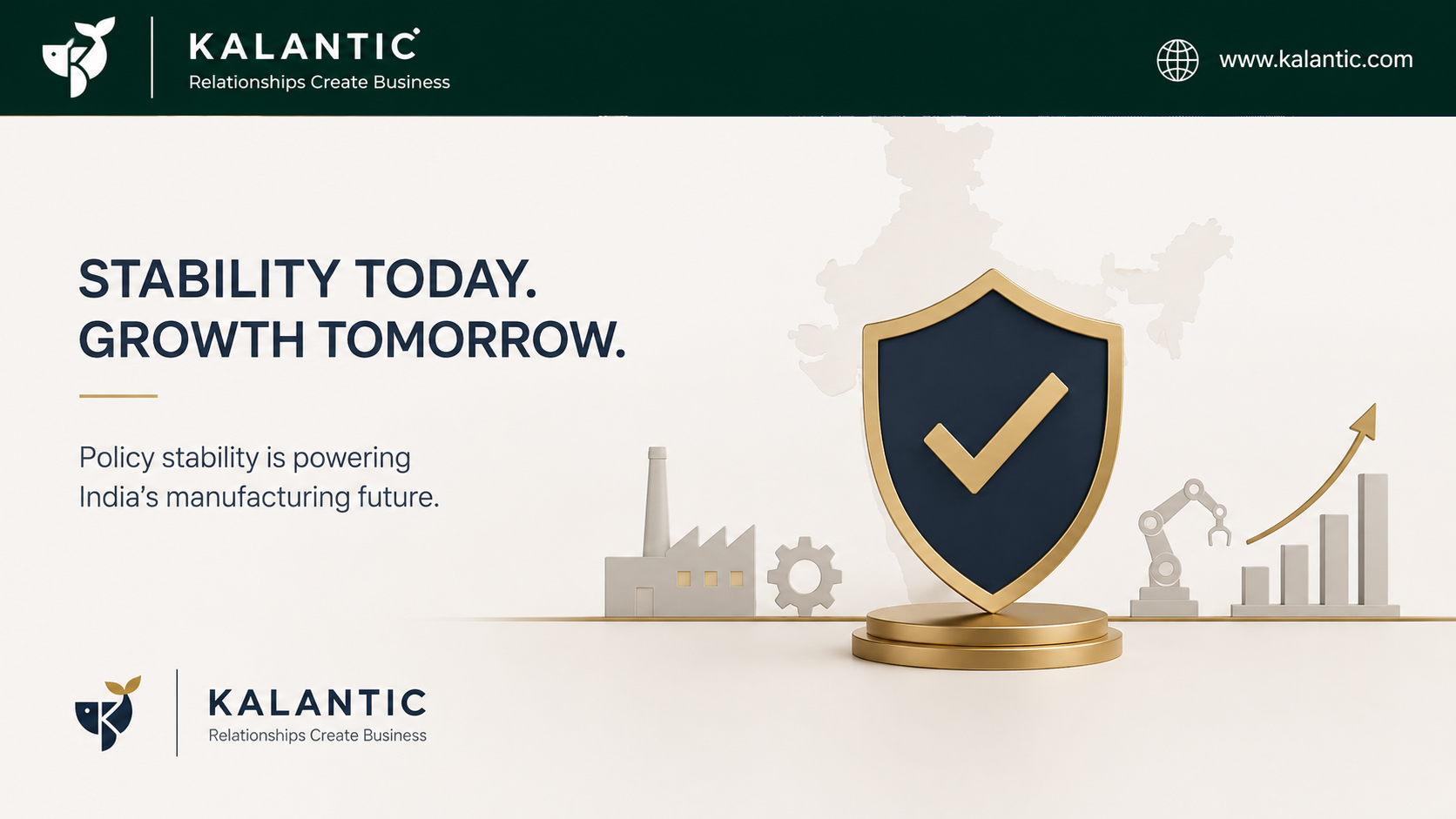
India's decision to extend manufacturing tax incentives well into the future demonstrates that policy stability is becoming one of its strongest competitive advantages. As multinational companies diversify their supply chains and commit billions of dollars to new manufacturing facilities, predictable regulations and long-term policy continuity are increasingly influencing investment decisions. For businesses evaluating India, confidence in future policy may prove as valuable as the incentives themselves.
- Policy stability is becoming a major factor in global investment decisions.
- India's long-term manufacturing incentives provide greater business confidence.
- Predictable regulations reduce commercial risk for international companies.
- Stable policy strengthens India's position as a global manufacturing destination.
- Successful market entry still requires local execution and trusted partnerships.
Policy Stability Is Becoming India's Biggest Competitive Advantage
For decades, businesses evaluating international expansion focused on three questions.
Can we manufacture efficiently?
Can we control costs?
Can we reach customers?
Today, another question has become equally important.
Can we rely on the country's policies over the long term?
This shift is quietly reshaping global investment decisions.
Companies are increasingly prioritising stability over short-term incentives, recognising that billion-dollar manufacturing investments require predictable business environments.
India's recent decision to extend manufacturing tax incentives well into the future sends a strong signal that the country intends to provide exactly that.
For international manufacturers, this may prove to be one of India's most significant competitive advantages.
Manufacturing Is a Long-Term Commitment
Building a factory is not a one-year decision.
Whether producing electronics, automotive components, industrial machinery or chemicals, manufacturing facilities are expected to operate for decades.
Businesses invest heavily in land, equipment, workforce training and supplier development before generating meaningful returns.
Frequent policy changes create uncertainty and delay investment decisions.
Stable policies, on the other hand, allow businesses to plan confidently.
By signalling long-term support for manufacturing, India is helping reduce one of the biggest concerns international investors often face.
Global Supply Chains Are Being Redesigned
The past five years have fundamentally changed how companies think about supply chains.
Pandemic disruptions.
Geopolitical tensions.
Shipping bottlenecks.
Rising concentration risks.
Instead of depending on a single manufacturing location, businesses are increasingly diversifying production across multiple countries.
India has emerged as one of the strongest candidates for this diversification.
However, diversification only succeeds when companies believe that today's investment environment will remain attractive tomorrow.
Policy consistency plays a major role in building that confidence.
Predictability Reduces Investment Risk
When companies evaluate new markets, incentives certainly matter.
But incentives alone rarely determine investment.
Executives also assess whether regulations remain predictable, taxation stays competitive and government priorities remain consistent over many years.
Predictability reduces commercial risk.
It enables companies to forecast returns more accurately, negotiate supplier contracts confidently and commit larger investments.
This is where India appears to be strengthening its position.
Rather than introducing short-term measures, policymakers are increasingly signalling long-term manufacturing ambitions.
That message resonates strongly with international investors.
Beyond Tax Benefits
Tax incentives may capture headlines, but businesses evaluate markets using a much broader lens.
Key considerations include:
- Infrastructure development
- Logistics efficiency
- Availability of skilled talent
- Supplier ecosystem maturity
- Ease of regulatory compliance
- Digital governance
- Access to domestic demand
India has made measurable progress across many of these areas over the past decade.
Combined with policy continuity, these improvements make the country increasingly attractive for long-term manufacturing investments.
Why This Matters for International Companies
If you're evaluating India as your next manufacturing or sourcing destination, policy stability should be viewed alongside labour availability, infrastructure and market potential.
Companies entering India today are not simply choosing a manufacturing location.
They are choosing a long-term business environment.
Stable policy enables better planning, stronger supplier relationships and greater confidence in future investment.
Frequently Asked Questions
Why is policy stability important for manufacturers?
Manufacturing investments typically have payback periods of 10–20 years. Stable policies reduce uncertainty and encourage long-term investment.
Why is India extending manufacturing incentives?
The objective is to strengthen India's position as a global manufacturing hub and attract long-term investments from international companies.
Is policy stability more important than tax incentives?
Both matter. However, predictable long-term policies often influence investment decisions more than temporary financial benefits.
Does this benefit only large multinational companies?
No. SMEs, component suppliers, technology firms and industrial service providers also benefit from stable investment environments.
Final Thoughts
Global manufacturing is entering a new phase.
Companies are no longer selecting locations solely on the basis of cost.
They are evaluating resilience, reliability and long-term predictability.
India's commitment to extending manufacturing incentives reflects a broader ambition to become a trusted destination for global investment.
For businesses considering India, the opportunity extends well beyond tax benefits.
The real advantage lies in the confidence to invest for the long term.
About Kalantic
Kalantic helps international companies build customers, partners and business in India through market research, partner development, customer acquisition and on-ground commercial representation.
Whether you're evaluating manufacturing, sourcing or business expansion, we help you make informed commercial decisions with confidence.
Sources
- Financial Times — India plans to extend manufacturing tax incentives to attract global manufacturers.
- Invest India — https://www.investindia.gov.in
- Ministry of Finance, Government of India — https://finmin.gov.in
Ready to Explore India?
Expanding into India requires more than market research—it requires the right customers, partners, and commercial strategy. Kalantic helps international companies validate opportunities, identify customers and channel partners, and build a sustainable business presence in India. Whether you’re evaluating India for the first time or accelerating your expansion, our team can help you make informed decisions with confidence.
Book an India Market Entry Discussion
Or email us at: info@kalantic.com