The India–UK Business Corridor Is Getting Deeper
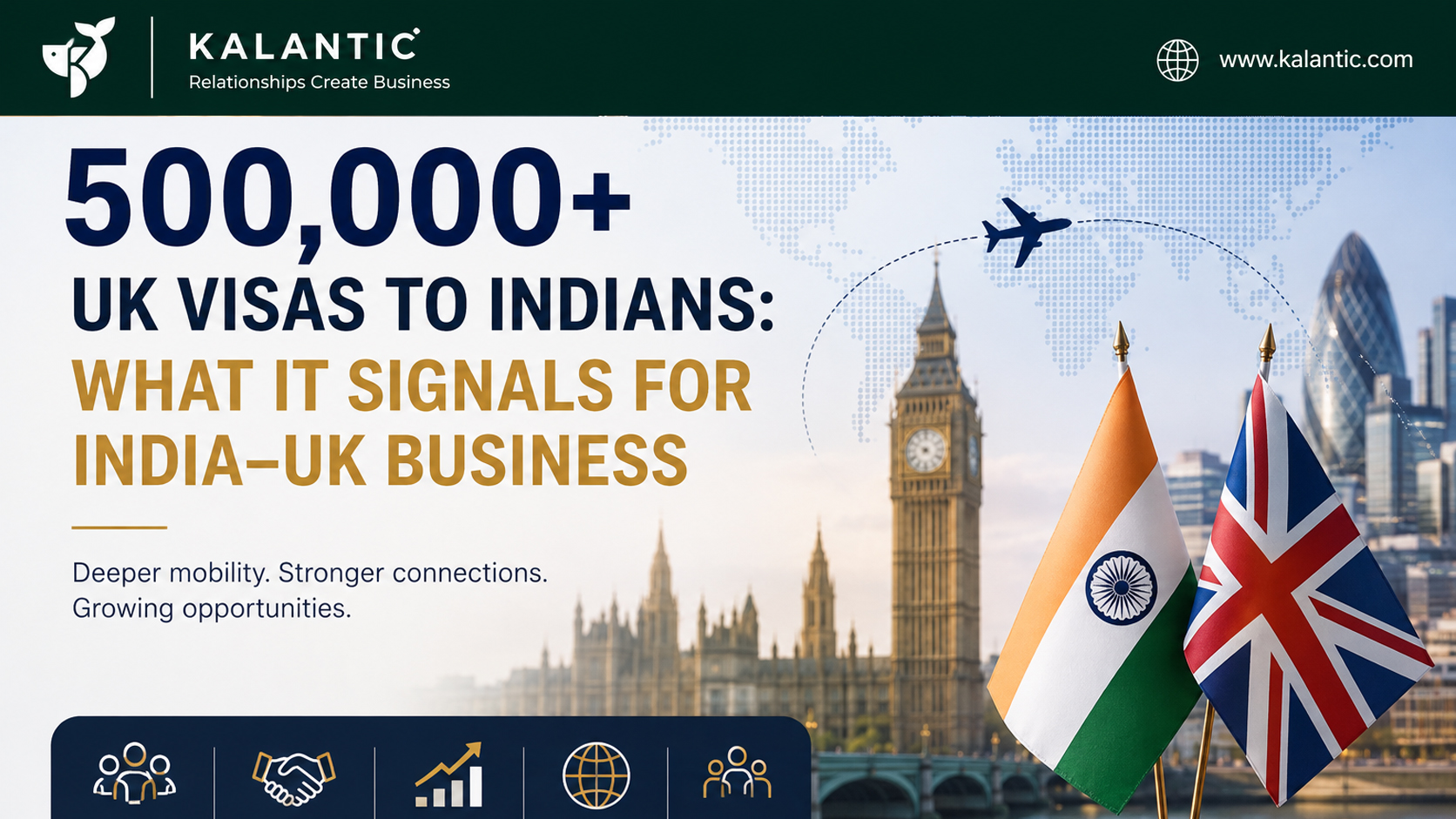
More than 500,000 visas were granted to Indian nationals travelling to the United Kingdom in the year ending March 2026.
The milestone was highlighted as the UK completed its transition to a fully digital visa system, with successful applicants now receiving an eVisa instead of a physical visa sticker. :contentReference[oaicite:0]{index=0}
At first glance, this looks like an immigration or travel statistic.
For businesses, however, it points to something much bigger.
It shows the sheer scale of movement between India and the UK—and, more importantly, the growing depth of the relationships that connect the two markets.
People Move Before Business Does
International business rarely begins with a contract.
It usually begins with a conversation.
A meeting at an industry event.
An introduction through a mutual contact.
A visit to a potential partner.
A conversation with a distributor.
A meeting with a prospective customer.
The more frequently people move between two markets, the easier it becomes for those conversations to happen.
That makes mobility an important part of the commercial infrastructure connecting two economies.
India and the UK already have a substantial people-to-people connection. The UK government describes at least 1.9 million people of Indian heritage living in Britain as a "living bridge" between the two countries. Bilateral trade was worth £43 billion in 2024. :contentReference[oaicite:1]{index=1}
The visa numbers add another dimension to that relationship.
India Is Already a Major UK Market
Indian nationals received 541,774 UK visitor visas in the year ending March 2026, the highest number among all nationalities.
The number was broadly stable year-on-year, even as the UK's overall immigration system continued to evolve. :contentReference[oaicite:2]{index=2}
The UK is also seeing stronger connectivity with India.
According to the Economic Times report, average weekly flights between India and the UK increased to 178 in 2026 from 155 the previous year. VisitBritain expects Indian visits to the UK to approach 959,000 annually by 2030, with an estimated value of £1.5 billion. :contentReference[oaicite:3]{index=3}
For companies, better connectivity means something very practical:
More opportunities to meet.
And meetings matter.
The Opportunity Works in Both Directions
The India–UK relationship is not simply about British companies selling to India.
It is increasingly a two-way commercial corridor.
UK businesses are looking at India for:
- Consumer markets
- Manufacturing
- Technology partnerships
- Professional services
- Distribution
- Sourcing
- Infrastructure
- Financial services
- Healthcare
- Education
- Engineering and advanced machinery
At the same time, Indian companies are increasingly looking at the UK as a gateway to international customers, capital, technology, partnerships and talent.
The UK's trade relationship with India is also becoming more significant.
The UK government estimates that India's import demand could grow by 144% in real terms between 2021 and 2035, reaching £1.4 trillion. It also expects India's middle class to expand substantially over the coming decades. :contentReference[oaicite:4]{index=4}
That creates an increasingly important question for international businesses:
Where does India fit into your growth strategy?
Digital Visas Remove One More Layer of Friction
The UK's move to eVisas may appear primarily administrative, but it is part of a broader shift toward making immigration status digital.
Since 1 July 2026, successful new UK visa applicants receive an eVisa rather than a physical visa vignette. Applicants can access their immigration status digitally through their UKVI account. :contentReference[oaicite:5]{index=5}
For companies with internationally mobile employees, executives, partners and customers, reducing administrative friction can make cross-border activity easier to manage.
It does not create business opportunities by itself.
But it can make it easier for people to pursue them.
And that distinction matters.
The Next Opportunity Is in the Relationships
Trade agreements can reduce tariffs.
Digital systems can reduce paperwork.
Air connectivity can reduce travel friction.
But none of these things creates a customer relationship.
That still requires people.
A company entering India needs to understand its market, identify the right customers, find credible partners and establish relationships that can develop over time.
The same is true for an Indian company entering the UK.
This is where cross-border business development becomes important.
The challenge isn't simply finding a list of companies.
It is finding the right people within those companies.
Who should you speak to?
Who can introduce you?
Who understands your proposition?
Who has influence in the market?
Who could become a customer, partner, distributor or strategic contact?
And perhaps most importantly:
Who should you know before you enter the market?
India–UK Business Is Becoming More Relationship-Driven
The numbers tell us that the India–UK corridor is already large.
More than half a million UK visas granted to Indians in a single year is one indication of the scale of movement.
£43 billion in bilateral trade is another.
The 1.9 million-strong Indian-origin community in the UK is another.
Together, these numbers point towards something bigger than travel.
They point towards an increasingly interconnected business ecosystem.
For companies looking at either market, the opportunity may not simply be about entering a new geography.
It may be about becoming part of an existing network of customers, suppliers, partners, investors and professionals.
And networks are built through relationships.
The Question for International Businesses
The India–UK relationship is entering its next phase with stronger commercial ties, greater connectivity and a large and growing community linking the two countries.
For businesses, the opportunity is increasingly clear.
But market entry is rarely solved by information alone.
You can research a market.
You can analyse the numbers.
You can identify the sectors.
You can build a target list.
Eventually, however, someone has to open the door.
And that brings the conversation back to a simple question:
Whom should you know?
Because in cross-border business, the right relationship can often be the difference between knowing that an opportunity exists—and actually being able to pursue it.
SOURCES:
Economic Times — Over 5 lakh UK visas issued to Indians as Britain completes eVisa rollout https://economictimes.indiatimes.com/nri/migrate/over-5-lakh-uk-visas-issued-to-indians-as-britain-completes-evisa-rollout/articleshow/133034460.cms
UK Government — How many people come to the UK each year? Immigration System Statistics, Year Ending March 2026 https://www.gov.uk/government/statistics/immigration-system-statistics-year-ending-march-2026/how-many-people-come-to-the-uk-each-year
UK Government — Updates on the move to eVisas https://www.gov.uk/government/publications/updates-on-the-move-to-evisas/updates-on-the-move-to-evisas
UK Government — UK-India Trade Deal: Conclusion Agreement Summary https://www.gov.uk/government/publications/uk-india-trade-deal-conclusion-summary/uk-india-trade-deal-conclusion-summary
Ready to Explore India?
Expanding into India requires more than market research—it requires the right customers, partners, and commercial strategy. Kalantic helps international companies validate opportunities, identify customers and channel partners, and build a sustainable business presence in India. Whether you’re evaluating India for the first time or accelerating your expansion, our team can help you make informed decisions with confidence.
Book an India Market Entry Discussion
Or email us at: info@kalantic.com