India's proposed Free Trade Agreement with the European Union could significantly improve market access for Indian exporters. However, a new set of European regulations covering environmental sustainability, carbon emissions, product traceability and labour practices could increase the cost of exporting to Europe.
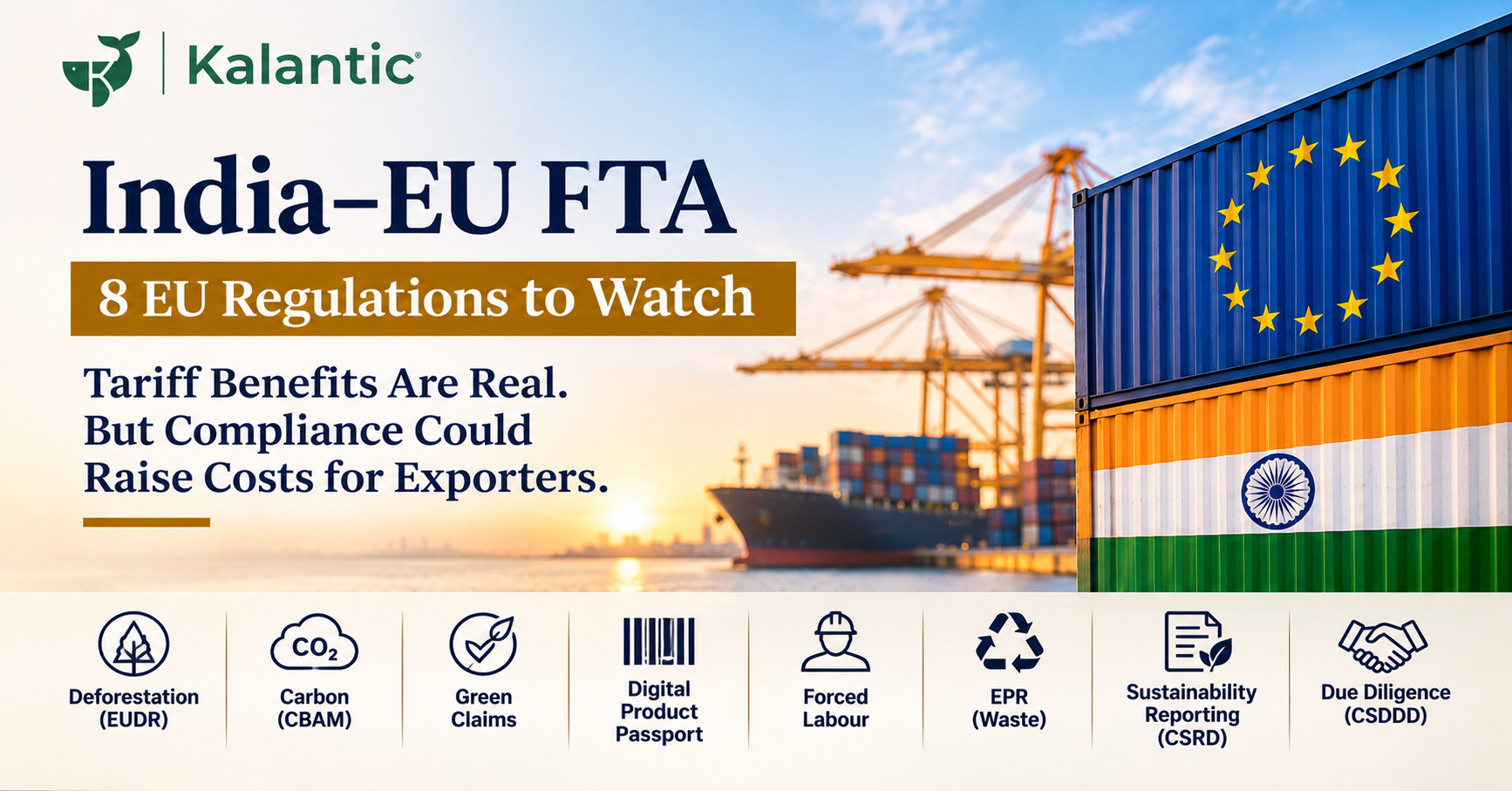
In a report released on 29 November 2026, the Global Trade Research Initiative (GTRI) identified eight EU regulations that Indian businesses should prepare for.
These include:
- EU Deforestation Regulation (EUDR).
- Carbon Border Adjustment Mechanism (CBAM).
- EU Green Claims Rules.
- Digital Product Passport (DPP).
- EU Forced Labour Regulation.
- Extended Producer Responsibility (EPR).
- Corporate Sustainability Reporting Directive (CSRD).
- Corporate Sustainability Due Diligence Directive (CSDDD).
The concern is particularly relevant for smaller Indian manufacturers that may not have the resources, systems or supplier networks required to meet these standards.
The central message is important: lower tariffs may improve access to Europe, but regulatory compliance will influence who can actually compete in that market.
Key Takeaways
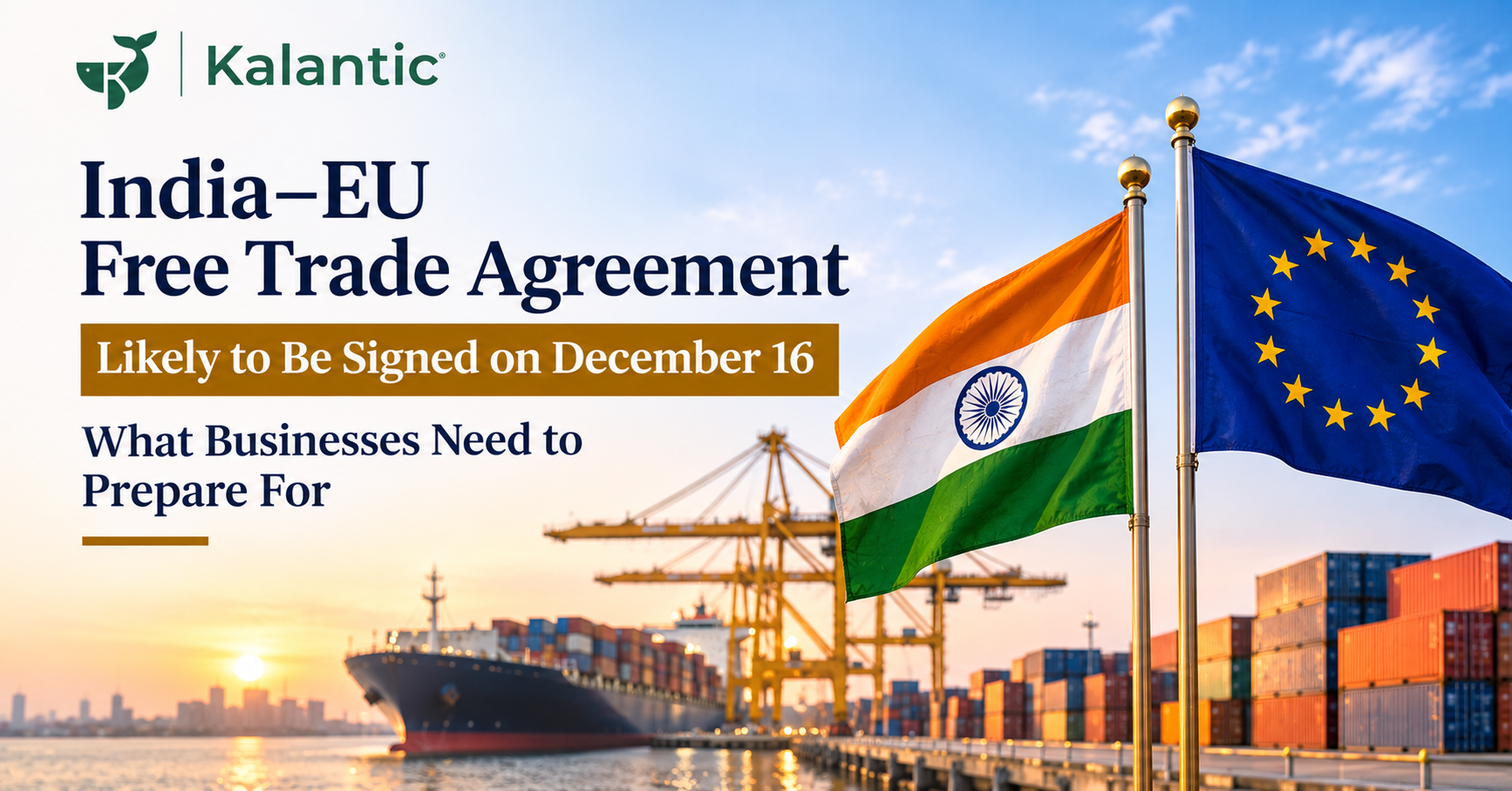
- India's proposed FTA with the EU is expected to provide significant tariff concessions, with the signing scheduled for 16 December 2026.
- India exported approximately US$72 billion worth of goods to the EU in FY2025–26.
- GTRI has identified eight European regulations that could increase compliance costs for Indian exporters.
- Requirements cover emissions reporting, deforestation traceability, product information, waste management and labour practices.
- Large manufacturers may be better equipped to absorb compliance costs than smaller exporters.
- European buyers may increasingly demand environmental, social and supply-chain information from their Indian suppliers.
- Companies that become compliance-ready could gain an advantage in securing long-term European contracts.
1. The India–EU FTA creates an opportunity, but there is another side to the story
The proposed India–EU Free Trade Agreement is expected to improve access to one of the world's largest consumer and industrial markets.
The agreement is scheduled to be formally signed in Brussels on 16 December 2026, subject to the required procedures.
For Indian exporters, the potential benefits are substantial.
Tariff reductions could improve the competitiveness of Indian textiles, engineering products, chemicals, pharmaceuticals, agricultural products and other manufactured goods.
India exported approximately US$72 billion worth of merchandise to the European Union in FY2025–26.
However, a new warning from GTRI highlights a less visible challenge.
Even as customs duties fall, the cost of meeting European regulatory requirements could increase.
European regulations increasingly require businesses to demonstrate where their products originate, how they are manufactured, what emissions they generate and whether their supply chains meet environmental and labour standards.
For large companies, these requirements may be manageable.
For smaller manufacturers and exporters, they could become a significant operational and financial burden.
The distinction is critical: a product may become cheaper to import because of lower tariffs, but more expensive to manufacture and certify because of compliance requirements.
2. The eight European regulations Indian exporters need to understand
GTRI has identified eight regulations that could influence Indian businesses selling into the European market.
They do not all apply to every exporter in the same way. Some directly regulate imported products or manufacturers, while others impose obligations on large European companies that may translate into information requests and audits for their suppliers.
Understanding the difference is essential.
Regulation 1: EU Deforestation Regulation (EUDR)
The EU Deforestation Regulation aims to prevent products associated with deforestation from entering the European market.
It covers commodities including:
- Coffee.
- Cocoa.
- Oil palm.
- Rubber.
- Soya.
- Wood.
It also covers certain derived products, including furniture, chocolate and tyres.
The underlying requirement is that covered products must not originate from land subject to deforestation after 31 December 2020 and must satisfy applicable legality and due-diligence requirements.
For Indian exporters, this creates a significant traceability challenge.
Businesses may need to establish:
- The precise geographical origin of raw materials.
- Geolocation information for relevant production plots.
- Supplier identities and sourcing records.
- Evidence of compliance with applicable local laws.
- Documentation supporting due-diligence declarations.
Consider an Indian furniture exporter sourcing timber through multiple intermediaries.
It may no longer be sufficient to obtain a supplier invoice and demonstrate that the timber was legally purchased.
The exporter may need reliable information about the original production location and the supply chain.
This could be particularly difficult for fragmented agricultural and forestry supply networks.
Business implication: Exporters dealing in covered commodities and derived products should begin mapping their sourcing networks and establishing traceability systems.
Regulation 2: Carbon Border Adjustment Mechanism (CBAM)
CBAM is one of the most commercially significant European climate regulations affecting Indian industrial exporters.
Its objective is to address carbon leakage by applying a carbon cost to certain imported goods, broadly linked to the carbon costs borne by European producers.
The mechanism initially covers selected carbon-intensive sectors, including iron and steel, aluminium, cement, fertilisers, electricity and hydrogen.
The definitive regime began in January 2026.
For Indian exporters, the challenge is to provide reliable information about the emissions associated with their products.
European importers may require verified emissions data, including information relating to:
- Production processes.
- Fuel consumption.
- Electricity consumption.
- Direct emissions.
- Relevant indirect emissions.
- Production volumes and emissions intensity.
A large steel manufacturer may already have systems to monitor plant-level emissions.
A smaller component manufacturer supplying steel products may not.
This creates a potential disadvantage for smaller businesses that lack emissions-monitoring systems and technical expertise.
GTRI has warned that smaller exporters could face greater costs if they cannot provide the required emissions information.
Business implication: Industrial exporters should begin collecting plant-level emissions data and understand the methodology used to calculate product-specific carbon intensity.
Regulation 3: EU Green Claims Rules
European consumers are increasingly exposed to claims that products are environmentally friendly, sustainable or carbon neutral.
The EU's Green Claims framework seeks to prevent misleading environmental marketing.
For Indian exporters, this has implications beyond manufacturing.
It can affect product labels, packaging, marketing material and promotional claims used in the European market.
Businesses may need evidence to substantiate statements such as:
- Environmentally friendly.
- Sustainable.
- Recyclable.
- Carbon neutral.
- Eco-friendly.
- Made using renewable materials.
Vague claims without credible supporting evidence can create regulatory and reputational risks.
European buyers may also ask Indian suppliers to review product descriptions, remove unsupported claims and provide environmental data.
Business implication: Exporters selling branded products in Europe should review environmental claims and ensure that sustainability statements are supported by appropriate evidence.
Regulation 4: Digital Product Passport (DPP)
The Digital Product Passport is designed to improve transparency around the materials, environmental footprint and lifecycle of products.
It creates a digital information record associated with a product.
Depending on the applicable product-specific rules, information may include:
- Materials and components.
- Origin of materials.
- Carbon footprint.
- Durability.
- Repairability.
- Recyclability.
- Disposal and end-of-life information.
The first major mandatory application is scheduled for electric vehicle and industrial batteries from 18 February 2027.
Further product-specific requirements are expected to cover additional sectors.
For Indian manufacturers, this could change the way product information is maintained and shared with European customers.
A textile manufacturer, for example, may increasingly need to maintain structured information about materials, suppliers, production processes and environmental characteristics.
This is more than a labelling exercise.
It requires data systems that can connect information across suppliers, manufacturers and distributors.
Business implication: Manufacturers in affected sectors should begin preparing digital product records and improving the quality of their supply-chain data.
Regulation 5: EU Forced Labour Regulation
The EU Forced Labour Regulation prohibits products made using forced labour from being placed on or made available in the EU market, as well as their export from the EU.
It is scheduled to apply from 14 December 2027.
The regulation can affect goods across sectors rather than being limited to a particular industry.
European businesses may need to assess whether products entering their supply chains are associated with forced labour.
This can lead to increased scrutiny of suppliers and subcontractors.
Indian exporters may face requests for information about:
- Labour practices.
- Recruitment processes.
- Subcontractors.
- Working conditions.
- Supplier monitoring.
- Grievance mechanisms.
- Labour-related due diligence.
For manufacturers operating through multiple tiers of subcontracting, this could become a significant challenge.
Business implication: Exporters should maintain transparent labour records and understand the employment practices of their suppliers and subcontractors.
Regulation 6: Extended Producer Responsibility (EPR)
Extended Producer Responsibility shifts responsibility for managing products at the end of their useful life towards producers.
The principle is that businesses placing products on the market should contribute to the collection, recycling and responsible disposal of those products.
European EPR requirements vary by product category and national implementation.
For Indian businesses exporting into Europe, this can create obligations involving:
- Registration with relevant national schemes.
- Reporting product and packaging quantities.
- Financing waste collection and recycling.
- Meeting recycling and recovery obligations.
- Appointing local representatives where required.
The requirements can be particularly relevant for Indian brands selling directly to European consumers.
A manufacturer selling packaged consumer goods may need to consider not just the product itself but also the packaging that enters the European waste-management system.
Business implication: Exporters should determine whether their products fall within relevant EPR schemes in their destination countries and identify the local registration and reporting requirements.
Regulation 7: Corporate Sustainability Reporting Directive (CSRD)
The Corporate Sustainability Reporting Directive establishes sustainability reporting requirements for companies within its scope.
It covers areas such as:
- Environmental impact.
- Energy consumption.
- Greenhouse gas emissions.
- Water usage.
- Workforce conditions.
- Social responsibility.
- Governance practices.
The regulatory framework has undergone changes and simplification discussions, so businesses must assess the applicable thresholds and implementation timetable rather than assume every European company or Indian supplier is directly covered.
For Indian exporters, the indirect impact can still be significant.
Large European customers may request information from suppliers to support their own sustainability reporting.
This means Indian manufacturers could receive questionnaires and data requests relating to their operations, even where they are not directly subject to the reporting obligation.
Business implication: Exporters supplying large European companies should establish reliable systems for recording energy use, emissions, water consumption and relevant workforce information.
Regulation 8: Corporate Sustainability Due Diligence Directive (CSDDD)
The Corporate Sustainability Due Diligence Directive requires qualifying companies to identify and address certain adverse human-rights and environmental impacts across their operations and relevant value chains.
Its scope and implementation timetable have been subject to EU legislative changes.
The framework can involve assessment of:
- Human-rights risks.
- Working conditions.
- Environmental impacts.
- Supply-chain practices.
- Risk prevention and mitigation.
- Monitoring and reporting.
For Indian suppliers, the most important implication is that large European buyers may scrutinise their supply chains more closely.
A European company purchasing products from an Indian manufacturer may seek information about factory conditions, worker safety, environmental practices and subcontracting arrangements.
Where material risks remain unresolved, buyers may reconsider supplier relationships.
Business implication: Indian exporters should treat responsible sourcing, labour practices and environmental management as important components of long-term supplier qualification.
3. Why smaller Indian exporters face a greater challenge
Large exporters generally have more resources to manage regulatory compliance.
They may have dedicated sustainability teams, environmental consultants, digital reporting systems and established supplier-audit processes.
Smaller manufacturers often operate differently.
A business with 50 or 100 employees may depend on several small suppliers and subcontractors.
It may not have:
- A dedicated compliance department.
- Product-level emissions data.
- Digital traceability systems.
- Formal supplier-audit procedures.
- Sustainability reporting capabilities.
- The financial capacity to absorb additional certification costs.
This creates a potential divide within the Indian export ecosystem.
Larger businesses may adapt relatively quickly, while smaller suppliers could struggle to meet the requirements of European buyers.
The issue is not necessarily that these businesses manufacture inferior products.
It is that they may lack the systems and documentation required to demonstrate compliance.
This is an important distinction.
The next competitive advantage in international trade may not simply be manufacturing cost. It may be the ability to prove how a product was manufactured.
4. Will the India–EU FTA still benefit Indian exporters?
Yes. The FTA could provide substantial commercial benefits through tariff reductions and improved market access.
However, tariff concessions and regulatory compliance address different aspects of international trade.
| Area | What the FTA or EU framework addresses |
|---|---|
| Customs duties | Reduction or elimination of applicable tariffs |
| Rules of origin | Conditions for qualifying for preferential treatment |
| Product standards | Technical and regulatory compliance |
| Carbon emissions | Emissions reporting and applicable carbon costs |
| Traceability | Evidence of sourcing and product information |
| Labour practices | Restrictions and due-diligence requirements |
| Sustainability | Environmental data and responsible business practices |
A lower customs duty does not exempt a product from European environmental, safety or labour requirements.
The FTA also preserves the parties' right to regulate in pursuit of legitimate public-policy objectives.
Therefore, exporters should treat tariff benefits and regulatory readiness as two separate workstreams.
The businesses that prepare for both will be better positioned to benefit from the agreement.
5. Compliance could become a competitive advantage
There is another way to look at the regulatory challenge.
European buyers are not necessarily looking for the cheapest supplier.
They also want reliability, consistency, transparency and reduced supply-chain risk.
An Indian manufacturer that can demonstrate:
- Verified product information.
- Traceable sourcing.
- Reliable emissions data.
- Responsible labour practices.
- Documented quality systems.
- Consistent regulatory compliance.
may become a more attractive supplier than a competitor offering a slightly lower price but lacking supporting documentation.
This is particularly relevant for medium-sized Indian manufacturers looking to move into higher-value international contracts.
Instead of viewing compliance entirely as a cost, businesses should consider how it can strengthen their commercial positioning.
A compliance-ready supplier can potentially reduce the administrative burden on its European customer and improve the buyer's confidence in the relationship.
6. What Indian exporters should do now
The India–EU FTA is expected to be signed on 16 December 2026, with implementation subject to the necessary procedures.
Businesses should not wait until the agreement becomes operational to prepare.
A practical preparation plan can begin with six steps.
Step 1: Map your products
Identify the HS codes of products exported or intended for export to Europe.
Determine which regulatory requirements apply to each product category.
Step 2: Map your supply chain
Identify the origin of raw materials, suppliers, subcontractors and manufacturing locations.
Build a documented record of the supply chain rather than relying on informal supplier declarations.
Step 3: Assess carbon and environmental data
Determine whether your business can calculate and substantiate relevant emissions, energy consumption and environmental information.
This is particularly important for industrial exporters affected by CBAM.
Step 4: Review labour and sourcing practices
Document employment practices, subcontracting arrangements, worker safety procedures and supplier monitoring.
Step 5: Build digital documentation systems
Develop a structured method for storing product information, certifications, supplier details and traceability records.
This will become increasingly important as Digital Product Passport requirements expand.
Step 6: Engage European buyers early
Ask potential customers what information and compliance standards they expect from suppliers.
Large European buyers may already have supplier questionnaires and qualification procedures that go beyond minimum legal requirements.
Understanding these expectations early can prevent expensive last-minute changes.
7. An emerging business opportunity: Helping Indian manufacturers become export-ready
The regulatory challenge also creates a new commercial ecosystem.
Indian manufacturers may require assistance from specialist service providers to prepare for European market requirements.
Potential opportunities include:
| Business requirement | Potential service opportunity |
|---|---|
| Carbon accounting | Emissions measurement and reporting |
| Product traceability | Digital supply-chain platforms |
| Product certification | Testing and certification services |
| Supplier audits | ESG and labour compliance assessments |
| Digital Product Passport | Product-data and software solutions |
| EPR compliance | Waste-management and registration services |
| Export documentation | Trade compliance and advisory services |
| European market access | Distributors, importers and commercial representatives |
This is an opportunity not only for Indian consulting and technology businesses but also for international service providers looking to establish partnerships in India.
For foreign companies with specialised compliance technology, environmental data platforms, testing capabilities or supply-chain software, India's exporter ecosystem could become an important market.
The challenge is identifying the right manufacturing segments, export clusters and business partners.
Frequently Asked Questions
What are the eight EU regulations that could affect Indian exporters?
The eight identified by GTRI are the EU Deforestation Regulation, CBAM, Green Claims Rules, Digital Product Passport, Forced Labour Regulation, Extended Producer Responsibility, Corporate Sustainability Reporting Directive and Corporate Sustainability Due Diligence Directive.
Will the India–EU FTA remove these regulatory requirements?
No. Tariff reductions under the FTA do not automatically exempt Indian exporters from applicable EU product, environmental, labour or sustainability regulations.
Which Indian industries are likely to be affected?
The impact varies by regulation. Important sectors include steel, aluminium, cement, fertilisers, textiles, apparel, furniture, rubber, coffee, cocoa, food products, batteries, electronics and consumer goods.
Will smaller Indian exporters be affected even if they are not directly covered by a regulation?
Yes, potentially. Large European customers may request emissions, traceability, labour and sustainability information from their suppliers to meet their own obligations and manage supply-chain risks.
What is CBAM?
The Carbon Border Adjustment Mechanism is an EU policy that applies a carbon cost to certain imported goods based on their embedded emissions, with the objective of addressing carbon leakage.
What is a Digital Product Passport?
A Digital Product Passport is a digital record containing relevant information about a product's materials, origin, environmental footprint, durability, repairability and recyclability, according to the applicable product-specific requirements.
When will the EU Forced Labour Regulation apply?
The regulation is scheduled to apply from 14 December 2027.
How can Indian exporters prepare for European compliance requirements?
Businesses should map their supply chains, document sourcing, establish emissions and sustainability data systems, review labour practices, understand product-specific regulations and engage European buyers early.
Can compliance create a commercial advantage?
Yes. Exporters able to demonstrate traceability, responsible sourcing, product quality and reliable environmental information may become more attractive to European buyers seeking dependable suppliers.
Final Thoughts
The India–EU Free Trade Agreement could create one of the most important new market-access opportunities for Indian exporters.
But the next phase of international trade will be shaped by more than tariffs.
European buyers are increasingly evaluating the origin of products, their environmental footprint, the conditions under which they are manufactured and the transparency of the supply chains behind them.
For Indian manufacturers, this means export competitiveness will increasingly depend on two capabilities:
The ability to manufacture competitively and the ability to demonstrate compliance.
Smaller exporters will need support from government agencies, industry associations, technology providers and specialist service companies to meet these requirements.
For international businesses, the emerging compliance ecosystem also creates opportunities to provide technology, certification, consulting and supply-chain solutions to Indian manufacturers.
The FTA may open the door.
But the businesses that can demonstrate reliability, transparency and compliance are more likely to build lasting relationships with European buyers.
In the next phase of global trade, being export-ready may not be enough. Businesses will need to be compliance-ready.
About Kalantic
Kalantic helps international businesses explore, enter and develop commercial opportunities in India.
From identifying potential distributors and business partners to facilitating strategic relationships and supporting market-level engagement, Kalantic works at the intersection of market access and commercial execution.
Because entering a new market is not just about identifying opportunities. It is about knowing whom to engage, how to build trust and how to turn relationships into business.
Whom should you know to build your business in India?
Explore more at Kalantic.
Sources
Global Trade Research Initiative (GTRI) — Why Exporters Must Prepare for Eight EU Regulatory Compliance Mandates, 29 November 2026.
https://www.basispointinsight.com/Story/why-exporters-must-prepare-for-eight-eu-regulatory-compliance-mandates_523cf7e690d4.htmlNDTV Profit / Press Trust of India — India-EU FTA: Eight EU Regulations May Raise Costs for Small Exporters, Says GTRI, 29 November 2026.
https://www.ndtvprofit.com/business/india-eu-fta-eight-eu-regulations-may-raise-costs-for-small-exporters-says-gtri-12392642The Economic Times — CBAM among eight EU laws to threaten exports despite trade deal: GTRI, 29 November 2026.
https://economictimes.indiatimes.com/news/economy/foreign-trade/cbam-among-eight-eu-laws-to-threaten-exports-despite-trade-deal-gtri/articleshow/136268073.cmsEuropean Commission — India–EU Free Trade Agreement, official proposal and documentation.
https://policy.trade.ec.europa.eu/eu-trade-relationships-country-and-region/countries-and-regions/india/eu-india-agreement_en
Ready to Explore India?
Expanding into India requires more than market research—it requires the right customers, partners, and commercial strategy. Kalantic helps international companies validate opportunities, identify customers and channel partners, and build a sustainable business presence in India. Whether you’re evaluating India for the first time or accelerating your expansion, our team can help you make informed decisions with confidence.
Book an India Market Entry Discussion
Or email us at: info@kalantic.com