Direct Answer
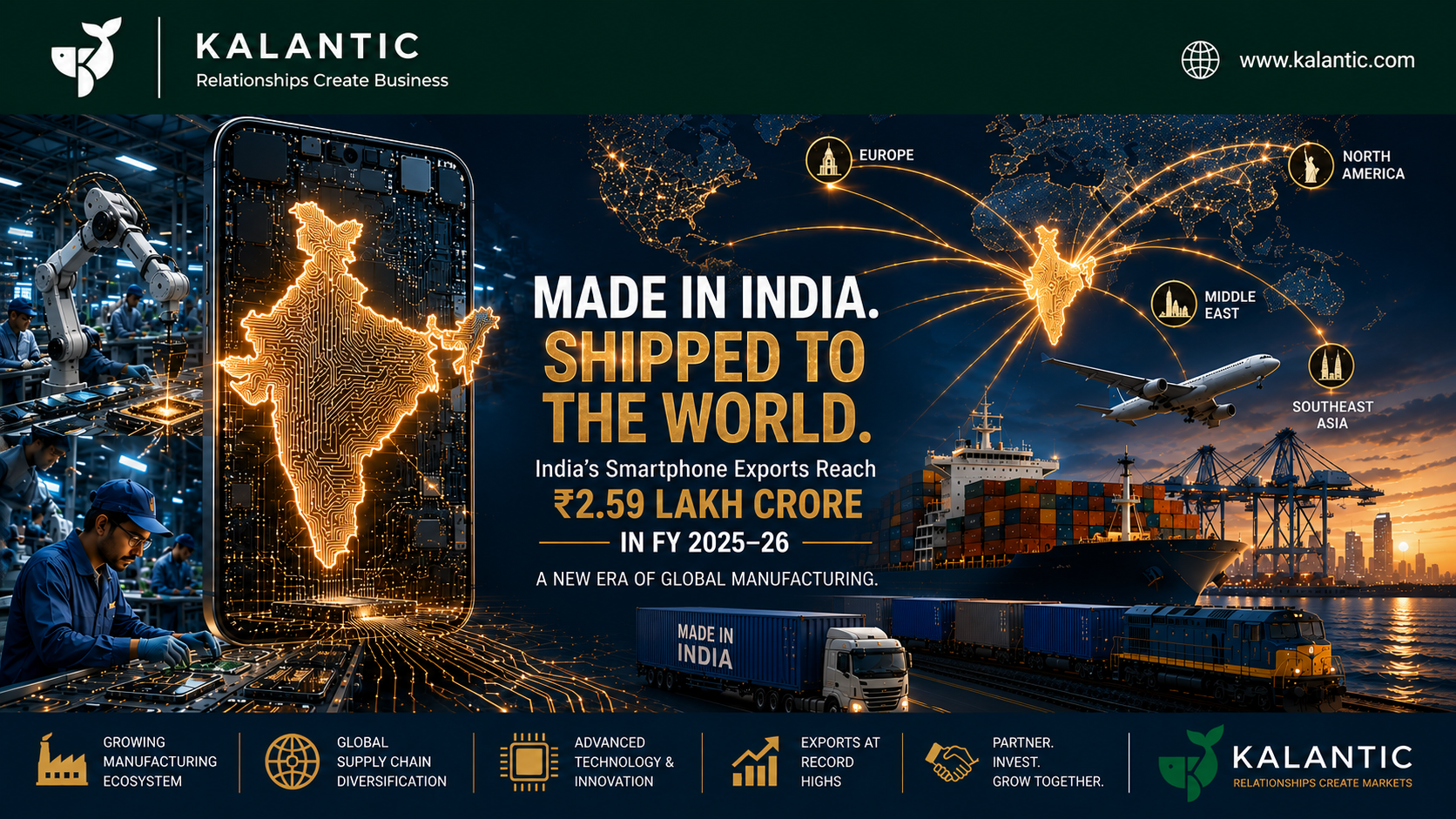
India's smartphone exports reached approximately ₹2.59 lakh crore in FY 2025–26, marking another milestone in the country's manufacturing growth. For international companies, this is not simply a success story for the electronics industry - it is evidence that India is becoming an increasingly important destination for global manufacturing, supply chain diversification, and export-oriented investment.
Key Takeaways
- India has become one of the world's fastest-growing smartphone manufacturing hubs.
- Electronics exports demonstrate the country's improving manufacturing ecosystem.
- Global companies are increasingly viewing India as both a production base and a strategic market.
- Supply chain diversification continues to create opportunities beyond China.
- Businesses considering India should focus on long-term capability rather than short-term cost advantages.
India's Smartphone Export Story Is Bigger Than Smartphones
India's smartphone exports touched approximately ₹2.59 lakh crore during FY 2025–26, continuing a remarkable upward trajectory over the past decade.
While the headline focuses on smartphones, the broader significance lies elsewhere.
The achievement demonstrates that India is steadily strengthening the capabilities required to compete in global manufacturing - including production capacity, supplier ecosystems, logistics, quality standards, and export infrastructure.
For companies evaluating manufacturing locations, these capabilities matter far more than any single export statistic.
Why Global Businesses Should Pay Attention
For years, multinational companies have sought to diversify manufacturing risk by reducing dependence on a single country.
India has emerged as one of the strongest alternatives due to several structural advantages:
- A large engineering workforce
- Growing domestic demand
- Government support for manufacturing
- Expanding infrastructure
- Increasing supplier maturity
- Stronger export capabilities
These factors make India attractive not only for serving its domestic market but also for supplying customers worldwide.
The Apple Effect - and Beyond
Companies such as Apple have helped accelerate India's electronics manufacturing ecosystem through local production and supplier development.
However, the opportunity extends well beyond smartphones.
As supplier networks become more sophisticated, companies across sectors—including industrial equipment, automotive components, medical devices, renewable energy, and consumer electronics—may benefit from stronger manufacturing capabilities.
The real story is ecosystem development rather than the success of any single company.
Why Supply Chains Are Changing
Over the past several years, businesses have increasingly prioritized supply chain resilience alongside cost efficiency.
Many manufacturers now seek:
- Multiple production locations
- Reduced geopolitical risk
- Greater supplier diversification
- Improved logistics flexibility
- Access to new growth markets
India's expanding manufacturing base aligns well with these strategic objectives.
Rather than replacing existing manufacturing hubs, India is increasingly becoming an important part of a diversified global production network.
Opportunities for International Companies
Businesses evaluating India today may find opportunities in several areas:
| Opportunity | Potential Benefit |
|---|---|
| Manufacturing | Competitive production capabilities |
| Component sourcing | Access to expanding supplier networks |
| Distribution | Growing domestic consumer market |
| R&D | Large engineering talent pool |
| Export operations | Regional and global market access |
The right opportunity depends on each company's industry, objectives, and long-term strategy.
Challenges Still Remain
India's progress should not be interpreted as the removal of every operational challenge.
Companies entering the market should still evaluate:
- State-level regulations
- Infrastructure differences
- Partner selection
- Labour availability
- Compliance requirements
- Tax considerations
- Logistics planning
Successful market entry continues to require careful planning and local expertise.
What This Means for Companies Considering India
Rather than asking:
"Should we manufacture in India?"
A more useful question may now be:
"Which part of our value chain could benefit from India's growing manufacturing ecosystem?"
For some businesses, the answer may involve sourcing.
For others, contract manufacturing, assembly, exports, engineering services, or regional distribution may offer stronger opportunities.
The key is to evaluate India strategically rather than viewing it solely as a low-cost manufacturing destination.
Frequently Asked Questions
Why are India's smartphone exports growing so quickly?
Growth has been driven by increasing manufacturing capacity, investments by global electronics companies, government initiatives supporting domestic manufacturing, and stronger export capabilities.
Does this opportunity only apply to smartphone companies?
No. Improvements in manufacturing infrastructure and supplier ecosystems can benefit businesses across multiple industries, including industrial products, healthcare, renewable energy, automotive, and consumer goods.
Is India replacing China as a manufacturing hub?
Most global manufacturers are pursuing diversification rather than complete replacement. India is increasingly becoming an important complementary manufacturing location within broader global supply chains.
Should foreign companies manufacture in India?
The answer depends on industry, product complexity, customer markets, and supply chain strategy. Many companies now evaluate India as part of a broader manufacturing portfolio rather than making an all-or-nothing decision.
What should companies evaluate before investing?
Businesses should assess customer demand, supplier availability, infrastructure, regulatory requirements, logistics, incentives, and potential commercial partners before making significant investments.
Final Thoughts
India's record smartphone exports represent more than an impressive economic statistic.
They reflect the gradual maturation of a manufacturing ecosystem capable of supporting global businesses across multiple industries.
For international companies, the opportunity is not simply to manufacture in India—but to determine where India fits within a resilient, diversified, and future-ready global supply chain.
Companies that begin evaluating these opportunities today are likely to be better positioned as India's manufacturing capabilities continue to expand.
About Kalantic
Kalantic helps international companies build customers, partners, and business in India.
Our services include:
- Market research
- Customer acquisition
- Partner identification
- Distributor evaluation
- Business development
- Commercial representation
Whether you're exploring manufacturing, distribution, or strategic partnerships, Kalantic helps you make informed commercial decisions with confidence.
Book an India Market Entry Discussion: https://kalantic.com/contact
Sources
Times of India. "Made-in-India phones go global: Smartphone exports jump to ₹2.59 lakh crore." https://timesofindia.indiatimes.com/business/india-business/made-in-india-phones-go-global-smartphone-exports-jump-165-times-to-rs-2-59-lakh-crore/articleshow/132710144.cms
Ministry of Electronics & Information Technology (MeitY). https://www.meity.gov.in/
Invest India. https://www.investindia.gov.in/
Department for Promotion of Industry and Internal Trade (DPIIT). https://dpiit.gov.in/
Ready to Explore India?
Expanding into India requires more than market research—it requires the right customers, partners, and commercial strategy. Kalantic helps international companies validate opportunities, identify customers and channel partners, and build a sustainable business presence in India. Whether you’re evaluating India for the first time or accelerating your expansion, our team can help you make informed decisions with confidence.
Book an India Market Entry Discussion
Or email us at: info@kalantic.com