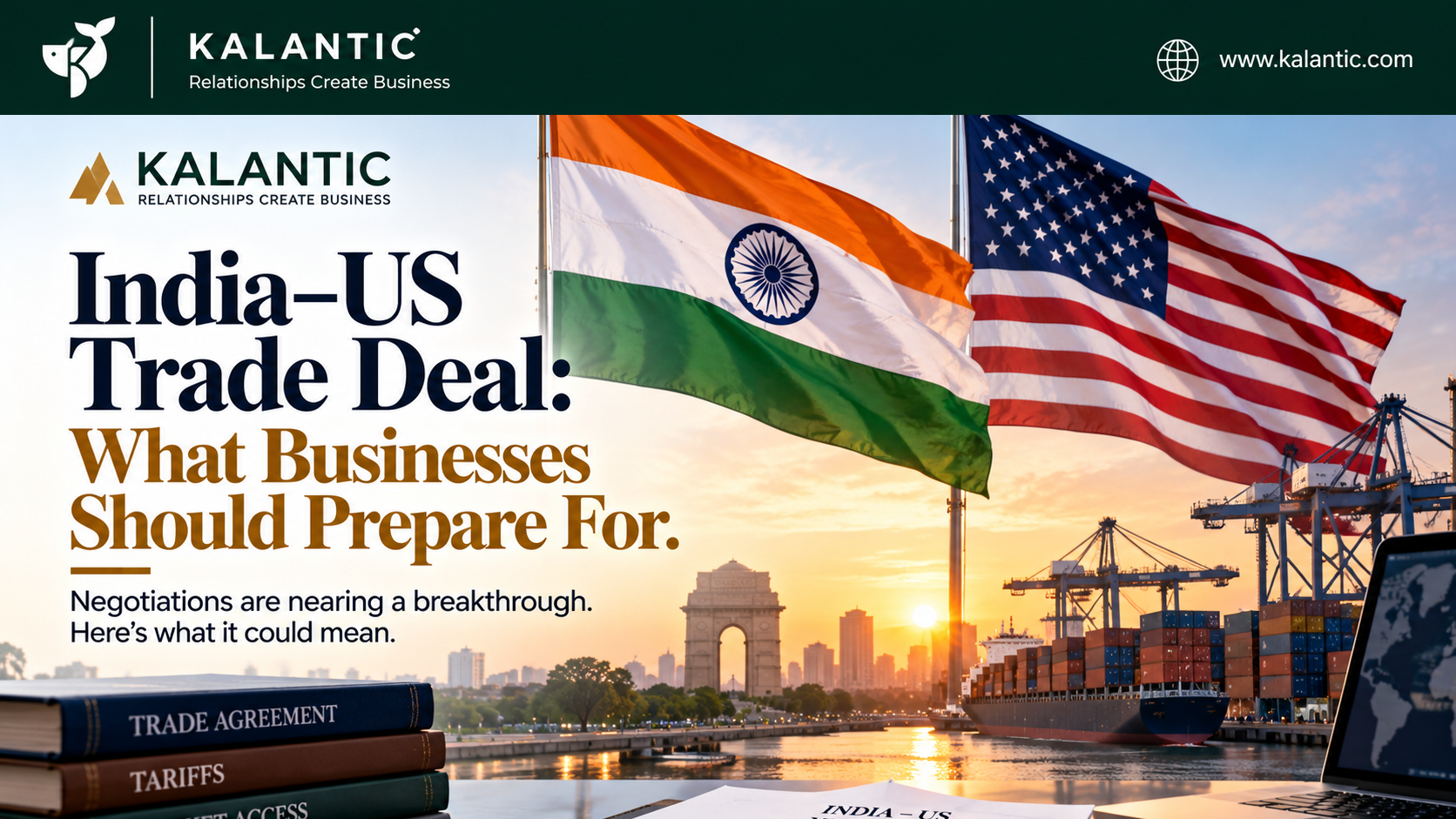
India and the United States could be moving closer to a bilateral trade agreement, according to recent public comments by US Ambassador Sergio Gor. Ahead of US Secretary of State Marco Rubio’s India visit scheduled for 19–22 October 2026, Gor said the major components of the negotiations had been addressed, while remaining details were still being worked through.
This is an important signal for businesses operating across the two economies. However, the negotiations should not be confused with a signed, implemented trade agreement. Until the final terms are officially announced and their implementation timelines are clear, companies should avoid making irreversible commercial decisions based on anticipated concessions.
The practical priority is preparation: identify where trade barriers affect your business, assess alternative sourcing and market-entry options, and build relationships with the partners who can help turn any eventual agreement into commercial growth.
Key Takeaways
- Negotiations appear to be advancing: US officials have publicly indicated substantial progress, but final terms remain unconfirmed.
- A potential agreement could change market access: Tariffs, product-specific rules, customs procedures and regulatory requirements may influence which opportunities become commercially viable.
- Preparation should begin before implementation: Companies can map their exposure, evaluate products and identify partners without assuming any particular tariff reduction.
- Market access is not the same as market success: Lower trade barriers alone do not establish distribution, customer demand or local execution capability.
- Relationships can become a competitive advantage: Businesses that understand the relevant importers, distributors, manufacturers and institutional stakeholders will be better positioned to respond when the final terms are known.
What Has Happened in the India–US Trade Negotiations?
On 15–16 October, reporting by The Indian Express described comments by US Ambassador Sergio Gor that negotiations were progressing rapidly. Gor indicated that the major components of the proposed agreement had been addressed, while acknowledging that a complex agreement involving two large economies would require further work.
His comments came ahead of a planned visit to India by US Secretary of State Marco Rubio from 19–22 October.
The visit is expected to include business-related engagements, with meetings involving Indian business interests also reported as part of the programme.
These developments suggest continued high-level engagement around the commercial relationship. They do not, by themselves, establish the final tariff schedule, the sectors covered, the rules of origin or the date on which any concessions would take effect.
For companies, that distinction is fundamental.
A public statement about progress can justify scenario planning. It cannot replace the legal text of an agreement or the official notifications required to implement it.
Why the Next Phase Matters More Than the Announcement
Trade agreements often receive the most attention when political leaders announce them. For businesses, the commercially important work frequently begins afterwards.
Companies need to understand which products qualify, what documentation is required, how customs procedures will operate and whether additional standards or regulatory approvals apply.
Three areas deserve particular attention.
1. Tariffs and Product-Level Competitiveness
A change in tariff treatment can alter the economics of exporting a product into another market.
For an Indian manufacturer selling to the United States, a lower applicable tariff could potentially improve price competitiveness. For a US company exporting to India, improved market access could change the attractiveness of serving Indian customers directly or through a local partner.
But the effect will not be uniform.
The commercial outcome depends on the specific product, the existing tariff, the final negotiated treatment, competing suppliers, logistics costs, currency movements and customer demand.
Companies should therefore assess individual product categories rather than assume that an agreement will benefit every exporter equally.
Practical action: Prepare a product-level exposure map showing current trade costs, alternative sourcing options, key competitors and the tariff scenarios that would materially change your margins.
2. Rules of Origin and Supply-Chain Decisions
A product's country of origin can determine whether it qualifies for preferential treatment under a trade agreement.
This matters for companies that manufacture in multiple countries, source components internationally or undertake final assembly in a different jurisdiction.
A change in tariff rates does not automatically make every shipment eligible for preferential treatment. The applicable rules of origin, documentation and product-specific requirements must be examined once the agreement's terms are published.
Businesses should avoid relocating manufacturing or restructuring procurement solely in anticipation of unconfirmed concessions.
Practical action: Identify the origin of key products and components, map supplier locations, and determine what documentation would be required under plausible trade scenarios.
3. Local Partnerships and Distribution
Even when a product becomes more competitive at the border, it still needs a route to the customer.
A foreign manufacturer entering India may require an importer, distributor, service partner, regulatory adviser or local sales organisation. An Indian exporter targeting the United States may need channel partners, customer introductions, warehousing arrangements or after-sales support.
The relevant partner depends on the product, sector and business model.
Trade policy can change the economics of an opportunity. It does not automatically create the commercial relationships required to capture it.
Practical action: Build a shortlist of qualified local partners, assess their capabilities and customer access, and validate their willingness to work together before committing to a market-entry plan.
Which Businesses Should Be Preparing Now?
Rather than speculate about which industries will receive the largest concessions, companies should identify where a change in trade conditions would materially affect their business.
| Business type | What to assess now |
|---|---|
| Indian exporters | US customer concentration, product competitiveness, origin documentation and channel partners |
| US manufacturers | Indian demand, local distribution, applicable import duties and regulatory requirements |
| Industrial suppliers | Product-level landed costs, technical standards and potential Indian buyers |
| Consumer brands | Pricing, importer margins, distribution coverage and customer acquisition costs |
| Multinational companies | Manufacturing footprint, sourcing alternatives and cross-border operating models |
| Investors | Sector exposure, regulatory constraints, partner credibility and the timing of any policy changes |
This is not a prediction that every category will benefit from the eventual agreement. It is a framework for identifying which businesses would be most sensitive to changes in the final terms.
A Practical 30-Day Preparation Plan
Businesses do not need to wait for a final agreement to begin preparing. They do, however, need to separate reversible planning from irreversible commitments.
Week 1: Establish Your Current Position
Identify the products, services and business operations most exposed to India–US trade conditions.
Document current tariffs and other trade costs using authoritative sources. Establish your existing customer and supplier concentration, and identify the commercial assumptions that depend on policy changes.
Week 2: Model the Scenarios
Build at least three scenarios: no immediate change, a limited set of concessions, and a broader agreement with meaningful sector-specific changes.
Model the effects on landed costs, pricing, margins and supplier competitiveness. Use illustrative assumptions until the final terms are published.
Week 3: Validate the Market
Speak with prospective customers, distributors, importers and suppliers. Determine whether the underlying commercial opportunity exists independently of any anticipated tariff benefit.
A product with genuine demand and a credible route to market is generally a stronger opportunity than one whose business case depends entirely on a policy change.
Week 4: Prepare an Execution Plan
Identify the partners, documentation, compliance work and operational investments required under each scenario.
Assign responsibility for monitoring official announcements and reviewing the final text. Set decision triggers for when to proceed, pause or revise the plan.
The objective is not to predict the exact outcome. It is to reduce the time required to act once the outcome becomes clear.
The India Opportunity Goes Beyond Tariffs
For international businesses, India–US trade negotiations are part of a broader commercial relationship involving manufacturing, technology, services, investment and market development.
An agreement may influence the economics of cross-border trade. Yet a successful expansion strategy also depends on customer access, partner quality, local competition, regulatory execution and the ability to operate consistently over time.
This is particularly important for smaller and mid-sized companies. They may have competitive products and the ambition to enter a new market, but lack the local relationships and commercial infrastructure of larger multinational businesses.
For these companies, the challenge is often not simply finding a market opportunity. It is determining whom to approach, which partners to trust and how to convert initial interest into repeat business.
That work can begin before a trade agreement is signed.
How Kalantic Helps Businesses Prepare
At Kalantic, we focus on the commercial side of cross-border growth.
For a company considering India, the questions are practical:
- Which customers or market segments should we prioritise?
- Which importers, distributors or strategic partners are relevant?
- What capabilities should a local partner demonstrate?
- Which relationships could accelerate market access?
- How do we move from initial discussions to a commercially viable operating model?
These questions remain important regardless of whether the eventual trade agreement delivers broad tariff reductions or more limited sector-specific changes.
Our approach centres on market intelligence, partner ecosystems, relationship development and commercial execution—not simply producing a list of companies.
The question is not only what the trade agreement might change. It is whom your business needs to know to take advantage of those changes.
Explore Kalantic's cross-border business development approach at https://kalantic.com.
Frequently Asked Questions
Has India signed a new trade agreement with the United States in October 2026?
The latest reporting cited here indicates that negotiations are progressing, with US officials saying major components have been addressed. These statements do not establish that a final agreement has been signed or implemented. Businesses should wait for official announcements and published terms before assuming that new concessions apply.
What could an India–US trade agreement mean for exporters?
Depending on the final terms, an agreement could change tariffs or other market-access conditions for particular products. The actual benefit would depend on product coverage, rules of origin, implementation timelines, compliance requirements and commercial competitiveness.
Should companies change their sourcing strategy before the agreement is finalised?
They should evaluate options and model scenarios, but avoid irreversible decisions based solely on unconfirmed concessions. Any sourcing change should also account for quality, logistics, supplier reliability and regulatory requirements.
How can a smaller company prepare for improved market access?
Start by identifying target customers, validating demand, calculating current landed costs, understanding product-specific requirements and developing relationships with credible importers or distributors. These steps are useful even if the negotiations take longer than expected.
Where should businesses verify the final trade terms?
Use official announcements and legal implementation documents from the relevant Indian and US government authorities. Media reports can explain the negotiations, but they should not substitute for the final agreement, tariff schedules or official customs guidance.
Final Thoughts
India–US trade negotiations may be approaching an important milestone, but businesses should distinguish diplomatic momentum from enforceable commercial terms.
The most effective response is neither to wait passively nor to commit prematurely.
It is to identify trade exposure, test commercial scenarios, validate customer demand and develop the relationships needed to execute quickly when the rules become clear.
Trade agreements can open doors. Preparation and commercial relationships help businesses walk through them.
About Kalantic
Kalantic Partners LLP helps international businesses develop their India market-entry and growth strategies through business development, partner ecosystems, on-ground market intelligence and commercial execution.
We help companies identify relevant relationships, validate opportunities and translate cross-border ambitions into actionable business plans.
Visit https://kalantic.com to learn more.
Sources
- The Indian Express, 16 October 2026 — US ambassador says India–US trade negotiations are moving at an incredible pace.
- Reuters, 16 October 2026 — India–US monetary and currency developments. This provides wider economic context rather than confirmation of trade-agreement terms.
Ready to Explore India?
Expanding into India requires more than market research—it requires the right customers, partners, and commercial strategy. Kalantic helps international companies validate opportunities, identify customers and channel partners, and build a sustainable business presence in India. Whether you’re evaluating India for the first time or accelerating your expansion, our team can help you make informed decisions with confidence.
Book an India Market Entry Discussion
Or email us at: info@kalantic.com