
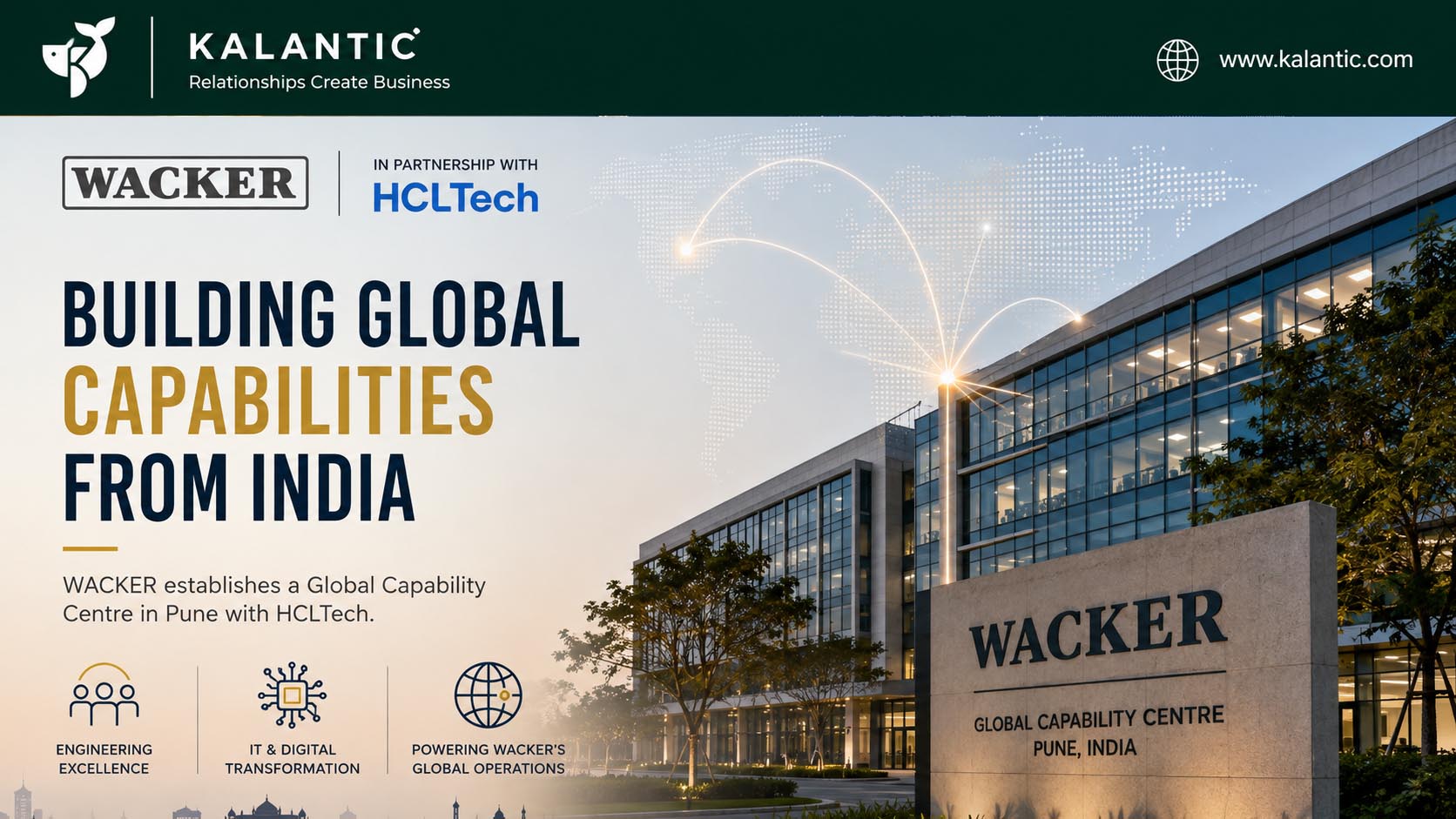
Why WACKER Is Building Its Global Capabilities in India
When international companies think about India, the first question is often:
Can we sell our products here?
But increasingly, another question is becoming important:
What can we build here for the rest of the world?
German chemicals and biotechnology company WACKER has just provided an interesting example.
The company has established a Global Capability Centre in Pune in collaboration with HCLTech.
The centre will support WACKER's engineering, IT and digital transformation initiatives and is designed to strengthen the company's global delivery and digital execution capabilities.
That distinction matters.
This is not simply an Indian office supporting the Indian market.
It is part of WACKER's global operating model.
India as More Than a Market
WACKER is a global company headquartered in Munich, with more than 16,000 employees and a network spanning production sites, technical competence centres and sales offices around the world.
India is already an established market for the company.
WACKER has operated in the country for decades, with businesses spanning chemicals, silicones, polymers and related applications.
The new Pune centre represents another layer of that presence.
Instead of focusing only on selling products in India, WACKER is using India to support activities that have relevance across its international operations.
That is a meaningful shift in how companies can think about India.
What Will the Pune Centre Do?
The new Global Capability Centre will support three broad areas:
- Engineering
- Information technology
- Digital transformation
HCLTech will work with WACKER to build and scale the centre, using capabilities including DevSecOps and automation.
The objective is to create a flexible and resilient operating model while strengthening governance and accelerating digital modernisation.
WACKER has described the centre as an important step in strengthening its global delivery and digital execution capabilities.
In other words:
India is becoming part of the company's global capability architecture.
This Is Different From Traditional Outsourcing
There is an important distinction here.
A traditional outsourcing arrangement is often about reducing the cost of a specific function.
A Global Capability Centre can be much broader.
It can become a long-term internal capability for the company.
The organisation can build:
- Engineering expertise
- Technology capabilities
- Digital platforms
- Process knowledge
- Domain expertise
- Innovation capabilities
- Global delivery teams
The goal is not simply to have work done in India.
It is to have important work owned and delivered from India.
That difference can have strategic implications.
Why India Makes Sense
India has spent decades building one of the world's largest technology and engineering talent ecosystems.
But the opportunity has evolved.
It is no longer limited to software development.
Companies are increasingly building capabilities in:
- Engineering
- Artificial intelligence
- Data
- Cybersecurity
- Product development
- Research
- Digital transformation
- Enterprise technology
- Industry-specific expertise
For a company like WACKER, this creates the possibility of combining India's technology and engineering capabilities with deep industrial knowledge.
That combination can be valuable.
The Industrial Company Is Becoming a Digital Company
Chemicals may appear far removed from digital transformation.
They aren't.
A modern specialty chemicals company operates across complex global processes.
It manages production facilities.
Customer applications.
Technical services.
Research and development.
Quality systems.
Regulatory requirements.
Global sales.
Supply and logistics operations.
And increasingly, large amounts of digital information.
Technology therefore becomes an important part of how the company operates.
For WACKER, the Pune centre can support that transformation.
The Strategic Value Goes Beyond Cost
India's cost advantage is well known.
But cost alone is no longer enough to explain why global companies establish substantial capabilities here.
A company can save money by outsourcing a process.
But a company builds a strategic capability when it wants to develop something that matters to its future.
Engineering.
Technology.
Digital transformation.
Automation.
AI.
These are not merely back-office functions.
They can influence how a company operates globally.
That makes the decision to build such capabilities in India more significant.
The Importance of the HCLTech Partnership
WACKER is not building the centre entirely from scratch.
It is doing so in collaboration with HCLTech.
That is another useful lesson for international companies.
Entering a new country does not always mean building every capability internally from day one.
A strategic technology partner can help with:
- Hiring
- Technology implementation
- Operating processes
- Governance
- Digital platforms
- Automation
- Scaling the organisation
This can reduce the time required to establish a new capability.
It also allows the international company to focus on the areas where its own domain expertise matters most.
Partnerships Can Be the Bridge
This is particularly relevant for international companies that are smaller than WACKER.
A large multinational may have the resources to establish a full Indian organisation.
A mid-sized European company may not.
But it may still have an excellent product, technology or industrial capability.
Instead of asking:
"Can we afford to build an entire India operation?"
the company could ask:
"Who can help us build the first part of it?"
That could be:
- A technology partner
- An engineering company
- A distributor
- A local implementation partner
- A strategic advisor
- A joint-venture partner
- A customer
The first relationship does not have to determine the final structure.
It can simply reduce the distance between an international company and the Indian market.
WACKER's Existing India Presence Matters
There is another reason this move is interesting.
WACKER did not arrive in India yesterday.
The company already has an established Indian presence.
Its India operations include sales, technical activities and production-related capabilities.
That means the Pune centre can build on an existing foundation.
There is already local knowledge.
There are already employees.
There are already relationships.
There is already an understanding of the market.
The company can therefore expand its India footprint without treating every new initiative as a completely new market entry.
This is an important lesson.
Market Entry Can Be Cumulative
International expansion is often described as a sequence:
Enter a market.
Launch a product.
Build a team.
Scale the business.
But the process can be much more cumulative.
A company can begin with sales.
Then establish distribution.
Then develop technical support.
Then build manufacturing.
Then establish engineering.
Then create a global capability centre.
Each step can make the next one easier.
The company's understanding of the market deepens.
Its relationships grow.
Its local talent pool expands.
Its confidence increases.
And India gradually becomes a larger part of the global organisation.
The New Question for International Companies
This creates a different way of looking at India.
Instead of asking:
"How much business can we generate in India?"
international companies can also ask:
"Which parts of our global business could we build in India?"
The answer could be technology.
Engineering.
R&D.
Digital transformation.
Customer support.
Finance.
Analytics.
Product development.
Or specialised industry capabilities.
That significantly expands the opportunity.
India Can Serve Both the Market and the Global Organisation
The strongest India strategies may eventually do both.
An international company can use India as:
A market
to sell products and services.
And simultaneously as:
A capability base
to support its global business.
Those two roles can reinforce each other.
The local market provides customer insight.
The capability centre provides talent and expertise.
The global organisation provides technology and processes.
And local relationships connect the pieces.
That can create a much deeper presence than a simple sales office.
What Other European Companies Can Learn
WACKER's move offers several lessons for international companies considering India.
1. Don't limit the India opportunity to sales.
India can support your global organisation as well as your Indian business.
2. Build on an existing presence.
If you already have customers, employees or partners in India, look for adjacent capabilities you can develop.
3. Consider partnerships.
The right local partner can help you build capabilities faster.
4. Think beyond cost.
Talent, engineering expertise, digital capabilities and market knowledge can be more strategically valuable than labour arbitrage.
5. Let the India strategy evolve.
Your first India activity does not need to define your long-term India presence.
A Bigger Shift Is Underway
WACKER is only one example of a much larger trend.
Global companies are increasingly building Global Capability Centres in India.
But the nature of those centres is changing.
They are moving beyond traditional IT support.
They are becoming part of engineering, analytics, AI, product development, cybersecurity, finance, research and digital transformation.
That means India is increasingly being integrated into the core operations of multinational companies.
Not merely their cost structures.
Their capabilities.
From "India for India" to "India for the World"
This may be the most important shift.
An international company can build an operation in India because it wants to serve Indian customers.
But it can also build in India because it wants to serve customers everywhere.
WACKER's Pune centre is an example of the latter.
The work being developed there is intended to strengthen the company's global delivery and digital execution.
That means the value created in Pune does not stop at India's borders.
It flows into the wider organisation.
The Opportunity for International Companies
For companies considering India, this creates an interesting strategic question.
Perhaps India does not need to be treated as a single-country expansion project.
Perhaps it can be treated as a component of the global business.
A company can ask:
Where are our customers?
Where is our talent?
Where are our partners?
Where can we build capabilities?
Where can we accelerate digital transformation?
And increasingly, one of those answers may be:
India.
The Question Is No Longer Just "Why India?"
For international companies, the India conversation is becoming more sophisticated.
The question is no longer simply:
"Why should we enter India?"
It may be:
"What role should India play in our global strategy?"
For some companies, India will be primarily a market.
For others, it will be a technology and engineering base.
For others, it may become a manufacturing, R&D or innovation centre.
And for the most integrated strategies, it can be several of these at once.
WACKER's new Pune centre is a useful reminder of that evolution.
India is not just becoming a bigger market for global companies.
It is becoming a bigger part of how global companies operate.
And for international businesses considering their next phase of expansion, that creates a much more interesting question:
What could you build in India that serves not just India, but the world?
Sources
- HCLTech, August 27, 2026 — WACKER establishes Global Capability Center in India with HCLTech.
- Business Standard, August 27, 2026 — HCLTech sets up Wacker Chemie global capability centre in Pune.
- The Economic Times, August 27, 2026 — HCLTech and Wacker Chemie establish global capability centre in Pune.
- WACKER — Company information and global operations.
Ready to Explore India?
Expanding into India requires more than market research—it requires the right customers, partners, and commercial strategy. Kalantic helps international companies validate opportunities, identify customers and channel partners, and build a sustainable business presence in India. Whether you’re evaluating India for the first time or accelerating your expansion, our team can help you make informed decisions with confidence.
Book an India Market Entry Discussion
Or email us at: info@kalantic.com