
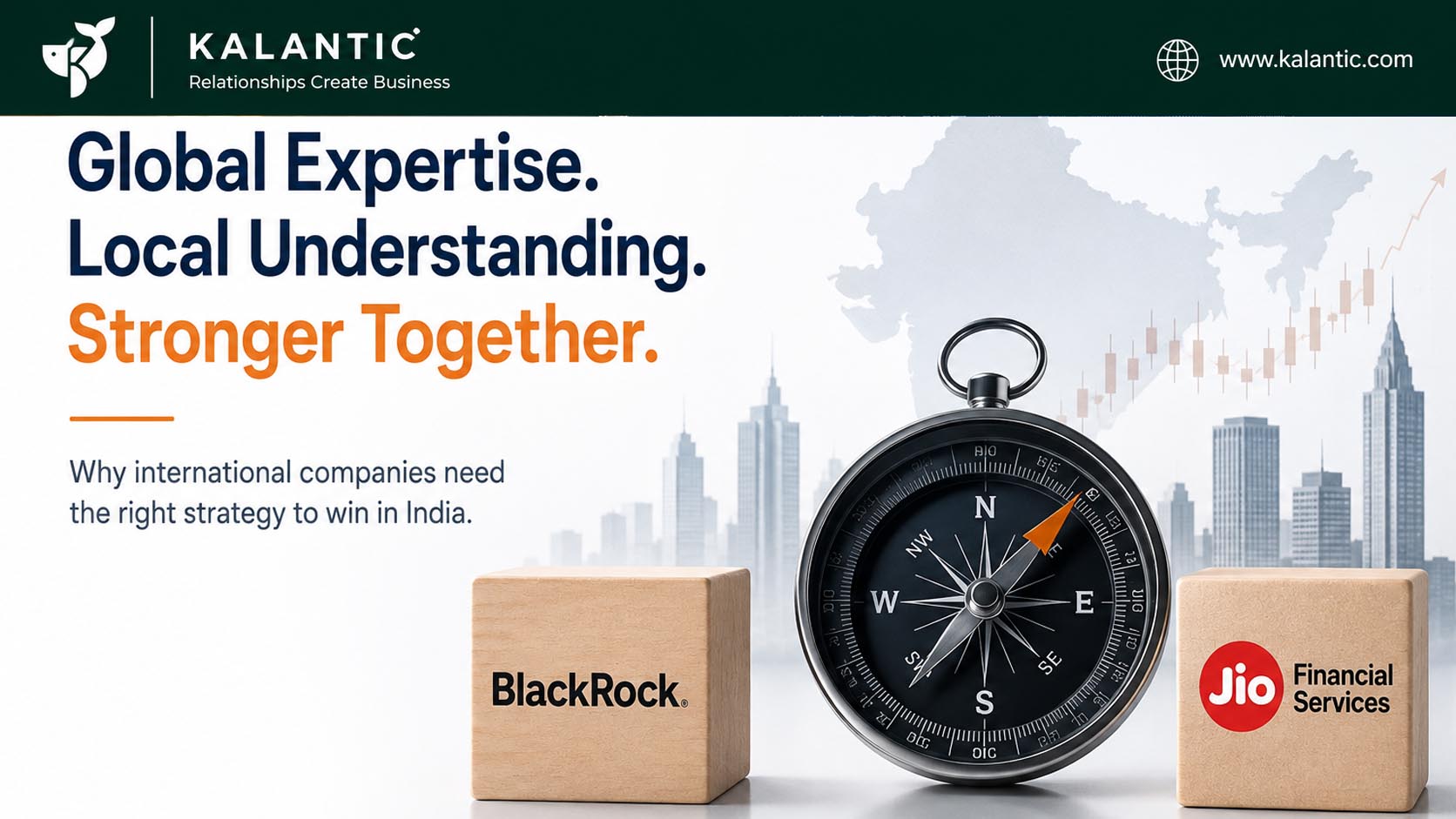
BlackRock Is Changing Its India Strategy. That Says Something Important About Entering India.
When a global company enters a new market, it usually brings something with it.
A proven business model.
A successful technology platform.
A familiar customer-acquisition strategy.
A global brand.
And, naturally, the assumption that what worked elsewhere can be adapted locally.
Sometimes it can.
Sometimes it cannot.
The latest move by JioBlackRock in India is an interesting example of the difference.
The joint venture between Jio Financial Services and global investment giant BlackRock has announced that it will introduce regular mutual-fund plans distributed through registered intermediaries.
This represents a meaningful expansion from its original approach, which was heavily focused on direct and digital distribution.
The lesson goes well beyond financial services.
India often requires international companies to adapt the way they do business, not simply the products they sell.
The Original Idea Was Simple
JioBlackRock entered India's asset-management industry with a proposition built around the strengths of both partners.
Jio brought enormous digital reach and a deep understanding of Indian consumers.
BlackRock brought global investment expertise, technology and one of the world's strongest asset-management brands.
The combination was designed to create a new model for Indian investors.
Digital.
Accessible.
Technology-led.
Direct.
The strategy made sense.
And it attracted substantial early interest.
By the end of FY2025–26, JioBlackRock had more than ₹15,000 crore in assets under management and more than one million retail investors.
Its quarterly average AUM subsequently crossed ₹16,700 crore in the first quarter of FY2026–27.
But the company also encountered an important characteristic of the Indian market.
Distribution still matters.
India Is Not Always a Direct-to-Consumer Market
India has one of the world's fastest-growing digital economies.
Consumers are comfortable with apps.
Digital payments are ubiquitous.
Online financial services have expanded rapidly.
It is tempting, therefore, to assume that a digital-first business can simply bypass traditional intermediaries.
But India's financial-services market tells a more nuanced story.
A significant proportion of retail investment still flows through distributors, advisers and other intermediaries.
For many consumers, especially when products become more complex, trust and guidance remain important.
That creates a tension between two models:
Technology-led distribution
and
relationship-led distribution.
The Indian market often rewards companies that understand how to combine both.
JioBlackRock's Latest Move
The company has now announced regular plans for its mutual-fund schemes, which will be available through registered distributors.
This expands its reach beyond investors who are comfortable researching and purchasing funds directly.
The move is particularly relevant as JioBlackRock expands into more sophisticated investment products.
The company has already moved beyond conventional mutual funds into areas such as ETFs and specialised investment funds.
As the product range becomes more complex, the role of advisers and distributors becomes increasingly important.
The company's strategy is therefore evolving.
Not abandoning digital.
Not abandoning direct distribution.
But adding another layer.
Digital plus distribution.
That may sound like a small commercial adjustment.
It isn't.
It represents something much bigger about how international businesses should approach India.
Global Playbooks Do Not Always Travel Intact
A company can have an extremely successful business model in one country.
That does not guarantee that the same model will work in another.
Customer behaviour differs.
Trust structures differ.
Distribution channels differ.
Regulations differ.
Pricing expectations differ.
Partnership models differ.
Even the way customers make decisions can differ.
This is particularly important for international companies entering India.
The mistake is not necessarily having the wrong product.
The mistake can be assuming that the route to the customer will be the same.
The Importance of Local Relationships
This is where relationships become commercially important.
A distributor is not simply another sales channel.
A good distributor may provide:
- Access to established customers
- Market intelligence
- Local credibility
- Customer education
- Regulatory familiarity
- Industry relationships
- Feedback on pricing and product positioning
The same principle applies outside financial services.
A foreign company entering India may need relationships with:
Customers.
Distributors.
Suppliers.
Technology partners.
Industry associations.
Professional advisers.
Potential joint-venture partners.
Local service providers.
The right network can shorten the learning curve dramatically.
The India Market Rewards Adaptation
There is a tendency to describe India as a market that international companies need to "enter."
That makes it sound like a geographical exercise.
It isn't.
Market entry is ultimately an exercise in adaptation.
You have to understand how the market works.
Then decide what to retain from your global model and what to change.
For one company, the change may be distribution.
For another, it may be pricing.
For another, it may be partnerships.
For another, it may be product localisation.
And for some, it may mean completely changing how they acquire customers.
This Is Not Unique to Financial Services
The lesson from JioBlackRock applies across industries.
Consider an international technology company entering India.
Its product may be globally proven.
But who will sell it?
Who will implement it?
Who will provide local support?
Who has relationships with the target customers?
Who understands procurement?
Who can navigate enterprise sales cycles?
Or consider an international healthcare company.
The product may be excellent.
But which hospitals should it approach?
Which distributors have the right reach?
Which local partners understand the regulatory environment?
The same questions appear again and again.
The product may be global. The market is local.
Why Partnerships Matter
This is one reason partnerships can be particularly powerful in India.
A local partner can provide something that cannot easily be purchased or replicated:
context.
They know how customers think.
They know who the decision-makers are.
They understand industry dynamics.
They know which introductions matter.
They understand the practical realities behind the formal rules.
And perhaps most importantly, they already have relationships.
That doesn't mean every international company needs a local partner.
It means every international company should at least understand which relationships it needs to build.
What Global Companies Can Learn From JioBlackRock
There are five useful lessons.
1. Don't confuse digital adoption with the disappearance of relationships.
India is highly digital, but digital does not automatically mean relationship-free.
2. Test the market before committing to a distribution model.
What looks efficient from outside may not be the most effective approach locally.
3. Adapt the route to market.
Your product may not need to change.
Your go-to-market model might.
4. Use local relationships as an advantage.
Partners, advisers, distributors and industry contacts can accelerate market learning.
5. Treat India as a market to understand, not simply a market to scale.
The companies that spend time understanding local behaviour often have a better foundation for long-term growth.
The Bigger India Opportunity
The JioBlackRock story is interesting because of the companies involved.
BlackRock is one of the world's largest financial institutions.
Jio is one of India's most powerful consumer and digital businesses.
Yet even this combination is finding value in adapting its distribution model to the realities of the Indian market.
That is an important signal for smaller international companies.
You don't necessarily need the biggest brand.
You don't necessarily need the largest investment.
But you do need to understand the market.
And you need to know the people who can help you understand it.
India's opportunity is enormous.
But the companies that succeed here will not necessarily be those with the best global playbook.
They may be the ones willing to rewrite part of that playbook for India.
Because entering India is not simply about bringing your business here.
It is about learning how to do business here.
Sources
- Reuters, August 17, 2026 — JioBlackRock to launch regular mutual-fund plans through distributors in India. :contentReference[oaicite:1]{index=1}
- Economic Times, August 17, 2026 — JioBlackRock launches regular mutual-fund plans through distributors. :contentReference[oaicite:2]{index=2}
- Jio Financial Services FY2026 investor presentation — JioBlackRock's AUM, investor base and expansion strategy. :contentReference[oaicite:3]{index=3}
- BlackRock — 2026 Chairman's Letter to Investors. :contentReference[oaicite:4]{index=4}
Ready to Explore India?
Expanding into India requires more than market research—it requires the right customers, partners, and commercial strategy. Kalantic helps international companies validate opportunities, identify customers and channel partners, and build a sustainable business presence in India. Whether you’re evaluating India for the first time or accelerating your expansion, our team can help you make informed decisions with confidence.
Book an India Market Entry Discussion
Or email us at: info@kalantic.com