Why European Companies May Need a Different India Entry Strategy
India's growing relationship with Europe is creating an interesting opportunity for companies that have historically found the Indian market difficult to access.
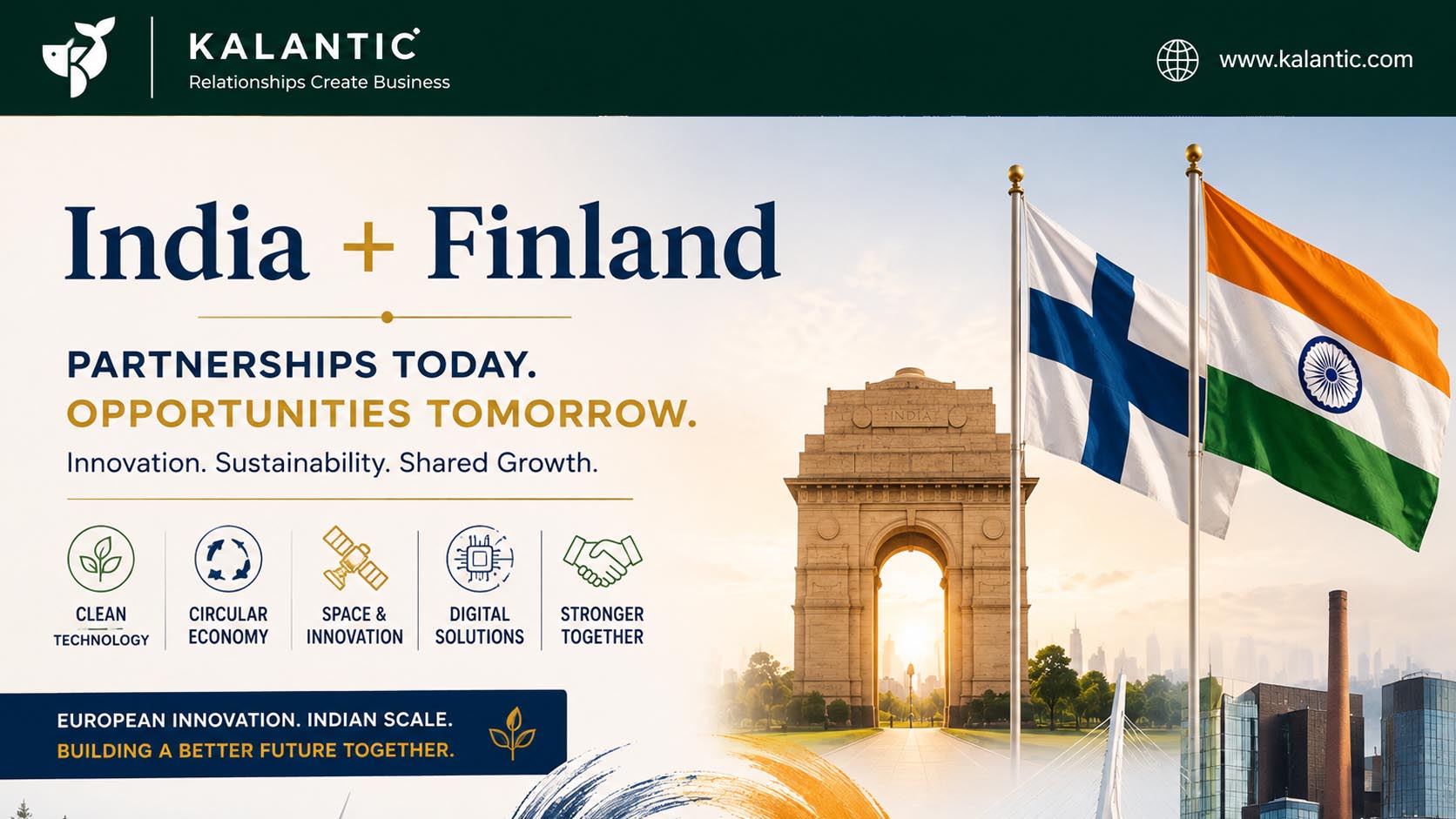
Finland offers a particularly useful example.
More than 100 Finnish companies are already active in India, across areas including clean energy, waste management, recycling, digital solutions and sustainable design.
And the relationship is expanding.
At the India Circular Economy Forum held in New Delhi this week, Finnish and Indian businesses explored opportunities across circular economy, sustainable business, resource efficiency and technology.
Finnish trade officials also highlighted opportunities in areas such as space and clean technology, with joint ventures and partnerships emerging as potential routes for Finnish companies looking to expand their presence in India.
The significance goes beyond Finland.
It raises a broader question for European businesses:
What is the best way to enter India when you have strong technology but limited local relationships?
India Does Not Need to Be Entered All at Once
For a European company, India can look enormous.
The market is large.
The geography is complex.
The customer base is diverse.
Regulatory requirements can vary by sector.
And building a sales organisation from scratch can take considerable time.
That can create a dilemma.
A company may see a substantial opportunity in India but hesitate to make a large upfront commitment.
This is where partnerships can become particularly useful.
Instead of immediately building an entire Indian operation, a company can begin by identifying organisations that already understand the market.
The objective is not necessarily to outsource the India strategy.
It is to build the strategy with people who understand India.
Finland Offers a Useful Model
Finland is not a huge country by population.
Its domestic market is relatively small.
Yet Finnish companies have developed globally competitive capabilities in areas such as telecommunications, industrial technology, clean technology, engineering, digital infrastructure and sustainability.
India presents a very different market.
Its scale is enormous.
Its industrial base is expanding.
Its digital economy is highly developed.
Its infrastructure requirements are significant.
And many of the challenges India faces — energy efficiency, waste management, water management, urbanisation and resource use — are precisely the areas where Finnish companies have specialised expertise.
That creates a natural complement.
Finnish expertise can meet Indian scale.
But converting that complement into business requires something more than a good technology.
It requires access.
Technology Alone Does Not Create Market Access
This is an important lesson for international companies.
A company may have an excellent product.
It may have strong intellectual property.
It may have successful customers across Europe.
It may have a compelling sustainability proposition.
None of those automatically creates an Indian customer.
The company still needs to answer:
Who should we sell to?
Who makes the purchasing decision?
Who are the right local partners?
Which companies already have access to our target customers?
Who understands the regulatory environment?
Who can implement and support the product?
Who can help us adapt our offering to Indian requirements?
These are relationship questions.
And they are often the questions that determine whether market entry succeeds.
The Partnership Model Can Reduce the Learning Curve
A local partnership can allow an international company to learn before it scales.
A partner may provide:
- Customer introductions
- Industry knowledge
- Local credibility
- Distribution
- Implementation capabilities
- Regulatory understanding
- Technical support
- Market feedback
This can dramatically reduce the time required to understand the market.
It also allows the international company to test its assumptions.
Does the product solve a real problem?
Will customers pay for it?
Is the pricing appropriate?
Does the sales process work?
Does the technology require localisation?
Which industries offer the strongest opportunity?
Those answers are often more valuable than a large market-size report.
The India-EU Relationship Makes This More Relevant
The broader economic relationship between India and Europe is also evolving.
India and the European Union concluded negotiations on a Free Trade Agreement earlier this year, creating expectations of deeper economic engagement.
For European companies, the implications go beyond tariffs.
A stronger trade relationship can encourage more companies to explore India as a commercial market.
But increased market access does not automatically solve the market-entry problem.
It can make the opportunity more attractive.
It does not necessarily make the market easier to navigate.
That distinction matters.
Smaller European Companies May Have an Interesting Opportunity
Large multinational companies can afford to establish large Indian teams.
A smaller European technology or industrial company may not have that luxury.
For these businesses, a partnership-first approach can make considerably more sense.
Instead of asking:
"Should we invest millions in an Indian operation?"
the first question could be:
"Who could help us test our proposition in India?"
That could lead to:
- A strategic distributor
- A technology partner
- A local implementation company
- A joint venture
- A customer pilot
- An industry partnership
- A commercial representative
- A strategic investor
The initial relationship does not have to determine the final structure.
It can simply be the beginning.
Circular Economy Is a Good Example
The circular economy illustrates how this can work.
European businesses are facing increasingly sophisticated requirements around resource efficiency, traceability, recycling and sustainability.
India, meanwhile, is dealing with enormous volumes of material, waste and resource demand as its economy grows.
There is therefore a potential commercial intersection.
A Finnish company may have technology for:
- Waste processing
- Industrial recycling
- Water treatment
- Resource optimisation
- Digital traceability
- Sustainable materials
- Circular manufacturing
An Indian company may have:
- Customers
- Distribution
- Manufacturing capacity
- Local implementation capability
- Market knowledge
Neither necessarily has everything required.
Together, they may have a much stronger proposition.
The Same Logic Applies Beyond Sustainability
This isn't just a circular-economy story.
The same model can work across many sectors.
Space
European companies with specialised technology can partner with Indian businesses and institutions with growing capabilities and market access.
Digital technology
A European technology company can combine its product with an Indian company's engineering, sales or implementation capabilities.
Healthcare
Specialised European medical technology can be introduced through established Indian healthcare networks.
Industrial technology
European engineering expertise can be combined with Indian manufacturing and customer relationships.
Clean energy
Technology providers can work with Indian developers, utilities and infrastructure companies.
The sectors are different.
The market-entry principle is the same.
The Most Important Asset May Be the Local Relationship
International businesses often think about market entry in terms of assets.
Capital.
Technology.
People.
Infrastructure.
Intellectual property.
But there is another asset that is harder to quantify:
relationships.
The right relationship can provide access to a customer that would otherwise take months to reach.
It can introduce a company to a potential partner.
It can reveal a regulatory issue before it becomes expensive.
It can explain why a product that works perfectly in Europe may need to be positioned differently in India.
It can tell a company which opportunities are real — and which only look attractive on paper.
That knowledge has commercial value.
European Companies Should Not Try to Become Indian Overnight
There is another mistake international businesses can make.
They assume that successful entry requires immediately becoming a fully local company.
That isn't necessarily true.
A European company can remain European.
Its technology can remain European.
Its brand can remain European.
Its standards can remain European.
But its go-to-market approach may need to become local.
That is an important distinction.
Localisation does not necessarily mean changing everything.
It means changing the things that need to change to make the business work.
What Should a European Company Do First?
For a European company considering India, the first six steps could be relatively simple.
1. Define the Indian problem you want to solve.
Don't start with the size of the Indian market.
Start with the specific problem your product solves.
2. Identify the customers.
Which companies or institutions actually experience that problem?
3. Map the ecosystem.
Who influences the buying decision?
Who distributes?
Who implements?
Who regulates?
Who already serves the customer?
4. Identify potential partners.
Look for complementary capabilities rather than simply companies that can sell your product.
5. Start conversations before making major commitments.
A market can be tested through partnerships, pilots and customer discussions.
6. Scale only after learning.
Once the market starts validating the proposition, larger investments become easier to justify.
India's Opportunity Is Not Only for Global Giants
This may be one of the most interesting implications of the growing India-Europe relationship.
India is increasingly accessible to companies that may not have the resources of a global multinational.
A specialised European company with excellent technology can potentially find an Indian partner that already understands the market.
A partnership can therefore bridge the gap between:
European expertise
and
Indian scale.
That is a powerful combination.
The Question Is Changing
For years, international companies considering India often asked:
"How do we enter such a large and complex market?"
A better question may now be:
"Who can help us build a business there?"
That changes the starting point.
It moves the conversation from incorporation to relationships.
From capital to collaboration.
From market size to market access.
And from simply entering India to actually building something in India.
The Finland-India relationship is a useful example of this shift.
The opportunities are expanding.
The sectors are diversifying.
And the number of companies looking at India is growing.
But the companies that convert opportunity into business will need more than good products.
They will need customers.
They will need partners.
They will need local knowledge.
And they will need relationships.
Because international expansion rarely begins with a factory, an office or a large investment.
It often begins with a conversation.
Sources
- The Tribune / ANI, August 21, 2026 — More than 100 Finnish companies already active in India; Finland pitches deeper circular-economy ties.
- ANI, August 21/22, 2026 — Finland sees potential for India partnerships in space and clean technology following the India-EU trade relationship.
- Government of India / PIB, July 16, 2026 — India-Finland business forum and institutional MoUs supporting greater trade, investment and industry cooperation.
- Prime Minister's Office, Government of India — India-Finland Joint Statement on cooperation in digitalisation, sustainability, trade and investment.
Ready to Explore India?
Expanding into India requires more than market research—it requires the right customers, partners, and commercial strategy. Kalantic helps international companies validate opportunities, identify customers and channel partners, and build a sustainable business presence in India. Whether you’re evaluating India for the first time or accelerating your expansion, our team can help you make informed decisions with confidence.
Book an India Market Entry Discussion
Or email us at: info@kalantic.com