Why Global Brands Are Choosing Partners to Enter India
Something interesting is happening in India's retail market.
Global brands are arriving.
But many of them are not arriving alone.
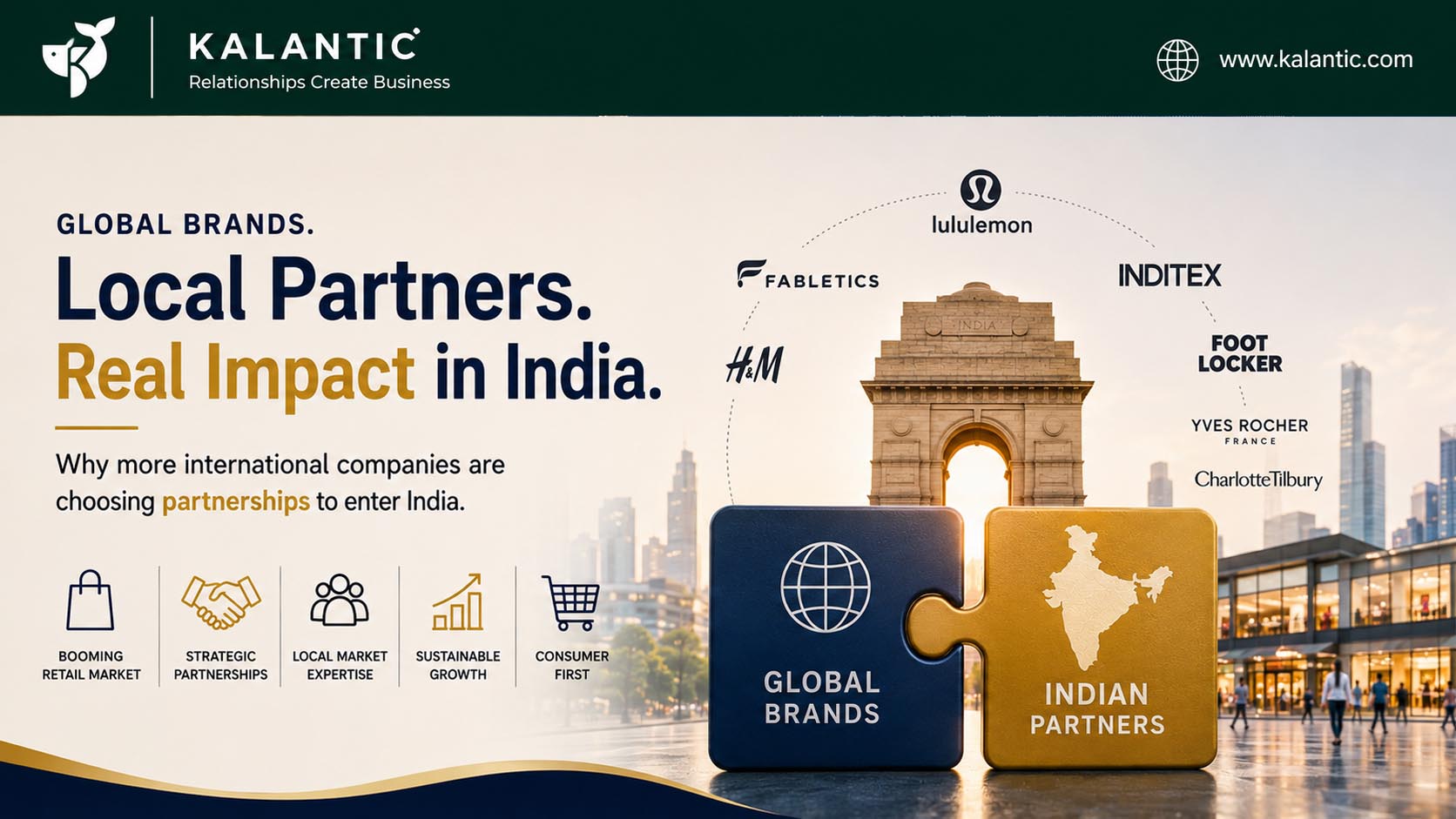
Lululemon is preparing its India retail debut through a partnership with Tata CLiQ.
Fabletics has entered India through a long-term partnership with Reliance Brands.
International fashion, beauty and lifestyle brands are increasingly looking at India as a market with enough scale and consumer demand to justify a serious expansion.
The bigger story, however, isn't simply that more foreign brands are entering India.
It is how they are choosing to enter.
India's Retail Opportunity Is Getting Harder to Ignore
India's retail market is already enormous.
Recent estimates put the market at roughly $950 billion to $1 trillion, with projections taking it substantially higher by 2030.
But the opportunity is not simply about population.
Indian consumers are changing.
A younger population is becoming more aspirational.
Disposable incomes are increasing.
Digital commerce is expanding.
Premiumisation is creating demand for higher-quality products.
And consumers are increasingly exposed to international brands through social media, travel and digital platforms.
The result is a market where a global brand can arrive with significant awareness before it even opens its first store.
That is a powerful proposition.
But India Is Not One Retail Market
This is where the opportunity becomes more complicated.
India is a single country.
It is not a single consumer market.
Consumer preferences can vary significantly between cities and regions.
Price sensitivity differs.
Shopping habits differ.
Brand awareness differs.
Retail infrastructure differs.
Even the way consumers discover and evaluate a product can differ.
A brand that succeeds in London, Paris or Los Angeles cannot simply assume that the same retail strategy will work in Mumbai, Delhi or Bengaluru.
The product may travel.
The brand may travel.
But the market-entry model often needs localisation.
This Is Where Local Partnerships Become Powerful
Consider Fabletics.
The US-based activewear brand is entering India through an exclusive long-term partnership with Reliance Brands.
The plan combines:
- A dedicated India website
- Physical stores
- Omnichannel retail
- Experiential retail
- Local market development
Fabletics brings its global brand, product and creative proposition.
Reliance brings its experience operating international brands in India and its local retail infrastructure.
That is a very different proposition from simply opening an international company's first Indian office.
It is a partnership designed around market access.
Lululemon Is Taking a Similar Approach
Lululemon is another useful example.
The Canadian activewear company is preparing to enter India through a partnership with Tata CLiQ.
Its first store is planned for Delhi, alongside an online presence through Tata's platforms.
Again, the model combines two strengths.
Lululemon brings:
Brand, product and global experience.
Tata brings:
Local infrastructure, market knowledge and established consumer relationships.
The combination can reduce some of the friction associated with entering a complex new market.
The Partner May Know Things the Global Headquarters Doesn't
This is perhaps the most important part of the story.
A global company can conduct extensive research on India.
It can commission consulting reports.
It can analyse consumer data.
It can study competitors.
But there are things that are difficult to understand from outside the market.
Which retail locations actually work?
Which customers are willing to pay a premium?
Which channels generate trust?
Which local relationships matter?
How should the product be positioned?
What kind of promotional strategy works?
Which cities should come first?
A local partner may already know many of these answers.
And that knowledge can have enormous commercial value.
Partnership Is Not the Same as Giving Up Control
There can be a misconception that working with a local partner means an international company is giving away part of its business.
Not necessarily.
A well-structured partnership can allow each side to focus on what it does best.
The global company can retain control over:
- Brand identity
- Product standards
- Design
- Technology
- Global positioning
- Intellectual property
The local partner can contribute:
- Market knowledge
- Distribution
- Retail infrastructure
- Customer relationships
- Local execution
- Regulatory familiarity
- Hiring and operations
The objective is not to choose between global and local.
It is to combine them.
India's Retail Market Is Also Becoming More Sophisticated
The opportunity is not limited to metropolitan luxury retail.
India's consumer economy is becoming increasingly diverse.
E-commerce is expanding.
Quick commerce is changing how products reach consumers.
Organised retail is growing.
Tier II and Tier III cities are becoming increasingly important.
Digital discovery is influencing purchasing decisions.
And premium categories are expanding beyond traditional luxury.
This creates opportunities for international companies across:
- Fashion
- Beauty
- Fitness
- Food and beverage
- Consumer technology
- Home and lifestyle
- Wellness
- Entertainment
- Premium services
The opportunity is becoming broader.
But Localisation Still Matters
One of the biggest mistakes an international company can make is assuming that international popularity automatically creates Indian demand.
It doesn't.
A product can be globally successful and still require localisation.
That could mean:
Pricing
The global price may not translate directly.
Product
Indian consumers may have different preferences.
Sizing
Particularly important in fashion and apparel.
Marketing
The cultural context matters.
Distribution
The most effective channels may differ.
Customer experience
What consumers expect from a premium brand can vary significantly.
The best international companies don't necessarily localise everything.
They identify what must be local and what should remain global.
The Partnership-First Model Can Reduce Risk
For an international company entering India for the first time, a partnership can also reduce the initial risk.
Instead of building an entire organisation immediately, the company can begin by leveraging an established network.
That allows it to learn.
It can test:
- Customer demand
- Pricing
- Product-market fit
- Distribution
- Marketing
- Store formats
- Digital acquisition
Then it can scale based on actual market feedback.
This can be particularly attractive for brands entering India for the first time.
The Bigger Lesson Goes Beyond Retail
This is where the story becomes relevant to international companies outside consumer businesses.
Imagine a European industrial company entering India.
It may have excellent technology.
But it may not know the right customers.
Or a US technology company.
It may have a successful SaaS product but limited enterprise relationships in India.
Or a Japanese healthcare company.
It may have strong products but need local distribution and regulatory expertise.
Or a Finnish clean-technology company.
It may have world-class technology but need an Indian company that understands the local market.
The principle remains the same.
Global capability + local relationships can be more powerful than either one alone.
India Is Becoming a Market Worth Building For
For years, international companies often approached India cautiously.
They tested the market.
They sold through distributors.
They waited for demand to develop.
That is changing.
The number of global brands actively preparing Indian launches suggests a greater level of confidence.
Companies are increasingly willing to invest in stores, digital platforms, marketing, partnerships and local teams.
They are not simply asking:
"Can we sell in India?"
They are asking:
"How big can our India business become?"
That is a significant shift.
But Market Entry Still Starts With the Right Questions
Before entering India, an international company should understand five things.
1. Who is the customer?
Not the theoretical Indian consumer.
The specific customer who is most likely to buy.
2. Where is the customer?
Which cities?
Which channels?
Which communities?
3. How does the customer buy?
Online?
Offline?
Through a distributor?
Through an adviser?
Through a marketplace?
4. Who already has the customer's trust?
This could be a retailer, distributor, partner, influencer, institution or industry network.
5. Who should we build the business with?
This may ultimately be the most important question.
The New India Entry Question
The latest wave of international retail expansion suggests that global companies are becoming more comfortable with India's opportunity.
But it also shows something else.
Many are choosing partnerships as part of their India strategy.
Not because they lack global capabilities.
Because they recognise that local market knowledge and relationships can accelerate those capabilities.
India does not necessarily require an international company to become local.
It requires the company to understand what being local means for its particular business.
And that understanding often comes faster through the right people.
The right partner.
The right customer.
The right distributor.
The right introduction.
The right conversation.
So perhaps the question for an international company considering India is no longer simply:
"How do we enter India?"
It is:
"Whom should we know before we enter?"
Because in a market as large and diverse as India, the right relationship can sometimes be the shortest route to the right opportunity.
Sources
- The Times, August 23, 2026 — India retail growth and increasing entry of Western brands.
- Indian Retailer, August 13, 2026 — Fabletics enters India through a long-term partnership with Reliance Brands.
- ET Retail, July 7, 2026 — Lululemon's planned India entry through a partnership with Tata CLiQ.
- Deloitte India–FICCI, August 2026 — India's consumer economy, digital adoption, premiumisation and changing consumer behaviour.
Ready to Explore India?
Expanding into India requires more than market research—it requires the right customers, partners, and commercial strategy. Kalantic helps international companies validate opportunities, identify customers and channel partners, and build a sustainable business presence in India. Whether you’re evaluating India for the first time or accelerating your expansion, our team can help you make informed decisions with confidence.
Book an India Market Entry Discussion
Or email us at: info@kalantic.com