
Why ICEYE’s India Entry Is Bigger Than a New Office
When an international technology company enters India, the first visible sign is often an office.
But the office is rarely the most important part.
The real question is what the company intends to build around it.
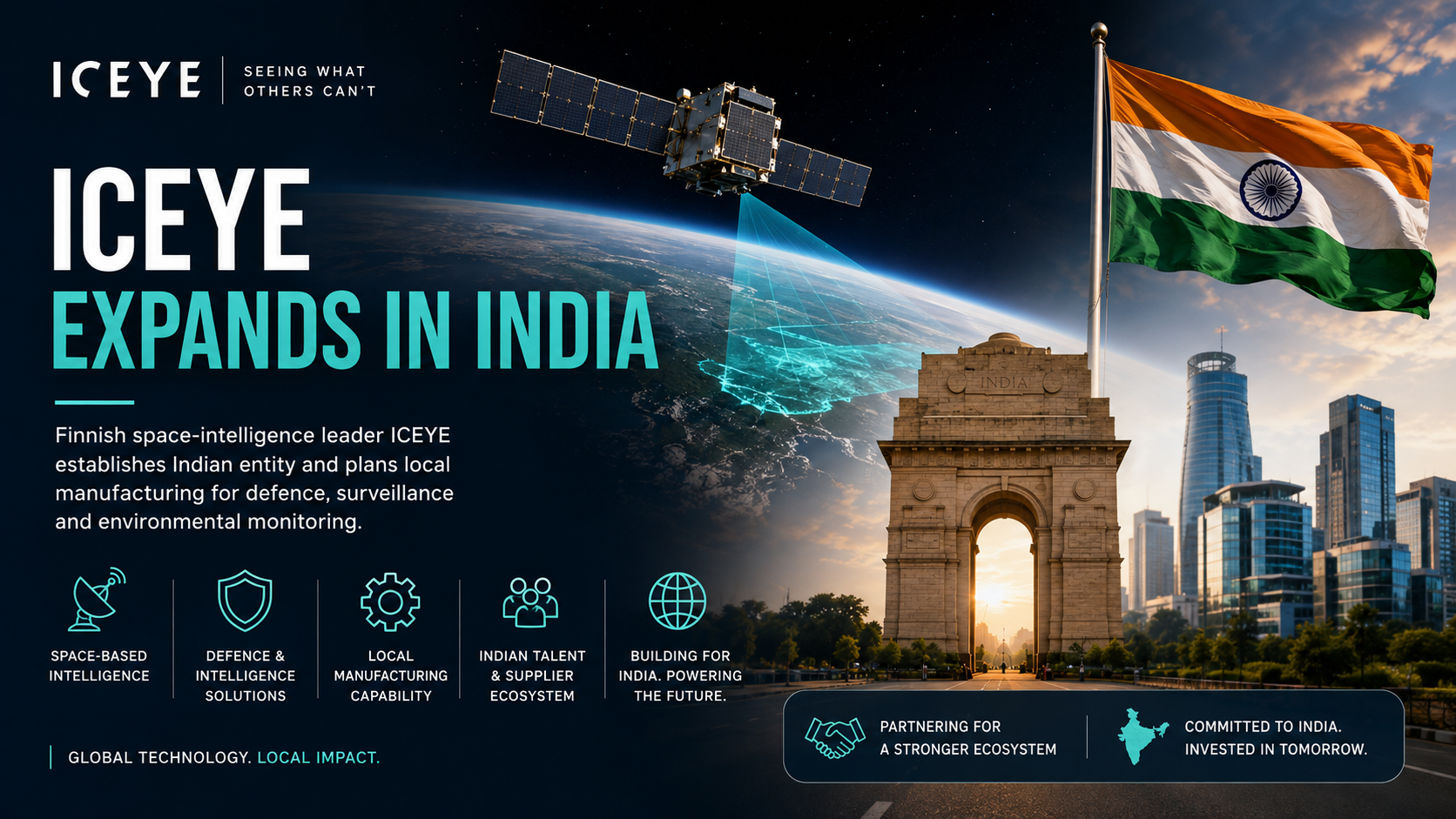
Finnish space-intelligence company ICEYE has formally established ICEYE India in New Delhi, marking a deeper expansion into India's defence and space ecosystem.
The company says its immediate priority is to support Indian defence and intelligence customers with space-based intelligence capabilities.
But it is also planning something more ambitious.
ICEYE intends to establish manufacturing capability in India, using local suppliers and Indian engineering talent for applications spanning defence, surveillance and environmental monitoring.
That makes this more than an overseas company opening an Indian office.
It is an example of an international technology company moving from selling into India to building in India.
Why ICEYE Is Looking at India
ICEYE specialises in synthetic aperture radar, or SAR, satellite technology.
Unlike conventional optical satellites, SAR systems can collect imagery regardless of daylight conditions and can operate through cloud cover.
The technology has applications across defence, intelligence, disaster response, infrastructure monitoring and environmental management.
ICEYE already operates a large SAR satellite constellation and works with governments and organisations internationally.
India presents a particularly interesting market.
The country has a growing space ecosystem.
Its private space sector is expanding.
Defence and security agencies are increasingly interested in advanced intelligence capabilities.
And the government is encouraging greater participation by domestic companies in strategic technologies.
For ICEYE, that creates an opportunity that goes beyond selling satellite data.
It creates the possibility of building a long-term Indian business.
From Customer to Ecosystem
This is the most interesting part of ICEYE's move.
The company isn't simply saying:
"We want to sell our technology in India."
It is talking about:
- Local engineering
- Indian suppliers
- Manufacturing capability
- Technology validation
- Engagement with India's space ecosystem
- Defence and intelligence customers
- Environmental monitoring
That represents a much deeper form of market entry.
The company is effectively trying to become part of India's technology ecosystem.
And that distinction matters.
Why This Is Important for International Technology Companies
There are different levels of entering a foreign market.
At the simplest level, a company can export.
The company remains largely outside the market while customers purchase its products.
The next level is distribution.
A local partner sells and supports the product.
Then comes a local operating presence.
The company establishes an office, hires people and develops direct relationships with customers.
But the deepest level is ecosystem participation.
The company begins to develop local capabilities.
It works with domestic partners.
It hires local talent.
It adapts its technology.
It participates in local industry networks.
And eventually, it becomes part of the market rather than simply a foreign company selling into it.
ICEYE appears to be moving in that direction.
India Is Becoming More Attractive for Deep Technology
For international technology companies, India's opportunity is increasingly extending beyond consumer technology and software.
India is developing capabilities across:
- Space
- Defence technology
- Artificial intelligence
- Semiconductors
- Advanced manufacturing
- Robotics
- Telecommunications
- Clean technology
- Digital infrastructure
This creates a different kind of opportunity for international companies.
India can be:
A customer.
A partner.
A talent base.
A technology-development location.
A manufacturing base.
And eventually, a platform for serving other markets.
That combination is becoming increasingly attractive.
The Local Partner Still Matters
Even for a highly specialised company like ICEYE, entering India isn't simply a technology exercise.
The company needs to understand the local ecosystem.
Who are the relevant government agencies?
Which organisations are the right customers?
Which Indian companies have complementary capabilities?
Which engineering partners can support the technology?
Which suppliers can meet the required standards?
Which institutions can help validate new applications?
These relationships take time to develop.
And they cannot simply be imported from a company's headquarters.
ICEYE Already Has an Indian Partnership
ICEYE's India strategy also illustrates how relationships can precede deeper market entry.
In June, ICEYE and Indian space company Dhruva Space announced a strategic partnership to explore collaboration across satellite manufacturing, space systems, Earth observation, disaster management and ground infrastructure.
The two companies bring complementary capabilities.
ICEYE contributes its SAR constellation and Earth-observation expertise.
Dhruva Space contributes spacecraft engineering, manufacturing, launch integration, ground infrastructure and space applications.
That is exactly the kind of relationship that can help an international technology company understand how its capabilities fit into the Indian ecosystem.
The Partnership Can Come Before the Investment
This is an important lesson for smaller international companies.
Entering India does not necessarily have to begin with a large investment.
It can begin with a relationship.
A technology partnership.
A distribution arrangement.
A pilot.
A customer discussion.
A joint development project.
An industry collaboration.
These early relationships allow a company to test assumptions before committing significant capital.
Does the market need the product?
Who actually buys it?
Which partners matter?
What needs to be localised?
Where should the company invest?
Those answers can emerge through conversations and early commercial activity.
India's Space Opportunity Is Changing
India's space sector has undergone a significant transformation in recent years.
The country is no longer relying exclusively on government institutions for space activity.
Private companies are increasingly participating across satellite manufacturing, launch services, Earth observation, communications and downstream applications.
That creates an environment in which international companies can potentially participate in multiple ways.
They can sell technology.
They can partner with Indian companies.
They can establish local operations.
They can collaborate on manufacturing.
They can develop applications for Indian customers.
And they can potentially use India as a base for broader regional opportunities.
The Important Shift Is From Market Access to Market Participation
This is perhaps the biggest lesson from ICEYE.
There is a difference between having access to a market and participating in that market.
A company can have access to India through an importer or distributor.
But participation means something deeper.
It means having people on the ground.
Understanding customers directly.
Building relationships.
Working with local companies.
Developing local talent.
And eventually creating capabilities that are specific to the market.
That is a much more durable form of market entry.
What Other European Technology Companies Can Learn
ICEYE's move offers several lessons for European companies considering India.
1. Don't think only about selling
India can be a customer market, but it can also be a place to develop and build.
2. Find the ecosystem before building the organisation
Understand the customers, partners, institutions and companies that shape your industry.
3. Build relationships early
A partnership can reveal opportunities that market research alone may not identify.
4. Localise selectively
Not everything needs to become local.
Identify the capabilities that genuinely benefit from being developed in India.
5. Think beyond the first customer
The first contract may be small.
The ecosystem built around it can become much larger.
Why This Matters Beyond Space
The same pattern is emerging across other technology sectors.
A European AI company may enter India through a technology partnership.
A Finnish clean-tech company may work with an Indian infrastructure company.
A German industrial technology company may establish an engineering centre.
A Japanese technology company may develop R&D capabilities.
An American healthcare company may build a local distribution and services network.
The models will differ.
But the underlying strategy is increasingly similar:
Don't simply sell into India. Find a way to become relevant within India.
India Is Becoming a Place to Build
For international companies, this is perhaps the most important shift.
India is increasingly being considered not only as a destination for products and services, but as a place where companies can:
- Develop technology
- Hire engineering talent
- Build partnerships
- Serve large customers
- Establish manufacturing
- Conduct R&D
- Create new products
- Build regional capabilities
That changes the economics of market entry.
The question is no longer only whether India is a large enough market.
It is whether India can become an important part of the company's global strategy.
The Question International Companies Should Ask
ICEYE's India move is still at an early stage.
Its local manufacturing plans will take time to develop.
Its relationships with Indian customers and partners will evolve.
But the strategic direction is clear.
The company isn't treating India simply as a country where it can sell satellite intelligence.
It is treating India as a market in which it can build capability.
And that is an important distinction.
For international companies considering India, perhaps the question should therefore not be:
"How much can we sell in India?"
It could be:
"What could we build in India?"
And before answering that question:
"Whom should we know?"
Because the path from international opportunity to local business rarely begins with an investment announcement.
It begins with understanding the market.
Then finding the right people.
Then building the right relationships.
And finally, deciding what is worth building.
Sources
- The Print, August 24, 2026 — ICEYE establishes Indian entity and plans local manufacturing for defence and intelligence.
- The Tribune, August 24, 2026 — ICEYE opens India office and plans local capability for defence, surveillance and environmental monitoring.
- ICEYE — Company information and sovereign intelligence capabilities.
- Dhruva Space, June 17, 2026 — Strategic partnership with ICEYE covering satellite manufacturing, Earth observation and space systems.
Ready to Explore India?
Expanding into India requires more than market research—it requires the right customers, partners, and commercial strategy. Kalantic helps international companies validate opportunities, identify customers and channel partners, and build a sustainable business presence in India. Whether you’re evaluating India for the first time or accelerating your expansion, our team can help you make informed decisions with confidence.
Book an India Market Entry Discussion
Or email us at: info@kalantic.com