
India Market Entry Is Not Just About Entering the Market
When an international company evaluates India, the first questions are usually commercial.
How large is the market?
Who are the customers?
What is the competitive landscape?
What will it cost to operate?
How quickly can the business scale?
But there is another layer that can become equally important:
How does the ownership structure affect what the business can actually do in India?
A fresh development involving Swiggy provides an interesting illustration.
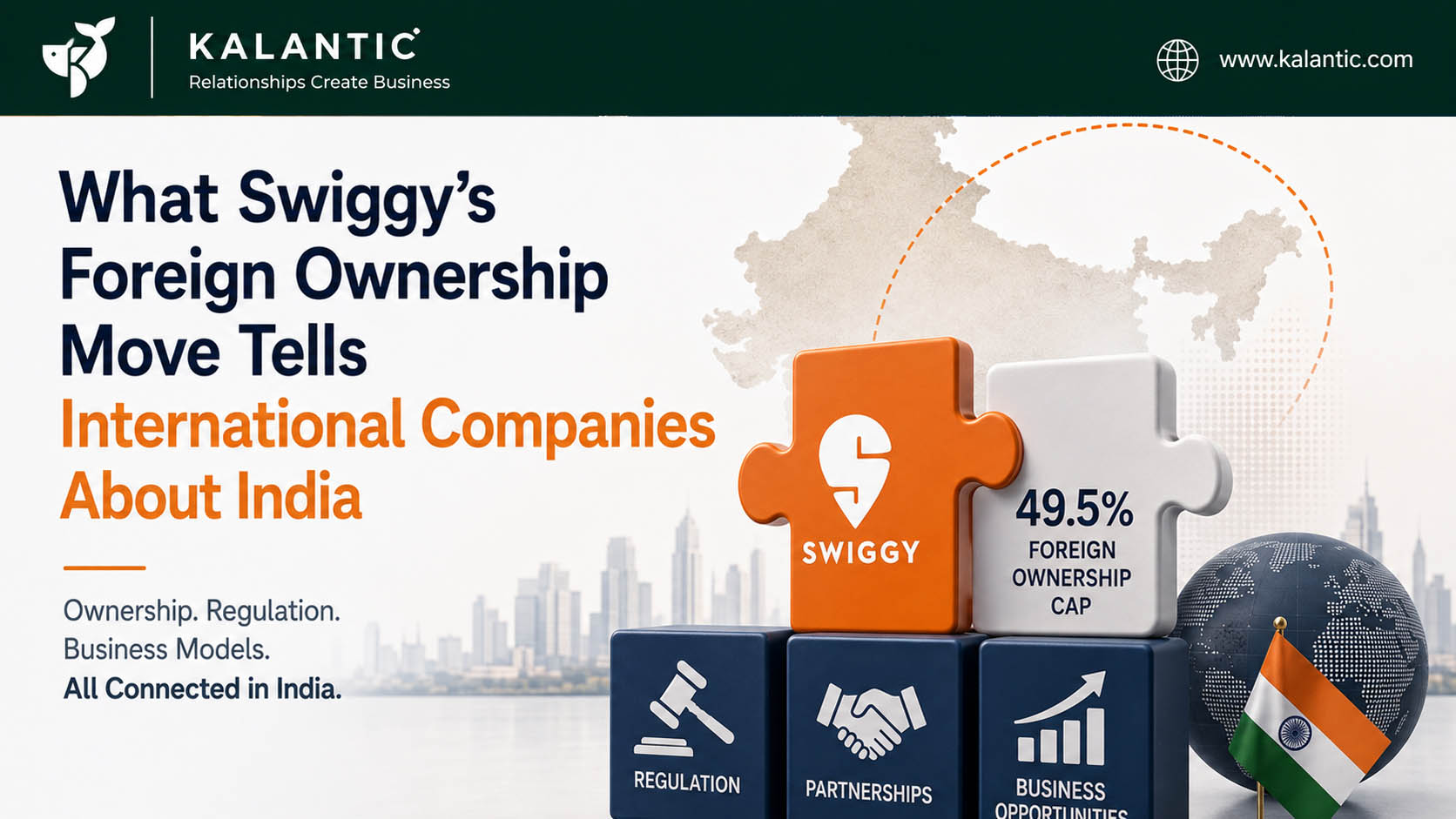
On August 18, Swiggy shareholders approved a proposal to cap aggregate foreign ownership at 49.5%, paving the way for the company to qualify as an Indian-owned and controlled company under India's foreign investment framework.
At first glance, this looks like a corporate-structure story.
For international businesses, it is much more useful to look at it as a market-entry story.
Why Does Foreign Ownership Matter?
India's foreign investment framework does not treat every business in exactly the same way.
Depending on the sector and the activity being undertaken, foreign ownership, control and investment structures can influence what a company is permitted to do.
That means the question for an international company is not simply:
"Can we invest in India?"
It can also be:
"What structure should we use to operate effectively in India?"
Those are very different questions.
A company might enter through a wholly owned subsidiary.
It might establish a joint venture.
It might work with an Indian partner.
It might invest in an existing Indian company.
It might operate through a distributor or franchise model.
And in some sectors, the distinction between foreign ownership and Indian ownership can have direct commercial consequences.
Swiggy Is a Useful Example
Swiggy's shareholders have approved a 49.5% ceiling on aggregate foreign ownership.
As of July 6, foreign investment in the company stood at 49.76%, while domestic investors held 50.24% on a fully diluted basis.
The company has said that qualifying as an Indian-owned and controlled company would help its quick-commerce business, Instamart, move from a marketplace model towards an inventory-ownership model.
That is important because it demonstrates something often missed in discussions about foreign investment.
Corporate structure can influence business strategy.
Ownership is not always simply about who owns how much of a company.
It can affect which activities the company can undertake, how it operates and which business models are available to it.
The Bigger Lesson for International Companies
An international company can spend months analysing India's consumer demand, competitors and pricing.
But if it has not understood the regulatory structure around its intended activity, it may still be making the wrong market-entry decision.
This is particularly relevant in sectors where foreign investment rules interact with the nature of the business.
For example, a company may discover that its preferred operating model requires:
- A different ownership structure
- An Indian joint-venture partner
- Specific regulatory approvals
- Local management or control arrangements
- A different distribution model
- Restrictions on certain activities
- Additional compliance requirements
These issues can fundamentally change the economics of entering the market.
India Requires Structural Thinking
One of the common mistakes in international expansion is treating regulation as something to check after the business plan has been created.
The better approach is to incorporate it from the beginning.
Before deciding how to enter India, an international company should ask:
What exactly are we trying to do?
Selling products into India is different from manufacturing in India.
Operating a digital marketplace is different from owning inventory.
Providing financial services is different from selling financial technology.
Running a franchise is different from directly operating the business.
The regulatory implications can therefore be very different.
How much control do we actually need?
Some international companies want complete operational control.
Others are comfortable working with a local partner.
That choice can influence the most appropriate structure.
What local relationships do we need?
Even when full foreign ownership is possible, a local network can still be commercially valuable.
Customers, distributors, advisers, suppliers, industry bodies and strategic partners can provide access and knowledge that a foreign-owned entity may not have on day one.
What happens when we scale?
A structure that works for a small pilot may not be ideal when the business reaches significant scale.
The market-entry structure should therefore be considered alongside the company's long-term ambitions.
The Local Partner Question
This is where the discussion moves beyond regulation.
An international company may technically be able to enter India on its own.
But that does not necessarily mean it should.
India is a relationship-intensive market across many industries.
The right local partner can help an international company understand:
Customers.
Distribution.
Pricing.
Procurement.
Regulation.
Industry networks.
Talent.
Local business culture.
And perhaps most importantly, the partner can help the company understand what is actually happening on the ground.
That knowledge can be difficult to acquire from headquarters thousands of kilometres away.
The Difference Between Legal Entry and Commercial Entry
This distinction is worth making.
A company can be legally present in India without being commercially established.
It can have:
- An Indian entity
- A registered office
- Employees
- A website
- A bank account
And still have very little business.
Commercial entry requires something else.
Customers.
Partners.
Relationships.
Market knowledge.
A functioning sales process.
A local ecosystem.
That is why market entry should not be viewed simply as an incorporation exercise.
It is a business-development exercise.
What International Companies Should Do Before Entering India
The Swiggy development reinforces the value of doing the groundwork early.
An international company considering India should ideally map five things before committing significant resources.
1. Regulatory structure
Understand the foreign investment rules applicable to the specific activity.
2. Operating model
Determine whether the intended business model is compatible with the proposed ownership and structure.
3. Market
Identify the actual customer segments rather than relying only on headline market size.
4. Relationships
Identify the customers, partners, distributors and industry stakeholders who matter.
5. Entry strategy
Decide whether India should initially be approached through direct sales, partnerships, distribution, a joint venture, acquisition or another structure.
The answer will differ from company to company.
There is no universal "India entry model."
India's Opportunity Is Still Enormous
It would be easy to interpret regulatory complexity as a negative.
That would miss the larger picture.
India's market is large enough and increasingly sophisticated enough that international companies are willing to adapt their strategies to participate in it.
The important lesson is not that India is difficult.
It is that India rewards companies that understand the market before committing to a strategy.
The strongest international businesses are not necessarily those that insist on reproducing their global model exactly.
They are often the ones willing to ask:
What needs to be different in India?
That could mean the ownership structure.
It could mean the distribution model.
It could mean the pricing.
It could mean the product.
It could mean the partner network.
Or it could mean all of the above.
The Real Question Is Not "Can We Enter?"
For international companies looking at India, the first question should not simply be:
"Can we enter India?"
It should be:
"What is the right way for us to build a business in India?"
That requires understanding the rules.
But it also requires understanding the market.
And understanding the market requires conversations with the people already operating within it.
Because ultimately, an India strategy is not just about structure.
It is about execution.
And execution starts with knowing whom you should know.
Sources
- Reuters — “Swiggy shareholders back move for Indian-owned status”, August 18, 2026.
- Swiggy — corporate disclosures relating to foreign ownership and Indian-owned and controlled company status.
- India's foreign investment framework and applicable foreign exchange regulations.
Ready to Explore India?
Expanding into India requires more than market research—it requires the right customers, partners, and commercial strategy. Kalantic helps international companies validate opportunities, identify customers and channel partners, and build a sustainable business presence in India. Whether you’re evaluating India for the first time or accelerating your expansion, our team can help you make informed decisions with confidence.
Book an India Market Entry Discussion
Or email us at: info@kalantic.com