Volkswagen Is Looking for a Local Partner in India
For years, Volkswagen tried to build its India business largely on its own.
Now, that strategy may be changing.
Volkswagen, through its Skoda brand, is working toward finalising a joint venture with a local Indian partner by the end of 2026.
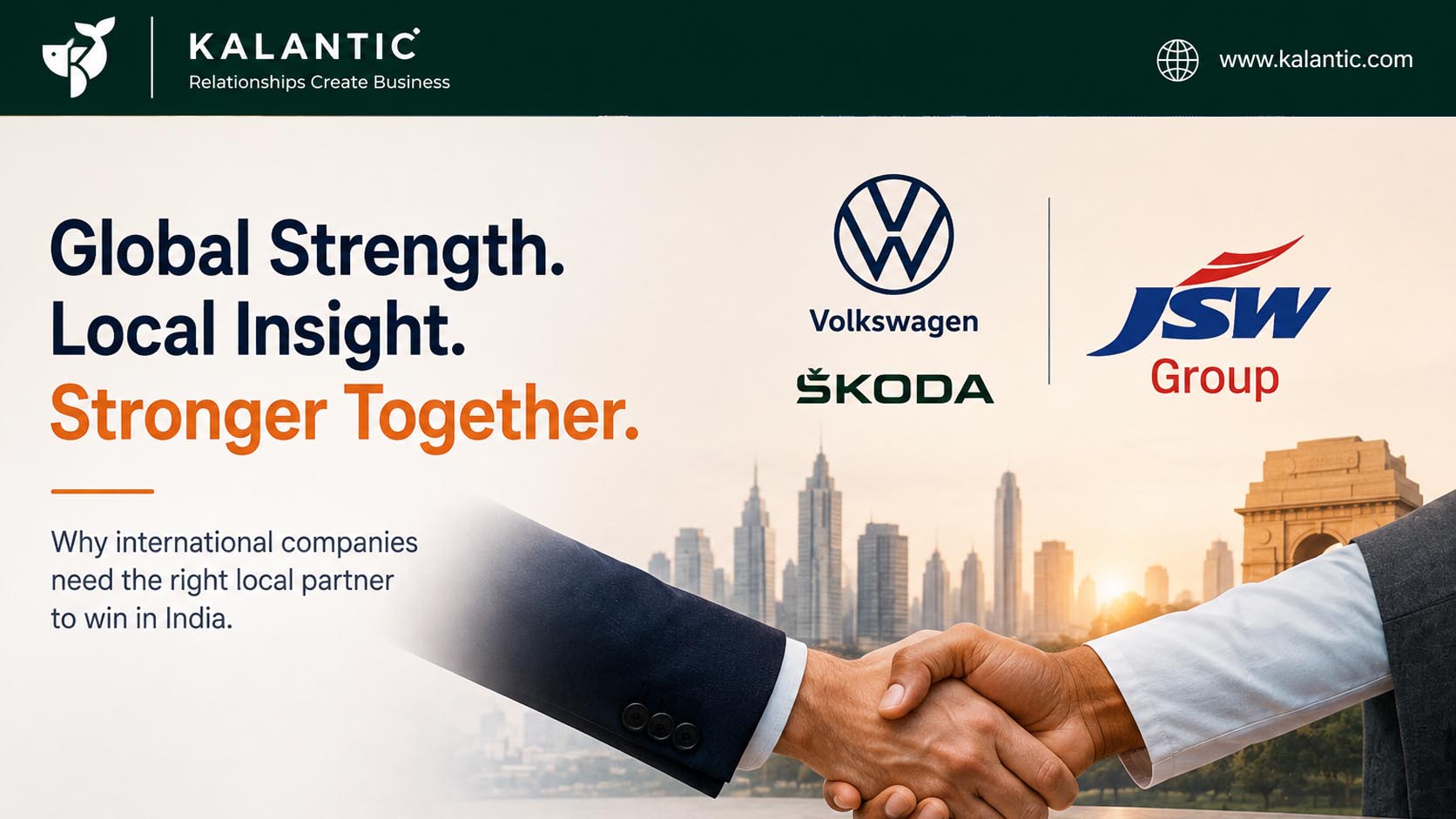
The company has been in discussions with JSW Group, which has been widely reported as a leading candidate for the proposed partnership.
The final structure has not yet been announced.
But the strategic direction is becoming increasingly clear:
Volkswagen believes that a stronger local partnership could help it build a bigger business in India.
And that makes this much more than an automotive story.
It is a useful lesson for every international company considering India.
When Going Alone Stops Making Sense
Volkswagen entered India with a powerful global brand, established technology and significant manufacturing capabilities.
It built factories.
It established a dealer network.
It introduced products specifically designed for the Indian market.
It developed engineering capabilities locally.
Yet after almost two decades, the company has struggled to achieve the scale it originally hoped for.
The Indian automobile market has become intensely competitive.
Domestic manufacturers have strengthened.
Japanese and Korean brands have established enormous customer bases.
New players are increasing their presence.
Electric vehicles are changing the competitive landscape.
And Indian consumers have more choices than ever.
Volkswagen now appears willing to change one of the fundamental assumptions behind its India strategy:
that it needs to do it alone.
A Local Partner Can Bring More Than Capital
The obvious interpretation is that Volkswagen is looking for additional investment.
But capital is only one part of the equation.
A strong Indian partner can potentially bring:
- Local market knowledge
- Established business relationships
- Regulatory familiarity
- Understanding of Indian consumers
- Access to local networks
- Commercial credibility
- Faster decision-making
- Experience navigating India's business environment
For an international company, these can be as valuable as financial investment.
This is particularly true when entering a market as large and diverse as India.
Why JSW Is Interesting
JSW Group is not simply a financial investor.
The group has been expanding across India's automotive and mobility landscape and already has an automotive partnership with SAIC through MG Motor India.
It has also been building capabilities across electric and new-energy vehicles.
That gives it an understanding of India's rapidly changing automotive market.
A partnership with Volkswagen would therefore potentially combine two very different strengths.
Volkswagen brings:
Global automotive technology, brands and engineering.
JSW brings:
Local capital, relationships, market knowledge and an increasingly significant automotive presence.
The combination could potentially be more powerful than either side trying to build everything independently.
The Bigger Lesson for International Companies
This is where the Volkswagen story becomes relevant beyond automobiles.
International companies frequently approach India with a straightforward assumption:
"We have a successful business model. We will bring it to India."
That is understandable.
But India may require something slightly different.
The product may work.
The technology may work.
The brand may work.
But the way the business reaches customers may need to change.
The partners may need to change.
The pricing may need to change.
The distribution model may need to change.
And sometimes, the ownership structure itself may need to change.
India Is a Relationship-Heavy Market
India has become significantly more digital.
But digitalisation has not eliminated relationships from business.
In many industries, relationships remain central to:
- Customer acquisition
- Distribution
- Enterprise sales
- Government engagement
- Supplier development
- Joint ventures
- Regulatory navigation
- Strategic partnerships
This doesn't mean an international company needs a local partner for everything.
It means that understanding the relationship landscape should be part of the market-entry strategy.
The Difference Between a Partner and a Distributor
There is an important distinction here.
A distributor helps you sell.
A strategic partner can help you build the business.
The right partner may help with:
Market intelligence
Who are the real competitors?
Who makes the purchasing decisions?
What does the customer actually value?
Commercial access
Which customers should you approach?
Who can make the introduction?
Which relationships already exist?
Local execution
Who can help navigate the practical realities of operating in India?
Strategic positioning
How should the international company adapt its offering to the Indian market?
These are difficult capabilities to build quickly from headquarters.
Volkswagen's Timing Is Also Important
The potential partnership comes at an important point for India's automobile industry.
India is moving toward stricter emissions requirements.
Electric and hybrid vehicles are becoming increasingly important.
Consumers are becoming more sophisticated.
And competition is intensifying.
Volkswagen therefore needs to invest for the next phase of the market.
The question is whether it is better to invest entirely on its own or share the opportunity and risk with a strong local player.
The company appears increasingly open to the latter.
Local Doesn't Mean Less Global
There is sometimes a misconception that partnering with a local company means an international business is giving up its global identity.
It doesn't have to.
A partnership can allow each side to focus on what it does best.
The international company can contribute:
- Technology
- Product expertise
- Global standards
- Brand
- R&D
- International experience
The local company can contribute:
- Market understanding
- Relationships
- Distribution
- Local execution
- Capital
- Customer insight
The objective isn't to choose between global and local.
It is to combine the two.
This Applies Far Beyond Automotive
Imagine an international technology company entering India.
It may have an excellent product.
But who knows the enterprise buyers?
Who understands procurement?
Who can introduce the company to the right CIOs?
Who can provide implementation support?
Or consider an international medical-device company.
The technology may be proven globally.
But which hospitals should it approach?
Which distributors have credibility?
Who understands the regulatory environment?
Or an international industrial company.
Who are the right customers?
Which local service partners can support installations?
Which relationships can accelerate market adoption?
The questions are different.
The principle is the same.
A global company may bring the product. A local relationship may help unlock the market.
The Most Important Question Before Entering India
International companies often ask:
"Should we establish our own subsidiary?"
That may be the right question eventually.
But it should not necessarily be the first one.
A better starting point might be:
"What do we need to understand and whom do we need to know before we decide how to enter?"
That question opens up more possibilities.
Perhaps the answer is a joint venture.
Perhaps it is a strategic alliance.
Perhaps it is a distributor.
Perhaps it is an acquisition.
Perhaps it is direct investment.
Perhaps it is simply building a network of customers and partners before making a larger commitment.
The correct answer depends on the business.
There is no universal "India entry model."
Volkswagen's India Story Is Still Being Written
It is important not to treat the proposed partnership as a completed deal.
Volkswagen and JSW are still working through the details.
The ownership structure, investment and final terms remain subject to agreement.
But the strategic signal is already interesting.
A major global automotive company that spent years trying to establish itself in India independently is now seriously considering sharing ownership and control with an Indian business.
That tells us something.
Not that international companies cannot succeed alone.
But that the right local relationship can sometimes create more value than complete control.
The New India Market-Entry Question
India's growth is attracting more international companies than ever.
But the competitive environment is becoming more sophisticated too.
Simply arriving in the country is no longer enough.
International businesses need to understand the market.
They need to identify the right customers.
They need to understand the competitive landscape.
And increasingly, they need to identify the people and organisations that can help them build locally.
The question for an international company should therefore not always be:
"How do we enter India?"
It may be:
"Who should we enter India with?"
That is a very different question.
And sometimes, it can lead to a very different strategy.
Because markets are not built by companies alone.
They are built through relationships.
Sources
- Reuters, August 19, 2026 — "Skoda CEO says VW aims to finalise India partner this year to share risk, drive growth."
- The Economic Times, August 19, 2026 — Volkswagen considering ceding majority control in India to a local partner.
- Autocar Professional, August 5, 2026 — JSW and Skoda Auto Volkswagen India in advanced discussions for a proposed joint venture.
Ready to Explore India?
Expanding into India requires more than market research—it requires the right customers, partners, and commercial strategy. Kalantic helps international companies validate opportunities, identify customers and channel partners, and build a sustainable business presence in India. Whether you’re evaluating India for the first time or accelerating your expansion, our team can help you make informed decisions with confidence.
Book an India Market Entry Discussion
Or email us at: info@kalantic.com